 +91 73584 98220
 info@rankmedaddy.com
 Rajasthan, India

Introduction
Everyone wants to make money online. But the real question is — which model pays better?
If you’ve been searching about CPA Marketing vs Affiliate Marketing, you’ve probably seen bold claims like “Best earning method” or “Make money fast.”
But what do these terms really mean? And which one is better for long-term earnings?
In simple words, both models help you make money by promoting other people’s products or services. You don’t need to create your own product. You just connect buyers to companies and earn a commission.
Sounds similar, right?
That’s where the confusion begins.
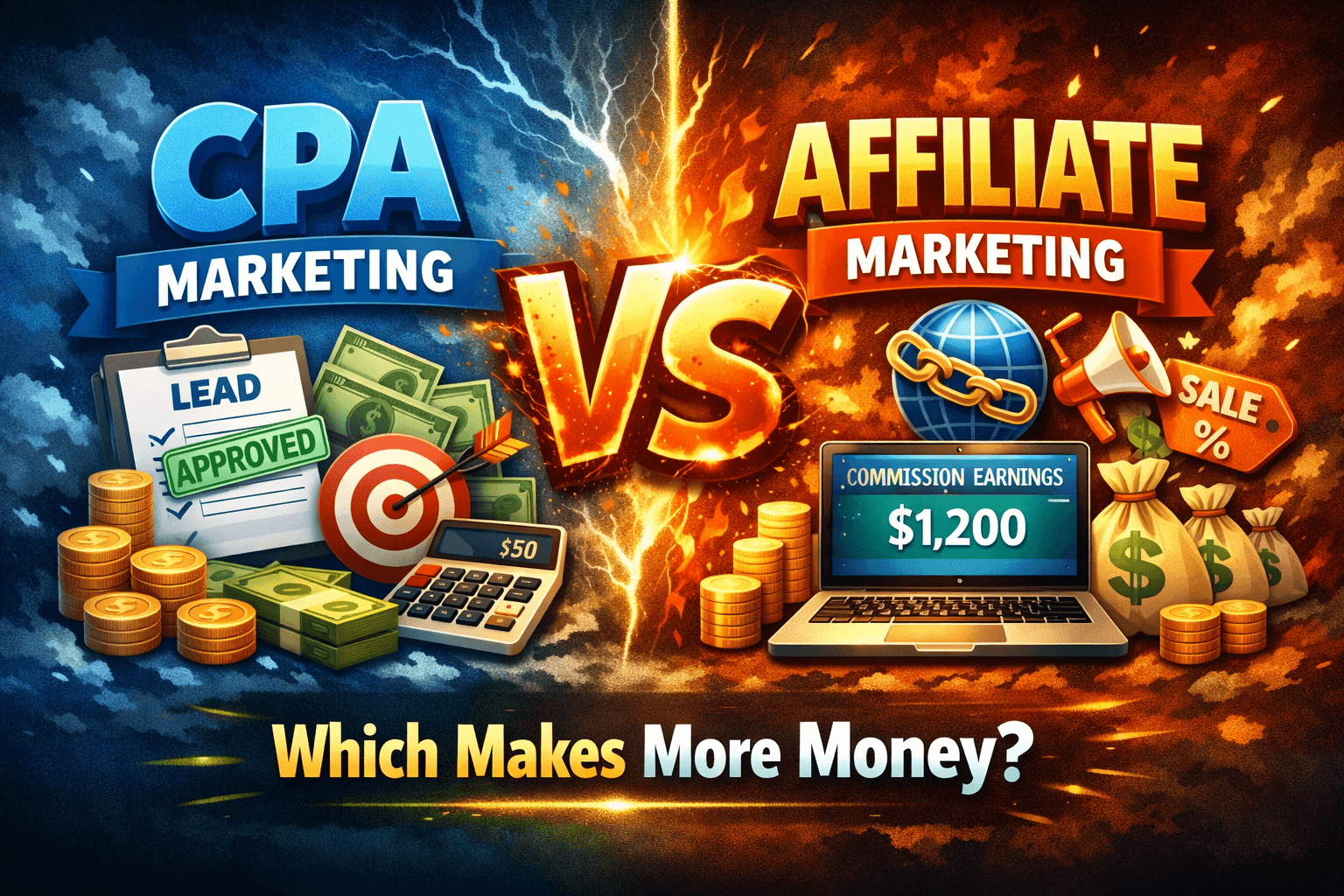
CPA Marketing and Affiliate Marketing may look alike, but the way you earn money from them is very different. One pays you for actions. The other pays you for sales.
So, which one actually makes more money?
In this guide, we will break down the meaning, earning potential, and how to start each model — in simple language.
Let’s get started. 🚀
Let’s start with the meaning first.
- Introduction
- What Is CPA Marketing?
- What Is Affiliate Marketing?
- How CPA Marketing Makes Money?
- How Affiliate Marketing Makes Money?
- CPA vs Affiliate Marketing: Key Differences
- Which Model Has Higher Earning Potential?
- Startup Costs: CPA vs Affiliate
- Paid Traffic vs Organic Traffic Strategy
- Best CPA Marketing Platforms
- Best Affiliate Marketing Platforms
- Pros and Cons of CPA Marketing
- Pros and Cons of Affiliate Marketing
- Can You Combine CPA and Affiliate Marketing?
- Common Mistakes Beginners Make
- Conclusion
- Frequently Asked Questions
What Is CPA Marketing?
CPA Marketing stands for Cost Per Action.
In simple words, you make money when someone completes a small action — not necessarily a purchase.
That action could be:
- Signing up for a free trial
- Filling out a form
- Installing an app
- Submitting an email
You get paid even if the person does not buy anything.
That is the biggest difference in the CPA Marketing vs Affiliate Marketing debate.
What Is Affiliate Marketing?
If CPA is the “speed dating” of the internet, the meaning of Affiliate Marketing is more like a long-term relationship. You aren’t just looking for a quick click; you are looking for a sale.
In this model, you make money by promoting a specific product or service. You only get paid when someone actually opens their wallet and completes a purchase through your unique link.
When we look at Affiliate Marketing vs CPA Marketing, the main difference is the reward. Because it is harder to get a sale than a simple email signup, your earning per lead is usually much higher. Sometimes, one single sale can be better for your bank account than hundreds of small CPA actions.
Knowing how to build trust with your audience is the best skill you can have here. If people trust your advice, they are more likely to buy what you recommend.
This is a powerful way to make money if you enjoy reviewing products or building a loyal following. It’s all about quality over quantity when it comes to earning those big commissions.
How CPA Marketing Makes Money?
Understanding how to make money with CPA Marketing is simpler than most people think.
You sign up on a CPA network. The network connects you with advertisers who are ready to pay for specific actions. You pick an offer, promote it, and earn every time someone completes that action.
That’s the whole cycle.
But let’s break it down even further.
Step 1 — Join a CPA Network
First, you register on a CPA network. These platforms act as the middleman between you and advertisers.
Once you apply and get approved, you get access to many offers in different niches.
Each offer clearly shows how much you can make per action.
Step 2 — Choose the Right Offer
This is where strategy matters.
The best marketers don’t choose random offers. They look at:
- The payout amount
- The type of action required
- The target audience
- The competition level
A simple email submit offer will convert differently compared to a finance lead form.
Smart selection leads to better earnings.
Step 3 — Drive Traffic
Now you promote your chosen offer.
You can use:
- Social media
- Paid ads
- Email marketing
- Blogs or organic content
Your only goal is to bring the right people and get them to complete the required action.
In the CPA Marketing vs Affiliate Marketing comparison, this step is where most of the money is made.
Step 4 — Get Paid
Every completed action earns you money.
Some offers pay small amounts. Others pay much higher, especially in finance, insurance, or health niches.
That’s how CPA Marketing works as an earning model.
What makes it powerful is low friction.
People don’t always need to spend money. Because of that, conversion rates can be better compared to traditional sales-based Affiliate Marketing models.
The more targeted your traffic, the more consistent your income becomes. 🚀
How Affiliate Marketing Makes Money?
Understanding how to make money with Affiliate Marketing is also simple. But the process works differently from CPA Marketing.
Here, you earn when someone buys a product through your link.
No sale, no commission.
That’s the core difference in the CPA Marketing vs Affiliate Marketing comparison.
Let’s break it down clearly.
Step 1 — Join an Affiliate Program
First, you sign up for an affiliate program.
This could be a company’s direct program or an affiliate marketplace. After approval, you receive a unique tracking link.
That link tracks every sale made through you.
Step 2 — Choose the Right Product
Not every product is worth promoting.
Smart affiliate marketers look at:
- Commission percentage
- Product price
- Demand in the market
- Refund rates
High-ticket products can give better earnings per sale. But they may convert more slowly.
Low-ticket products convert faster but need volume.
Step 3 — Promote to the Right Audience
You promote the product through:
- Blog articles
- YouTube videos
- Social media
- Email lists
Unlike CPA Marketing, your goal is not just an action. Your goal is a sale.
That means building trust becomes very important.
Step 4 — Earn Commission on Sales
When someone clicks your link and buys, you earn a percentage of the sale.
For example, if a product costs ₹10,000 and offers 20% commission, you earn ₹2,000 from one sale.
That’s why many people believe Affiliate Marketing offers better long-term earning potential.
Even though sales are harder to generate, the payout per conversion is usually higher.
So, which is better for making money — quick actions or higher-paying sales?
Let’s compare both models side by side. 🚀
Most readers miss this (don’t be one of them)
CPA vs Affiliate Marketing: Key Differences
Both models can help you make money online — but they work very differently.
Understanding these differences will help you choose the best path based on your goals, budget, and strategy.
Here’s a clear side-by-side comparison to make it simple.
| Factor | CPA Marketing | Affiliate Marketing |
| Meaning | Earn per specific action | Earn per sale or referral |
| Payment Trigger | Form fill, sign up, download | Product purchase |
| Earning Potential | Fixed payout per action | Percentage-based commission |
| Conversion Rate | Higher — no purchase needed | Lower — requires a sale |
| Best For | Beginners and paid traffic users | Content creators and bloggers |
| Risk Level | Low to Medium | Low |
| How to Start | Join a CPA network | Join an affiliate program |
| Income Type | Short-term, fast earning | Long-term, passive earning |
| Product Needed | No | No |
| Audience Trust Required | Low | High |
| Better for Scaling | Paid ads and campaigns | Organic content and SEO |
| Money Timeline | Faster results | Takes time to build |
The biggest difference is simple — CPA Marketing pays you for actions, while Affiliate Marketing pays you for sales.
If you want faster results, CPA Marketing might feel better in the beginning.
If you are focused on building a long-term passive earning stream, Affiliate Marketing is usually the stronger play.
In the end, the CPA Marketing vs Affiliate Marketing debate is not about which is better for everyone.
It’s about which one is better for you.
Your skills. Your traffic source. Your money goals.
Which Model Has Higher Earning Potential?
This is the question everyone wants answered.
And the truth is — it depends on how you play the game.
Let’s be real about both sides.
CPA Marketing — Fast but Capped
CPA Marketing is great for making money quickly.
Since the barrier to conversion is low, you can see results faster. People don’t need to buy. They just need to take an action.
But here’s the catch — your payout per action is fixed.
You might earn $2, $5, or maybe $50 per action depending on the offer. That number does not increase unless you scale your traffic aggressively.
To make serious earning with CPA Marketing, you need volume. Lots of it.
More clicks. More conversions. More campaigns.
It’s a fast cash flow model — but it requires constant traffic.
Affiliate Marketing — Slow but Unlimited
Affiliate Marketing takes longer to build. You need trust. You need content. You need patience.
But the earning ceiling is much higher.
Why? Because commissions are percentage based.
If you promote a $1,000 product at 40% commission, you make $400 from one sale. That’s the power of leverage.
The best affiliate marketers earn anywhere from a few hundred dollars to tens of thousands per month — often from content they created months or even years ago.
That’s compounding effort.
One blog post. One video. One ranking page.
Working for you again and again.
So Which One Makes More Money?
Here’s the honest breakdown:
- CPA Marketing is better for short-term, fast cash flow.
- Affiliate Marketing is better for long-term, passive income growth.
- Combining both is what the best online marketers actually do.
The highest earners don’t choose one over the other.
They use CPA Marketing to generate quick revenue.
And they use Affiliate Marketing to build a sustainable earning engine in the background.
In the end, your income potential is not decided by the model alone.
It depends on your consistency, your traffic strategy, and how well you understand your audience.
Startup Costs: CPA vs Affiliate
One of the first things beginners worry about is — how much does it cost to get started?
Good news.
Both models are accessible even if you are on a tight budget.
But they do have different cost structures depending on how you approach them.
Let’s break it down clearly.
CPA Marketing Startup Costs
Getting into CPA Marketing can be free if you start with organic traffic.
But most serious marketers invest in paid advertising to scale faster.
Here’s what you might spend on:
- Paid Ads — Platforms like Facebook, Google, or TikTok to drive traffic. Budgets can start as low as $5 to $10 per day.
- Landing Page Builder — Tools to create high-converting pages. Usually $30 to $100 per month.
- Tracking Software — To measure which campaigns make money and which don’t. Around $50 to $100 per month.
Without paid ads, startup cost is close to zero.
But scaling without investment is slower.
CPA Marketing gives you speed — if you are willing to fund it.
Affiliate Marketing Startup Costs
Affiliate Marketing is arguably the better low-cost model to begin with.
Most beginners need just three things:
- A Domain and Hosting — Around $50 to $100 per year.
- A Website or Blog — Can be created for free using platforms like WordPress.
- Content Creation Time — Your biggest investment here is time, not money.
The best part? You can genuinely start with almost no budget.
Write helpful content. Rank on search engines. Earn commissions.
No ads required.
Quick Cost Comparison
| Expense | CPA Marketing | Affiliate Marketing |
| Minimum Startup Cost | $0 — $200+ per month | $0 — $100 per year |
| Paid Ads Required? | Often yes | Optional |
| Tools Needed | Tracker, landing page tools | Website, content tools |
| Best for Low Budget | Organic CPA methods | Blogging and SEO |
| How to Scale | Increase ad spend | Publish more content |
If you have money to invest and want faster results, CPA Marketing gives you more control over your earning timeline.
If you are starting with little to no budget, Affiliate Marketing is hands down the better place to begin your online money journey.
Different paths. Different pace.
The right choice depends on your situation.
Paid Traffic vs Organic Traffic Strategy
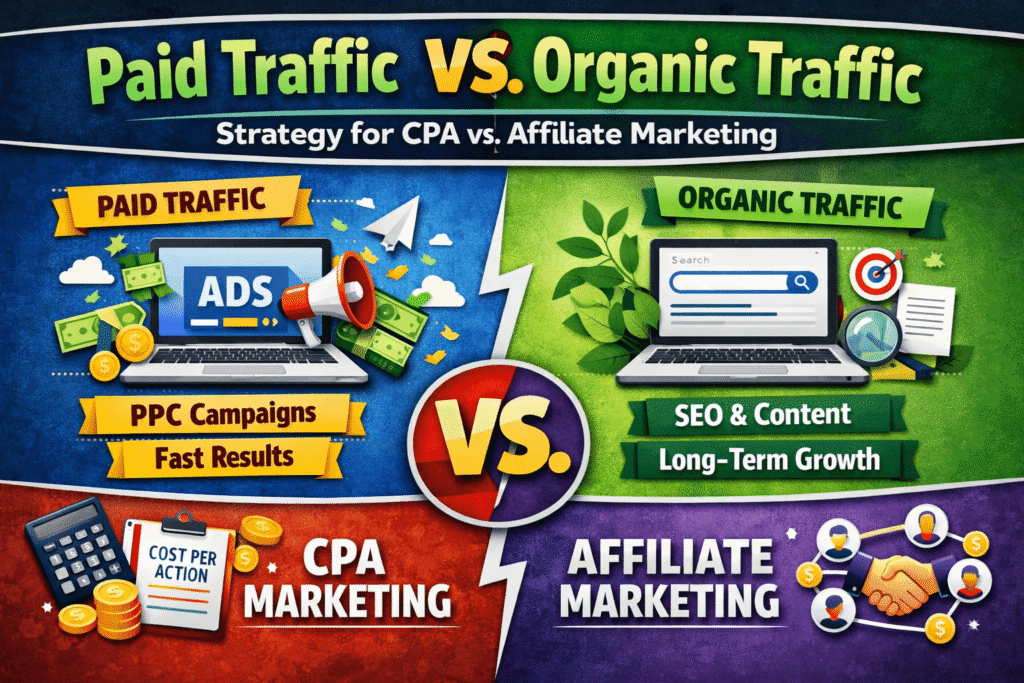
Traffic is the lifeblood of both CPA Marketing and Affiliate Marketing.
Without it, even the best offer or the best content means nothing.
But not all traffic is the same. And choosing the right strategy can make or break your earning potential.
What Is Paid Traffic?
Paid traffic means you spend money to get people to see your offer.
Think Facebook Ads, Google Ads, TikTok Ads, or native advertising platforms.
You set a budget. You target a specific audience. You send them directly to your landing page or offer.
It’s fast. It’s scalable. But it costs money.
What Is Organic Traffic?
Organic traffic means people find you naturally.
- Through Google search.
- YouTube videos.
- Social media posts.
- Or even word of mouth.
You create content. You optimize it. You let it grow over time.
It’s slower to build.
But once it works, it keeps working for free.
Which Strategy Works Best for CPA Marketing?
CPA Marketing and paid traffic are almost a natural pair.
Here’s why:
- CPA offers often have short windows and specific targeting needs
- Paid ads let you control exactly who sees your offer
- You can test, tweak, and scale campaigns quickly
- Faster traffic means faster earnings
The best CPA marketers treat ads like a science experiment.
They test small budgets. Find winning campaigns. Then scale aggressively.
Speed is the game.
Which Strategy Works Best for Affiliate Marketing?
Affiliate Marketing thrives on organic traffic.
Here’s why:
- Blog content and SEO bring in free, targeted visitors month after month
- YouTube videos build trust and drive consistent clicks
- Organic audiences convert better because they already trust you
- No ad spend means higher profit margins on every commission
The simple how to make money strategy here is clear —
Create helpful content. Rank it. Let it earn passively over time.
Paid vs Organic — A Quick Comparison
| Factor | Paid Traffic | Organic Traffic |
| Speed | Immediate results | Takes 3 to 6 months |
| Cost | Ongoing ad spend | Time and effort |
| Best For | CPA Marketing | Affiliate Marketing |
| Earning Timeline | Fast | Slow but sustainable |
| Scalability | High with budget | High with content volume |
| Risk | Higher — ad costs can eat profits | Lower — traffic is free |
| How to Start | Set up ad account and campaign | Start a blog or YouTube channel |
The Smart Move
The best online marketers don’t limit themselves to one traffic strategy.
They use paid traffic to generate quick wins with CPA Marketing.
At the same time, they build organic assets through Affiliate Marketing.
Over time, the organic side becomes stronger and more stable.
Less dependence on ads. Better margins. More consistent earnings.
That’s how you build a sustainable online income system.
Best CPA Marketing Platforms
Choosing the right platform is one of the most important decisions you’ll make as a CPA marketer.
The best networks connect you with high-paying offers, reliable tracking, and on-time payments.
Pick the right one, and your earning journey becomes much smoother.
Here are the top CPA Marketing platforms worth your attention.
1. MaxBounty
MaxBounty is widely considered one of the strongest CPA networks in the industry.
It has been around since 2004 and offers thousands of campaigns across finance, health, software, and more.
- Weekly payouts
- Dedicated affiliate managers
- Beginner-friendly (with interview approval)
If you are serious about CPA Marketing, this platform sets a high standard.
2. CPAlead
CPAlead is a solid starting point for beginners who want to make money quickly.
- Instant approval
- Simple dashboard
- Strong in mobile installs and content locking
If you’re just learning how to make money with CPA offers, this is one of the easiest entry points.
3. Clickbooth — Now Perform[cb]
Perform[cb] is a premium CPA network suitable for both beginners and advanced marketers.
- High-quality offers
- Strong advertiser relationships
- Competitive payouts in finance and insurance
If you want better than average earning potential, this network is worth exploring.
4. AdWork Media
AdWork Media is ideal for marketers focused on content locking and incentive traffic.
- User-friendly interface
- Reliable support
- Good beginner accessibility
It’s a strong choice if you’re still figuring out your CPA strategy.
5. OGAds
OGAds specializes in mobile traffic and content locking.
If your audience is primarily mobile users, this platform offers some of the better earning opportunities in the CPA space today.
Quick Platform Comparison
| Platform | Best For | Approval | Payment Frequency | Minimum Payout |
| MaxBounty | All levels | Interview based | Weekly | $100 |
| CPAlead | Beginners | Instant | Weekly | $1 |
| Perform[cb] | Intermediate to Advanced | Application | Monthly | $50 |
| AdWork Media | Content locking | Easy | Monthly | $35 |
| OGAds | Mobile traffic | Moderate | Monthly | $25 |
How to Get Approved Faster?
Most CPA networks want to know you are serious before approving you.
Here are a few practical tips:
- Be honest about your traffic sources and experience level
- Have a basic website or landing page ready
- Answer application questions clearly and professionally
- Start with beginner-friendly networks like CPAlead to build a track record
Once you show consistent earning results on one network, getting approved on higher-paying platforms becomes much easier.
The right platform, combined with the right offer, is where real CPA Marketing money starts to flow.
Best Affiliate Marketing Platforms

The platform you choose can directly impact how much you earn and how fast you grow.
The best affiliate platforms offer a wide range of products, reliable tracking, and consistent payouts.
If you want to make money consistently, you need a strong foundation.
Here are the top Affiliate Marketing platforms worth joining today.
1. Amazon Associates
Amazon Associates is one of the most well-known affiliate programs in the world.
It’s often the best starting point for beginners because Amazon sells almost everything.
Commissions usually range from 1% to 10%, depending on the product category.
The big advantage? High conversion rates.
People already trust Amazon with their money, which makes earning easier even if commissions are lower.
2. ClickBank
ClickBank specializes in digital products like ebooks, online courses, and software.
This is where earning potential becomes exciting.
Commission rates can go as high as 75% per sale, making it a better option for serious income seekers.
It’s also beginner-friendly with instant approval and a massive product library.
3. ShareASale
ShareASale connects affiliate marketers with thousands of merchants across different niches.
It supports both physical and digital products.
Payouts are reliable, and the dashboard makes tracking your earnings simple and clear.
A strong platform for steady, long-term growth.
4. Impact
Impact is a premium affiliate platform used by major global brands.
If you have an established audience and want to promote recognizable companies, this platform offers some of the best brand partnership opportunities available today.
It’s more selective, but the quality of partnerships is high.
5. CJ Affiliate — Commission Junction
CJ Affiliate is one of the oldest and most trusted networks in the industry.
It works with top-tier advertisers and offers competitive commissions.
It’s especially strong for marketers looking to make money in retail, finance, and technology niches.
6. Digistore24
Digistore24 focuses mainly on digital products but also includes some physical items.
It offers strong commission rates, sometimes up to 70%.
It’s a solid alternative if you want better options beyond ClickBank.
7. Hostinger and Bluehost Affiliate Programs
Web hosting affiliate programs deserve special attention.
Companies like Hostinger and Bluehost pay high commissions per referral.
For bloggers in tech or blogging niches, these are some of the best high-ticket opportunities in Affiliate Marketing.
Most readers miss this (don’t be one of them)
Quick Platform Comparison
| Platform | Best For | Commission Rate | Approval | Payment Frequency |
| Amazon Associates | Beginners | 1% to 10% | Easy | Monthly |
| ClickBank | Digital products | Up to 75% | Instant | Weekly or Bi-weekly |
| ShareASale | All niches | Varies | Moderate | Monthly |
| Impact | Established creators | Varies | Selective | Monthly |
| CJ Affiliate | Retail and tech | Varies | Moderate | Monthly |
| Digistore24 | Digital products | Up to 70% | Easy | Weekly |
| Bluehost | Bloggers and tech | Fixed per sale | Easy | Monthly |
How to Choose the Right Platform?
Not every platform will suit every marketer.
Here’s how to choose wisely:
- If you are a beginner, start with Amazon Associates or ClickBank.
- If you create tech or software content, look at Impact or CJ Affiliate.
- If you want higher commissions fast, focus on digital products.
- If you want better long-term earnings, diversify across multiple platforms.
The smartest affiliate marketers don’t rely on just one source of money.
They spread risk. They test offers. They optimize performance.
Choose the platform that matches your niche, audience, and content style.
That alignment is what turns clicks into consistent Affiliate Marketing income.
Pros and Cons of CPA Marketing
Every money-making model has strengths and weaknesses.
CPA Marketing is no different.
Before you dive in, it’s important to understand both sides so you can make the best decision for your goals.
Pros of CPA Marketing
1. No Purchase Required to Earn
This is the biggest advantage.
Your audience doesn’t need to spend money to trigger your commission. A simple sign-up or form fill is enough.
That makes conversions easier and faster compared to many other models.
2. Fast Earning Potential
If you know how to drive targeted traffic, CPA Marketing can generate income quickly.
Unlike Affiliate Marketing, you don’t always have to wait months to see results.
The earning cycle is shorter.
3. Fixed and Predictable Payouts
You always know exactly what you will earn per action.
This makes budgeting and scaling easier.
Predictable payouts mean better campaign planning.
4. Wide Range of Offers
CPA networks provide hundreds of campaigns across niches like health, finance, gaming, and education.
There is almost always something that fits your audience.
Finding the best offer match becomes easier when you have options.
5. Low Entry Barrier
You don’t need a website, a large following, or brand authority to start.
Many beginners launch campaigns with just a simple landing page or social media traffic source.
That makes it accessible for anyone serious about learning how to make money online.
6. Works Great With Paid Traffic
CPA Marketing and paid ads are a strong combination.
You can test offers quickly. Optimize campaigns based on data. Scale what works.
It’s one of the better models for marketers who enjoy numbers and performance tracking.
Cons of CPA Marketing
1. Approval Can Be Difficult
Top CPA networks don’t approve of everyone.
If you have no experience, getting into the best platforms can take time.
2. Dependent on Network Reliability
Your earning depends on the network paying you on time and keeping offers active.
If an offer gets removed or a network shuts down, your income can disappear overnight.
3. High Competition in Popular Niches
The best-paying offers attract heavy competition.
This increases ad costs and makes profitability harder, especially for beginners with limited budgets.
4. Ad Costs Can Kill Profits
Paid traffic is common in CPA Marketing.
But if campaigns are not optimized properly, ad spend can exceed your revenue.
That turns fast earning into fast losses.
5. Short-Term Income Model
CPA rarely builds long-term passive income.
Once you stop sending traffic, your income usually stops too.
It requires consistent effort and active management.
6. Strict Rules and Restrictions
CPA networks have clear promotional rules.
Violating them — even accidentally — can result in account bans and withheld payments.
Compliance is critical.
CPA Marketing is powerful when done correctly.
The smart approach is simple:
Start with a clear strategy. Set a realistic budget. Test carefully. Scale only what proves profitable.
That’s how real earning happens.
Pros and Cons of Affiliate Marketing
Affiliate Marketing is one of the most popular ways to make money online — and for good reason.
But like every model, it has advantages and challenges.
Let’s look at both sides honestly.
Pros of Affiliate Marketing
1. Passive Income Potential
This is the biggest attraction.
You can publish a blog post today and it can continue earning commissions months — even years — later.
Your content keeps working while you sleep. That’s the best kind of income.
2. Low Startup Cost
You don’t need a large budget to begin.
A simple website and valuable content are enough to get started.
Compared to many online business models, the financial risk is low.
3. No Product Creation Required
You promote someone else’s product and earn a percentage of each sale.
No inventory. No shipping. No customer support.
Your focus stays on traffic and content. The merchant handles the rest.
4. Unlimited Earning Ceiling
Unlike fixed CPA payouts, affiliate commissions are percentage-based.
Promote a high-ticket product, and one sale could mean hundreds of dollars.
The stronger your audience and content, the higher your earning potential grows.
5. Builds Long-Term Authority
Affiliate Marketing pushes you to create helpful, niche-focused content.
Over time, that builds trust.
And trust is an asset that pays beyond just commissions.
6. Multiple Income Streams
You’re not limited to one program.
You can promote multiple products across different platforms and niches.
This makes your income more stable and less dependent on a single source.
7. Works Beautifully With SEO
Search engine traffic and Affiliate Marketing are a powerful combination.
Rank your content on Google and you can generate consistent, free traffic daily.
It’s one of the best long-term strategies for sustainable online income.
Cons of Affiliate Marketing
1. Takes Time to See Results
This is where most beginners struggle.
Affiliate Marketing is not a fast-cash model.
Building traffic and trust can take 3 to 12 months before meaningful earning begins.
2. Commission Rates Can Be Low
Not every affiliate program pays generously.
Some platforms offer very small percentages, which means you need a serious traffic volume to make consistent money.
3. You Don’t Control the Product
The merchant controls pricing, product quality, and commission structure.
If they change terms or discontinue a product, your income can drop overnight.
You have limited control.
4. High Dependence on Traffic
No traffic means no clicks. No clicks means no commissions.
If rankings drop or social reach declines, your earnings can fall quickly.
5. Intense Competition in Popular Niches
Finance, health, tech, and fitness are highly profitable niches.
They are also extremely competitive.
Standing out requires better content, stronger SEO, and real value.
6. Programs Can Change or Shut Down
Affiliate programs can reduce commission rates or close completely.
When that happens, your income takes an immediate hit.
Diversification is critical.
7. Requires Consistent Content Creation
Traffic growth depends on publishing consistently.
For solo creators, this can feel overwhelming — especially in the early months when results are slow.
Affiliate Marketing rewards patience and consistency more than anything else.
It may not generate fast cash, but when it gains momentum, it becomes one of the most reliable and scalable passive income models available online.
Slow build. Strong foundation. Long-term payoff.
Can You Combine CPA and Affiliate Marketing?

Absolutely.
And honestly — this is where things get interesting.
Most beginners treat CPA Marketing and Affiliate Marketing like an either-or decision.
But the smartest marketers don’t choose. They combine.
CPA brings fast, consistent cash flow. Affiliate Marketing builds long-term passive income.
Together? You get short-term wins and long-term growth working side by side.
That’s a powerful position to be in.
How to Combine Both Models?
Here’s a practical way to run them together without overcomplicating things.
Step 1 — Build a Niche Website
Start with a blog or content site around one focused niche.
This becomes the foundation of your Affiliate Marketing strategy.
High-quality content attracts organic traffic. Organic traffic turns into consistent earnings over time.
Step 2 — Monetize With Affiliate Links
Place affiliate links naturally inside your content.
Product reviews. Comparison posts. How-to guides.
Let those links generate passive commissions while you continue growing traffic.
Step 3 — Layer CPA Offers on Top
Once traffic starts flowing, introduce relevant CPA offers alongside your affiliate promotions.
Email opt-ins. Free trial sign-ups. App downloads.
Low-friction actions convert easily because your audience doesn’t need to spend money.
Now your traffic earns twice.
Step 4 — Use Paid Ads for CPA Campaigns
Run separate paid traffic campaigns focused purely on your best CPA offers.
This creates immediate daily income.
While your affiliate content compounds in the background.
Fast cash in front. Slow wealth building behind.
Step 5 — Reinvest Your CPA Earnings
This is where the system becomes powerful.
Use your CPA profits to:
- Fund more content creation
- Invest in SEO tools
- Scale paid ads
- Improve your website
Your CPA income finances the growth of your Affiliate Marketing engine.
Real-World Example
Imagine you run a personal finance blog.
Here’s how combining both models might look:
- You publish a post about the best budgeting apps — earning affiliate commissions when readers upgrade
- On that same page, you include a CPA offer for a free credit score check — earning a small payout per sign-up
- You run paid ads promoting a debt consolidation CPA offer — generating daily income
- That income funds three new SEO-optimized blog posts each week
Every piece supports the next. Every channel strengthens the system.
You don’t have to choose between CPA Marketing and Affiliate Marketing.
The better question isn’t which one is better.
It’s how to make both work together in your favor.
Use CPA to make money now. Use Affiliate Marketing to build wealth over time.
Combine them intelligently, and you create an income system that is scalable, resilient, and built to last.
The highest earners aren’t loyal to one model.
They’re loyal to results.
Common Mistakes Beginners Make
Every beginner makes mistakes.
That’s normal.
But in CPA Marketing and Affiliate Marketing, some mistakes cost serious time and money.
If you know them upfront, you’re already ahead of most people starting out.
Here are the biggest pitfalls to avoid.
1. Choosing the Wrong Niche
This is where many beginners stumble first.
They chase the highest-paying offers without asking a simple question — Do I actually understand this audience?
If you have no interest or knowledge in a niche, your content feels forced. And forced content rarely converts.
Choose a niche you understand. Knowledge and genuine interest outperform trend-chasing every time.
2. Expecting Overnight Results
Both CPA and Affiliate Marketing require learning, testing, and optimization.
Many beginners quit after a few weeks because the earning isn’t “fast enough.”
That’s the biggest mistake.
Patience isn’t optional here. It’s a core skill.
3. Promoting Too Many Offers at Once
Signing up for every network. Promoting dozens of offers. Testing everything at the same time.
That scattered focus leads to scattered results.
Start with one or two strong offers. Master them. Then expand.
Consistency beats chaos.
4. Ignoring Traffic
Some people build beautiful websites and pick great offers —
But forget the most important part.
Traffic.
No traffic means no clicks. No clicks means no earnings.
Traffic strategy should be your first priority — not an afterthought.
5. Not Tracking Performance
If you’re not tracking what’s working, you’re guessing.
And guessing is expensive.
You need to know:
- Which traffic sources convert?
- Which offers perform?
- Which content generates income?
Data is what separates better marketers from struggling ones.
6. Violating Platform Rules
Every CPA network and affiliate program has terms and conditions.
Skipping them can lead to account bans — sometimes with earnings withheld.
One mistake can set you back months.
Always read the rules before promoting any offer.
7. Relying on One Traffic Source
Depending on a single platform is risky.
Algorithms change. Accounts get restricted. Policies update overnight.
Diversify across SEO, social media, email, and paid ads.
Never let one platform control your entire earning stream.
8. Skipping the Learning Phase
Jumping straight into paid ads or aggressive scaling without understanding the fundamentals leads to wasted money.
Learn first. Test small. Scale later.
The knowledge you build early pays dividends for years.
9. Giving Up Too Soon
This is the most painful mistake.
Online income follows a curve — slow in the beginning, then suddenly accelerating.
Many people quit right before momentum starts building.
The ones who succeed aren’t always the smartest.
They’re the ones who stayed long enough to figure it out.
Mistakes aren’t failures.
They’re feedback.
Every successful marketer in CPA and Affiliate Marketing started exactly where you are — learning, adjusting, and improving step by step.
The real difference between those who make money and those who don’t?
The willingness to keep going.
Conclusion
So here is the truth — there is no single best answer between CPA Marketing and Affiliate Marketing.
Both models can genuinely change your financial life. Both give you the freedom to make money on your own terms. And both reward the people who show up consistently and keep learning.
If you want fast results, go with CPA Marketing. If you want to build a long-term passive earning stream, go with Affiliate Marketing. And if you want the best of both worlds — combine them.
The only wrong move is doing nothing.
Pick a model. Take the first step. And trust the process. Your journey to making money online starts with a single decision — and you have already taken it by reading this far.
Now go make it happen. 🚀
Before you leave, read this 👇
Frequently Asked Questions
Q1. What are the biggest risks in CPA marketing?
The biggest risks in CPA marketing are related to paid traffic and compliance. If your campaigns are not optimized properly, ad costs can quickly exceed your earnings. Another major risk is violating network rules, which can result in account bans or withheld payments. Since many CPA campaigns rely on active traffic, income can also stop immediately if your ads stop running or an offer gets pulled.
Q2. Does affiliate marketing require more trust-building?
Yes. Affiliate marketing heavily depends on trust. Because users are usually making a purchase, they need confidence in both the product and your recommendation. This means building authority through valuable content, honest reviews, and consistent engagement. The stronger the trust, the higher the conversion rate and long-term earning potential.
Q3. Can CPA marketing become passive income?
CPA marketing is generally less passive than affiliate marketing. Most CPA campaigns require ongoing traffic generation and regular optimization. However, it can become semi-passive if you build evergreen funnels or automate paid ad campaigns that consistently perform. Still, it typically requires more active management compared to SEO-driven affiliate content.
Q4. Which has higher competition?
Both models are competitive, especially in profitable niches like finance, health, and technology. CPA marketing often has intense competition in high-paying offers because many marketers use paid ads. Affiliate marketing faces heavy competition in organic search results. The real challenge isn’t competition itself — it’s how well you differentiate your strategy and deliver value.
Q5. Which is better for building a personal brand?
Affiliate marketing is generally better for building a personal brand. Since it involves content creation, audience engagement, and trust-building, it naturally positions you as an authority in your niche. CPA marketing focuses more on performance campaigns and short-term conversions, which doesn’t always contribute to long-term brand recognition.
Both models can make money — but if brand authority and long-term influence matter to you, affiliate marketing has the stronger advantage. 🚀

Leave a Reply