 +91 73584 98220
 info@rankmedaddy.com
 Rajasthan, India

Introduction
Picture this: you pour money into an ad campaign, but nothing happens. No clicks. No sales. Just crickets.
That’s the nightmare every business owner dreads.
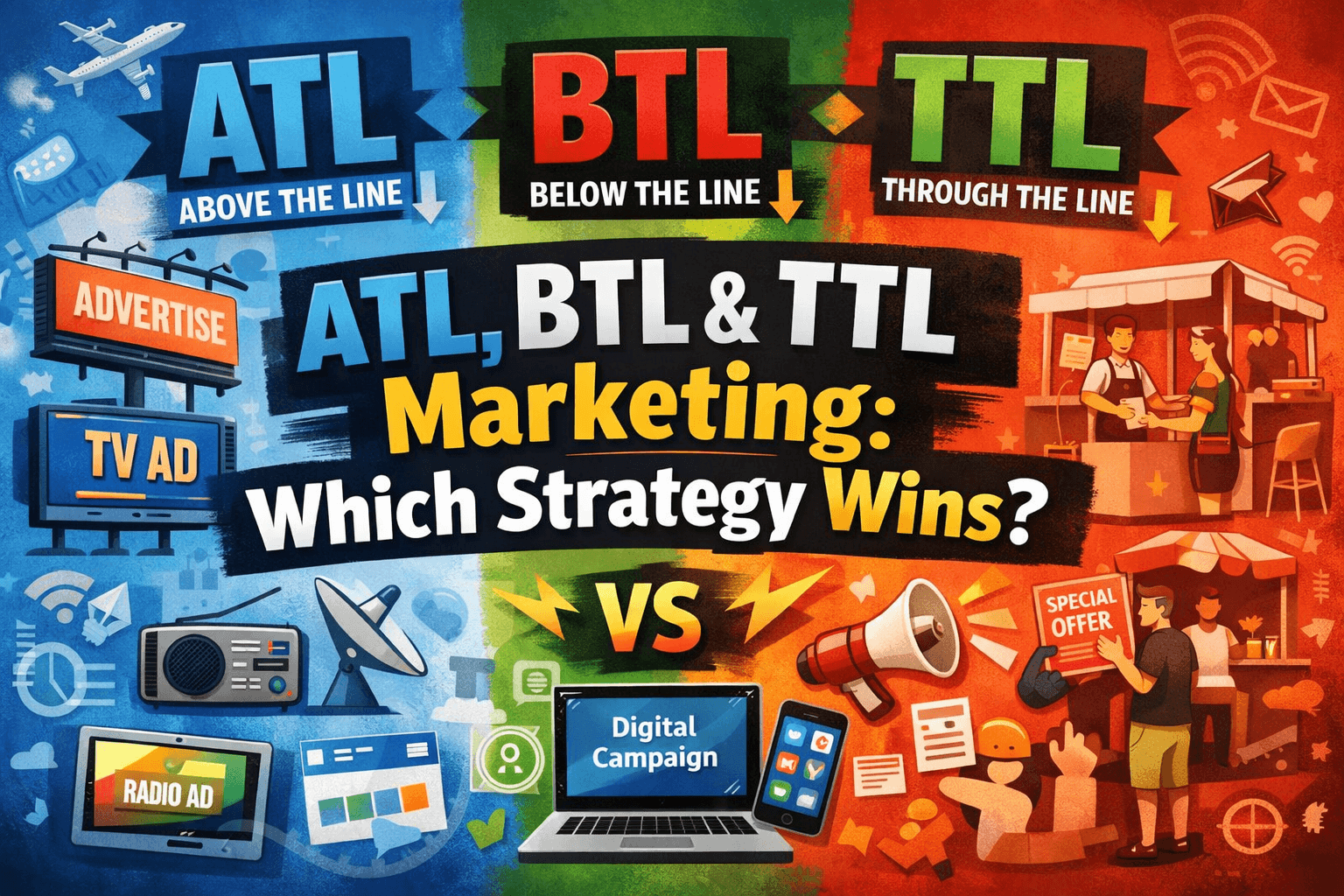
The good news? There are three smart ways to do marketing that actually work — Above the Line (ATL), Below The Line (BTL), and Through The Line (TTL).
Each one plays a different game.
Above the Line (ATL) is all about reaching a massive audience through channels like TV, radio, and billboards. It’s the loud voice that spreads brand awareness far and wide.
Below The Line (BTL) takes a more direct approach. It focuses on targeted activities like promotions, events, and direct communication that connect closely with potential customers.
Then comes Through The Line (TTL) marketing — a smart mix of both. It combines the wide reach of ATL with the precision of BTL to create a balanced strategy.
In this guide, you’ll discover how to use ATL, BTL, and Through The Line marketing effectively. We’ll also explore their key benefits and the practical activities businesses use to make them work in the real world.
By the end, you’ll know which strategy wins for your business — and how to make it happen without wasting a single rupee.
Ready to find out? Let’s dive in. 🚀
- Introduction
- What is ATL Marketing (Above The Line Marketing)?
- What is BTL Marketing (Below The Line Marketing)?
- What is TTL Marketing (Through The Line Marketing)?
- Advantages and Limitations of ATL, BTL and TTL Marketing
- Key Differences Between ATL, BTL, and TTL Marketing
- Real-World Examples of ATL, BTL, and TTL Marketing
- ATL vs BTL vs TTL: Which Strategy Wins?
- How Digital Marketing Changed ATL, BTL, and TTL Strategies?
- Common Mistakes Businesses Make When Choosing a Marketing Strategy
- Blindly Copying Competitors
- Sticking to One Strategy Forever
- Ignoring the Customer Journey
- Treating ATL and BTL as Separate Silos
- Overspending on ATL Without BTL Follow-Up
- Underestimating the Power of TTL Marketing
- Not Measuring Results
- Choosing Strategies Based on Trends
- Neglecting Brand Consistency
- Waiting for the “Perfect” Budget
- How to Choose the Right Marketing Strategy for Your Business?
- Conclusion
- Frequently Asked Questions (FAQs)
- Q1. Which marketing strategy is best for small businesses?
- Q2. Is digital marketing ATL or BTL?
- Q3. Which marketing strategy provides better ROI?
- Q4. Which industries benefit the most from ATL marketing?
- Q5. Which industries benefit the most from BTL marketing?
- Q6. Is TTL marketing suitable for startups?
What is ATL Marketing (Above The Line Marketing)?
ATL Marketing is all about reaching the widest crowd possible.
It’s called Above the Line because it works “above” the direct sales line — focusing on big, bold messages that almost everyone sees.
Think about TV commercials during your favourite show, huge newspaper ads, catchy radio jingles you can’t forget, or massive billboards on busy roads. These are classic ATL marketing activities designed to grab attention on a large scale.
The main job of ATL marketing is simple: make people remember your brand name.
You’re not asking them to buy right away. Instead, you’re planting a small seed in millions of minds at the same time.
For example, when a new smartphone brand runs the same ad on multiple TV channels for weeks, that’s Above the Line marketing in action. The goal is to make sure everyone recognizes the brand.
One of the biggest benefits of this approach is visibility. When people see a brand repeatedly across major media platforms, it starts to feel familiar and trustworthy.
It’s loud. It’s powerful. And yes, it can be expensive. But it can also turn an unknown brand into a household name.
That’s ATL marketing — the giant spotlight for your business.
Next, we’ll see how Below The Line plays a totally different (and smarter) game.
What is BTL Marketing (Below The Line Marketing)?
BTL Marketing is the smart, direct opposite of ATL.
It’s called Below The Line because it works “below” the big-broadcast line — talking straight to specific people who are already interested in what a brand offers.
Instead of mass Above the Line marketing, BTL focuses on personal and targeted communication.
Think personal emails, WhatsApp offers, SMS discounts, shop coupons, targeted Instagram ads, or fun in-store activities. These marketing activities are designed to reach the right people at the right time.
The main job of BTL marketing is simple: make people take action right now.
Buy today. Visit the store. Sign up. No waiting.
For example, imagine your local bakery sending a message to its past customers saying: “Buy one cake, get the second half off – only for you!” That’s perfect Below The Line marketing in action.
One of the biggest benefits of BTL is that it’s cheaper than ATL, easier to measure, and often delivers faster results. Businesses can see exactly how customers respond to their campaigns.
That’s Below The Line marketing — the clever, pocket-friendly way to turn interest into real sales.
Next, let’s see how Through The Line (TTL) marketing combines both ATL and BTL to create something even more powerful.
What is TTL Marketing (Through The Line Marketing)?
If Above the Line is a megaphone and Below The Line is a handshake, Through The Line (TTL) is the best of both worlds.
It’s an integrated approach to marketing that looks at the customer from every angle — often called a 360-degree strategy.
In the past, companies treated ATL and BTL like two completely separate worlds. Big TV ads were handled by one team, while direct coupons or store promotions were handled by another.
Today, that approach doesn’t work anymore.
Customers move constantly between the digital world and the real world. They might see a billboard on the road, search the brand on Google later, and finally buy through a social media ad. Through The Line marketing is designed to follow customers across all these touchpoints.
One of the biggest benefits of TTL marketing is consistency. No matter where someone sees your brand — on a giant billboard or in a personalized Instagram ad — the message and the feeling stay the same.
Some common TTL marketing activities include:
- Social media campaigns that support a national ATL TV advertisement
- A QR code on a magazine ad that leads to a digital discount page
- Influencer marketing that reaches a huge audience but still feels personal
When businesses understand how to use Through The Line marketing, they create a clear path for the customer.
First, they grab attention using the wide reach of Above the Line strategies. Then they guide interested people toward action using Below The Line methods.
In simple words, TTL marketing is not about choosing one side. It’s about making sure your message travels smoothly from the “line” all the way to the checkout counter.
Most readers miss this (don’t be one of them)
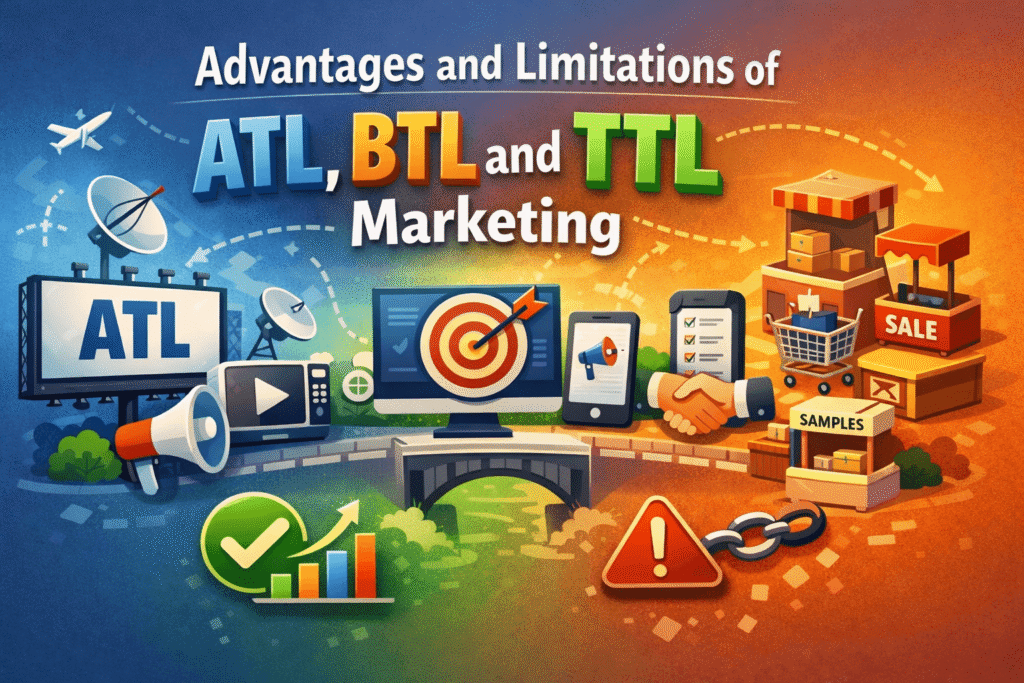
Advantages and Limitations of ATL, BTL and TTL Marketing
Advantages of ATL Marketing
When you’re chasing massive brand visibility and want your message to reach millions in one shot, ATL Marketing (Above the Line marketing) becomes the heavyweight champion.
Think prime-time TV commercials, full-page newspaper ads, catchy radio jingles, giant highway billboards, and glossy magazine spreads. These classic marketing activities are designed to grab attention at a huge scale and make people notice your brand instantly.
Here are some of the biggest benefits of ATL marketing.
1. Explosive Reach & Brand Awareness
One of the strongest advantages of Above the Line marketing is reach. A single TV commercial or a popular YouTube ad can introduce your brand to millions of people overnight. Instead of targeting a small group, ATL spreads the message across the entire market.
2. Strong Emotional Brand Building
ATL campaigns give brands the space to tell powerful stories. With cinematic visuals, music, and even celebrity endorsements, companies can create emotional connections with the audience. People remember not just the product, but the feeling behind it.
3. Credibility and Trust
Seeing a brand on national TV or in a respected newspaper automatically builds trust. Large-scale marketing campaigns make a company look established and reliable, which increases customer confidence.
4. Speed and Simplicity
Another benefit of ATL marketing is its straightforward execution. Once the campaign is produced and launched, it quickly starts building brand awareness. Businesses often notice increases in brand searches, website traffic, and customer interest soon after.
5. Long-Term Brand Recall
Great Above the Line campaigns can stay in people’s minds for years. A memorable jingle, slogan, or visual can keep reminding people about the brand long after the campaign ends.
Yes, ATL marketing can be expensive. But when the goal is to make everyone notice your brand, its reach and long-term benefits often make the investment worthwhile.
Limitations of ATL Marketing
Even though ATL Marketing (Above the Line marketing) can deliver massive reach, it’s not perfect. In today’s fast-moving digital world, the same strengths that make ATL powerful can also create serious challenges for businesses.
Here are some important limitations of Above the Line marketing.
1. High Costs with Uncertain Results
Running large-scale ATL marketing activities like TV commercials, billboard campaigns, or prime-time radio ads can be extremely expensive. Businesses often invest huge budgets upfront without any guarantee that the campaign will deliver the expected results.
2. Limited Targeting
One of the biggest downsides of Above the Line marketing is poor targeting. Since ATL focuses on reaching a wide audience, many people who see the ad may have no interest in the product. This means a large part of the campaign reach may not translate into actual customers.
3. Difficult to Measure ROI
Tracking the exact return on investment for ATL marketing can be tricky. While brands may notice improvements in awareness or website traffic, it is hard to clearly connect those results to a specific TV ad or billboard.
4. One-Way Communication
Another limitation is that ATL works as a broadcast message rather than a conversation. Customers see the advertisement but cannot interact with it immediately. Unlike Below The Line or Through The Line marketing, there is little direct engagement.
5. Changing Consumer Behaviour
Modern audiences are consuming media differently. Many people skip ads, use ad blockers, or spend more time on digital platforms. Due to this shift, traditional Above the Line marketing channels may not always capture attention as effectively as before.
6. Longer Campaign Planning
Launching an ATL campaign often takes time. From creating the advertisement to securing media placements, the process can take weeks or even months. In a fast-changing market, this slower pace can be a disadvantage.
Advantages of BTL Marketing
BTL Marketing (Below The Line marketing) may not have the glamour of a big TV commercial, but what it lacks in size, it makes up for in precision and real results.
Instead of shouting to the whole market like Above the Line marketing, BTL focuses on connecting with the right people. That focused approach gives businesses several strong benefits.
Here’s why many companies rely heavily on BTL marketing.
1. Highly Targeted
One of the biggest advantages of Below The Line marketing is precise targeting. Businesses can send the right message to the people who are most likely to buy. This reduces wasted spending and makes marketing campaigns more efficient.
2. Easy to Measure
Unlike many ATL marketing activities, BTL campaigns are easy to track. Brands can measure email open rates, link clicks, coupon redemptions, and other data to see exactly what is working.
3. Cost-Effective
Another major benefit of BTL marketing is affordability. Activities like email campaigns, SMS offers, direct mail, and in-store promotions can deliver strong results without requiring a huge advertising budget.
4. Drives Direct Action
Below The Line marketing is designed to encourage quick responses. Limited-time offers, special discounts, and personalized messages push customers to act immediately rather than just remember the brand.
5. Builds Personal Relationships
When brands communicate directly with customers, the interaction feels more personal. This personal touch helps build trust and loyalty, turning one-time buyers into long-term customers.
6. Perfect for Niche Markets
If a product targets a specific audience, BTL marketing makes it easier to reach that group without spending money on people who may never be interested.
7. Encourages Two-Way Communication
Unlike traditional Above the Line campaigns, Below The Line marketing allows customers to respond and interact. They can reply to messages, comment on campaigns, and give feedback, which helps brands improve their strategy.
For businesses that want clear results and measurable impact, BTL marketing offers a smart and practical solution.
Limitations of BTL Marketing
BTL Marketing (Below The Line marketing) is sharp, targeted, and measurable. But it also comes with its own set of challenges. Below the Line marketing isn’t a one-size-fits-all solution, especially when businesses want large-scale visibility.
Here’s where BTL marketing can fall short.
1. Limited Reach
BTL marketing focuses on a specific audience, which means it doesn’t reach the masses. If your goal is broad brand awareness, Below The Line activities alone may not be enough. This is where Above the Line marketing often has an advantage.
2. Time-Consuming to Execute
Running personalized campaigns takes effort. Businesses must segment audiences, craft tailored messages, and manage multiple BTL marketing activities at the same time. This process can be slow and require dedicated resources.
3. Difficult to Scale
What works for a small targeted campaign may not work the same way at a larger scale. As the customer base grows, maintaining personalization in Below The Line marketing becomes more complex.
4. Short-Term Impact
Many BTL campaigns focus on quick actions such as flash sales, discount codes, or event promotions. These activities often create a sudden spike in engagement but may not build long-term brand awareness.
5. Can Feel Intrusive
Nobody likes spam. If BTL marketing is not handled carefully, it can feel pushy or invasive. Too many promotional emails, SMS offers, or direct messages can damage the customer’s perception of the brand.
6. Limited Mass Brand Credibility
While Below The Line marketing is great for driving conversions, it does not always create a strong public brand image. A promotional email or store flyer rarely builds the same recognition that ATL campaigns achieve.
7. Dependent on Quality Data
The success of BTL marketing depends heavily on accurate customer data. If the data is outdated or incorrect, the campaign may reach the wrong audience, resulting in wasted time and budget.
Advantages of TTL Marketing
TTL Marketing (Through The Line marketing) takes the best of both worlds — and that’s exactly what makes it so powerful. Instead of choosing between Above the Line reach or Below The Line precision, TTL marketing blends them into one complete marketing strategy.
Here’s why more and more brands are moving toward Through The Line marketing.
1. Complete Customer Coverage
One of the biggest benefits of TTL marketing is that it covers the entire customer journey. From the moment someone first hears about a brand to the moment they make a purchase, every stage is supported by connected marketing activities.
2. Consistent Brand Message
With Through The Line marketing, the brand story stays consistent across every platform. Whether someone sees a TV advertisement, a billboard, or a targeted email campaign, the message feels connected and clear.
3. Combines ATL and BTL Strengths
TTL marketing gives businesses the wide visibility of Above the Line marketing while still using the targeted engagement of Below The Line marketing. This combination creates a powerful and balanced strategy.
4. Better Return on Investment
Because different marketing activities support each other, TTL campaigns often deliver stronger results. ATL efforts help build awareness, while BTL campaigns convert that interest into action.
5. Builds Awareness and Customer Loyalty
Another key benefit of Through The Line marketing is that it works on two levels. It introduces the brand to new audiences while also strengthening relationships with existing customers.
6. Flexible for Businesses of All Sizes
Whether a company is a startup or a well-known brand, TTL marketing can be adjusted to fit different budgets and goals. The strategy is flexible and can grow as the business grows.
7. Matches Modern Consumer Behaviour
Today’s customers move across many channels — online and offline. Through The Line marketing is designed for this multi-channel environment, helping brands stay visible wherever customers interact.
In simple terms, TTL marketing doesn’t force businesses to choose between reach and engagement. It allows them to do both in a smarter and more connected way.
Limitations of TTL Marketing
TTL Marketing (Through The Line marketing) often sounds like the perfect strategy — and in many ways, it is. By combining Above the Line and Below The Line approaches, it creates a powerful and connected marketing strategy.
But like any strategy, TTL marketing also has its challenges. Before adopting it fully, brands should understand where Through The Line marketing can get tricky.
1. Complex to Plan and Execute
Combining ATL and BTL marketing activities into one seamless campaign is not simple. It requires careful planning and strong coordination so that every channel works together smoothly.
2. Requires a Bigger Budget
Since TTL marketing often runs multiple campaigns across different platforms at the same time, the cost can rise quickly. Without proper planning, budgets can easily get stretched.
3. Needs a Skilled Team
Successful Through The Line marketing requires expertise in both Above the Line marketing and Below The Line marketing. Building a team that understands both approaches can be challenging for many businesses.
4. Risk of Inconsistent Messaging
When several marketing activities run across different channels, there is always a chance of mixed messaging. If a brand’s TV advertisement says one thing while its email campaign says another, customers may become confused.
5. Harder to Manage and Monitor
Tracking the performance of multiple TTL campaigns at the same time can be complicated. Without proper tools and analytics systems, it can be difficult to understand which marketing efforts are delivering the best results.
6. Can Lead to Audience Fatigue
When customers see the same brand everywhere — on TV, social media, emails, and billboards — it can sometimes feel overwhelming. Too much exposure can cause people to ignore the brand altogether.
7. Not Ideal for Every Business
While TTL marketing offers many benefits, it may not suit every company. Smaller businesses or niche brands may find it difficult to manage the cost and complexity of a full Through The Line marketing strategy.
In short, TTL marketing is powerful — but it works best when businesses maintain the right balance between strategy, budget, and execution.
Most readers miss this (don’t be one of them)
Key Differences Between ATL, BTL, and TTL Marketing
Understanding each strategy individually is helpful — but the real clarity comes when you compare them side by side. When you look at ATL, BTL, and TTL marketing together, it becomes much easier to decide which approach fits your business goals.
Each strategy plays a different role in the world of marketing.
Above the Line focuses on mass visibility, Below The Line focuses on targeted engagement, and Through The Line connects both to guide customers from awareness to action.
Here’s a simple breakdown of how these three strategies differ.
| Factor | ATL Marketing | BTL Marketing | TTL Marketing |
| Full Form | Above The Line | Below The Line | Through The Line |
| Target Audience | Mass audience | Specific, targeted audience | Both mass and targeted |
| Primary Goal | Brand awareness | Direct conversions | Awareness + conversions |
| Reach | Very broad | Narrow and focused | Wide and focused |
| Cost | High | Low to medium | Medium to high |
| Measurability | Difficult | Easy | Moderate |
| Channels Used | TV, radio, billboards, print | Email, flyers, events, direct mail | Combination of ATL and BTL channels |
| Communication Type | One-way | Two-way | Both |
| Best For | Large brands and mass visibility | Small to mid-sized businesses | Brands of all sizes |
| Results Timeline | Long-term | Short to mid-term | Short to long-term |
| Customer Relationship | Indirect | Direct and personal | Both |
| Flexibility | Low | High | Very high |
To make the comparison even clearer, here is another quick overview focusing on strategy purpose and practical use.
| Strategy | Main Focus | Typical Activities | Key Benefits | Limitations |
| ATL Marketing | Mass brand awareness | TV ads, billboards, newspaper ads, radio commercials | Massive reach and strong brand visibility | Expensive and hard to measure |
| BTL Marketing | Targeted engagement and conversions | Email campaigns, promotions, direct messaging, store events | Highly targeted and measurable | Limited reach |
| TTL Marketing | Integrated customer journey | Combination of ATL campaigns and BTL promotions | Balanced reach and conversions | More complex to manage |
The tables reveal one important truth: no single strategy wins in every situation.
The smartest brands don’t rely on just one method. Instead, they combine Above the Line, Below The Line, and Through The Line marketing depending on their goals, audience, and budget.
When used correctly, these strategies work together to create a powerful and complete marketing system.
Real-World Examples of ATL, BTL, and TTL Marketing
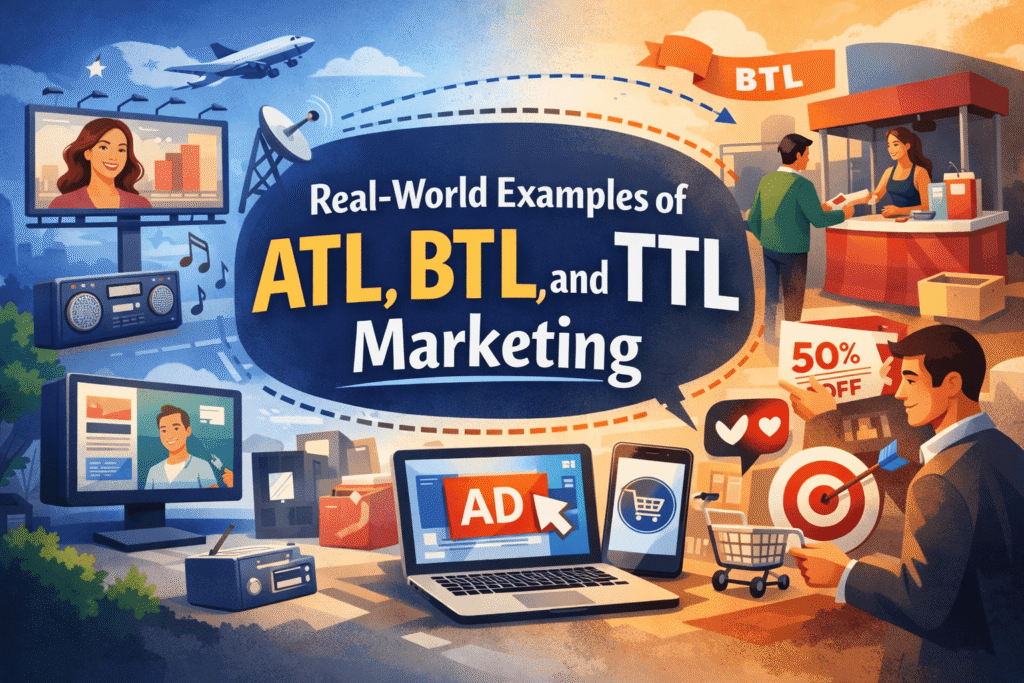
Sometimes the easiest way to understand a marketing strategy is to see it in action. Real brands use ATL, BTL, and TTL marketing every day to reach customers in different ways.
Here are some clear examples of how well-known companies apply Above the Line, Below The Line, and Through The Line marketing in the real world.
ATL Marketing Examples
Coca-Cola — “Open Happiness” TV Campaign
Coca-Cola created one of the most famous Above the Line marketing campaigns with its “Open Happiness” commercials. These TV ads ran across many countries and reached millions of viewers. The goal wasn’t direct sales — it was pure brand awareness on a global scale.
Apple — Billboard Advertising
Apple’s minimalist billboards are a perfect example of ATL marketing activities. A simple image of the product, a short tagline, and placement in busy locations. Millions of people see it every day, which strengthens the brand’s presence everywhere.
Amul — Newspaper Print Ads
Amul’s witty topical ads in newspapers have been a part of Indian culture for decades. These ads speak to the entire nation at once, making them a classic Above the Line marketing example.
BTL Marketing Examples
Nykaa — Personalised Email Campaigns
Nykaa sends personalised product suggestions and discount offers based on what customers have previously browsed or purchased. This type of Below The Line marketing targets individuals directly and encourages immediate purchases.
Supermarket Sampling Campaigns
Brands like Maggi or Lay’s often set up tasting stalls in supermarkets. Shoppers can try the product instantly while they are already in buying mode. These BTL marketing activities are designed to trigger quick decisions.
Zomato — Push Notifications
Zomato uses highly targeted push notifications based on your location, order history, and time of day. These personalised messages are a textbook example of Below The Line marketing focused on quick conversions.
TTL Marketing Examples
Nike — “Just Do It” Integrated Campaign
Nike uses a powerful Through The Line marketing strategy. Large TV commercials and billboards build awareness (ATL), while personalised social media ads, emails, and app promotions drive engagement (BTL). Together, they create a seamless customer journey.
Amazon — Prime Day Campaign
Amazon builds excitement for Prime Day with TV ads and media coverage (ATL). At the same time, it sends personalised deal notifications, targeted emails, and app alerts to users (BTL). This combination turns awareness into purchases — a strong TTL marketing approach.
Flipkart — Big Billion Days
Flipkart promotes Big Billion Days with TV ads and newspaper campaigns to create nationwide buzz (ATL). Then it sends personalised offers, app alerts, and targeted promotions to users (BTL). This mix of reach and relevance makes it a powerful Through The Line marketing campaign.
These examples show an important lesson. The most successful brands don’t rely on just one approach. They know when to go broad with Above the Line marketing, when to go targeted with Below The Line marketing, and when to combine both using Through The Line marketing for maximum impact.
Most readers miss this (don’t be one of them)
ATL vs BTL vs TTL: Which Strategy Wins?
After exploring ATL, BTL, and TTL marketing, the big question remains: which strategy actually wins?
The honest answer is simple — none of them wins all the time. Each approach serves a different purpose in the world of marketing.
Above the Line (ATL) is designed for mass awareness. When a brand wants millions of people to recognize its name, ATL marketing activities like TV ads, billboards, and print campaigns work extremely well. Large companies often use this strategy to build a strong public presence.
Below The Line (BTL) focuses on direct engagement and quick conversions. Targeted emails, promotional offers, and personalized campaigns allow brands to connect with customers more closely and encourage immediate action.
Then comes Through The Line (TTL) — a strategy that combines both ATL and BTL marketing. Instead of choosing one approach, TTL marketing uses broad visibility to attract attention and targeted campaigns to turn that attention into real sales.
In today’s digital world, many experts believe Through The Line marketing offers the best balance. It allows businesses to build brand awareness while still maintaining personal engagement with customers.
However, the best strategy depends on the goal:
- If the goal is mass visibility, ATL marketing works best.
- If the goal is immediate conversions, BTL marketing is more effective.
- If the goal is a complete customer journey, TTL marketing is often the smartest choice.
In reality, the most successful brands don’t treat these strategies as competitors. Instead, they use ATL, BTL, and TTL marketing together to create a powerful and flexible marketing system.
How Digital Marketing Changed ATL, BTL, and TTL Strategies?
Not too long ago, marketing channels were clearly divided. ATL meant TV and radio. BTL meant flyers and direct mail. TTL was simply the combination of the two.
Then the internet arrived — and everything changed.
ATL Marketing Went Digital
Traditional Above The Line marketing was always about reach. Brands used television, radio, and print to speak to the masses with a single message.
Digital platforms expanded their reach dramatically — and in many cases, made it more affordable.
Today, YouTube pre-roll ads, Instagram Reels promotions, and programmatic display advertising function as modern ATL channels. A brand can reach millions of viewers online without spending massive budgets on traditional TV slots.
Even better, digital ATL campaigns can be launched faster, tested quickly, and optimized in real time. Marketers can track impressions, engagement, and conversions almost instantly — something traditional ATL marketing never offered.
BTL Marketing Became Smarter
Digital tools gave Below The Line marketing a major upgrade.
Instead of relying only on physical promotions like flyers, coupons, or in-store campaigns, brands can now target audiences with extreme precision. Marketers can segment customers based on age, location, interests, browsing behaviour, and past purchases.
Tools like email automation, WhatsApp marketing, retargeting ads, and personalised push notifications allow brands to communicate directly with individual users.
What once required printing and distributing thousands of leaflets can now happen with one well-timed notification on a smartphone.
TTL Marketing Became the Default
The biggest transformation happened with Through The Line marketing.
Digital marketing platforms naturally combine mass awareness with personalised targeting. As a result, TTL marketing has quietly become the default strategy for modern campaigns.
For example, a brand might launch a YouTube video ad to create awareness, retarget viewers with personalised social media ads, follow up with an automated email sequence, and finally close the sale through an app notification or special offer.
Everything happens inside one connected ecosystem.
Platforms like Google, Meta, and LinkedIn now provide tools that allow businesses to run ATL and BTL activities simultaneously — making TTL marketing easier and more accessible than ever.
The Lines Are Blurring
The original distinction between ATL and BTL was created in a pre-digital world.
Today, those boundaries are increasingly blurred.
A single Instagram campaign, for instance, can reach millions of users (ATL) while still targeting specific audience segments based on interests or behaviour (BTL).
So is it ATL or BTL?
Technically, it’s both. And that’s exactly what makes digital marketing so powerful.
Digital marketing didn’t replace ATL, BTL, or TTL strategies. Instead, it evolved them into something far more connected, measurable, and adaptable.
For modern brands, understanding this evolution isn’t optional anymore — it’s essential for staying competitive in today’s marketing landscape.
Common Mistakes Businesses Make When Choosing a Marketing Strategy
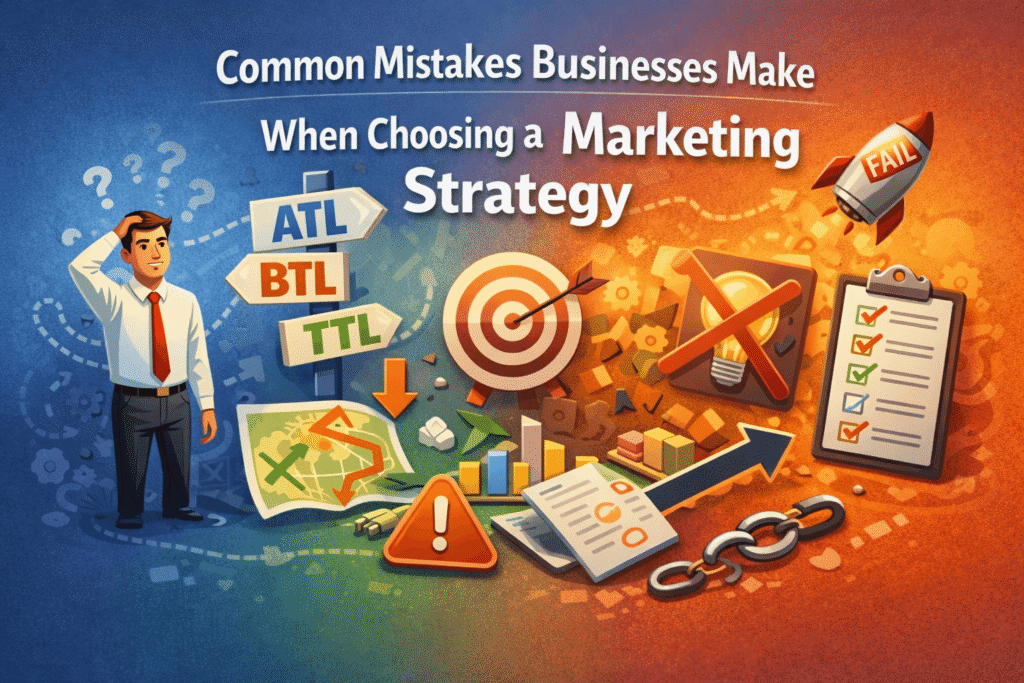
Choosing between ATL, BTL, and TTL marketing isn’t always straightforward. Many businesses — big and small — fall into the same traps when building their marketing strategy.
Here are some of the most common mistakes brands make — and why avoiding them can save both time and budget.
Blindly Copying Competitors
Just because a competitor is running Above The Line campaigns doesn’t mean you should follow the same path.
Every business has different goals, audiences, and budgets. A strategy that works for one brand may fail completely for another. Smart marketing decisions should always come from your own objectives, not from what others are doing.
Sticking to One Strategy Forever
Some businesses find a single approach — usually Below The Line marketing because it’s affordable — and never move beyond it.
But marketing strategies need to evolve as a brand grows. What works during the early stages may not be enough when the business starts expanding. Growth requires adapting your approach over time.
Ignoring the Customer Journey
A major mistake is focusing only on awareness or only on conversions.
Customers rarely purchase immediately after discovering a brand. They move through several stages — awareness, interest, consideration, and finally decision. Ignoring any part of this journey means losing potential customers along the way.
Treating ATL and BTL as Separate Silos
Many companies run ATL and BTL campaigns independently — handled by different teams, with different messaging and goals.
The result is a disconnected brand experience. Customers may see one message in an advertisement and a completely different one in a targeted campaign, which creates confusion rather than clarity.
Overspending on ATL Without BTL Follow-Up
Running a massive TV commercial or billboard campaign without a clear follow-up strategy is a common — and expensive — mistake.
ATL marketing builds awareness, but awareness alone doesn’t drive sales. Without BTL activities to engage and convert the audience, much of that marketing investment goes to waste.
Underestimating the Power of TTL Marketing
Some smaller businesses assume Through The Line marketing is only for large corporations with huge budgets.
But modern digital tools have made TTL strategies far more accessible. Even smaller brands can combine awareness campaigns with targeted follow-ups. Ignoring TTL marketing today means missing out on a powerful growth opportunity.
Not Measuring Results
This mistake is especially common in ATL marketing campaigns.
Many businesses run large-scale promotions without defining clear metrics for success. Without tracking results — impressions, engagement, leads, or conversions — it becomes impossible to know whether a campaign is actually working.
Choosing Strategies Based on Trends
Marketing trends change constantly. Influencer collaborations, OTT advertising, or viral social media campaigns may be popular — but popularity doesn’t automatically make them effective for your business.
The smartest strategy always begins with clear business goals, not with the latest trend.
Neglecting Brand Consistency
Whether a business runs ATL, BTL, or TTL campaigns, consistency matters.
Your message, tone, and brand identity should remain the same across all platforms. When messaging changes from one channel to another, it weakens brand recognition and reduces trust.
Waiting for the “Perfect” Budget
Some businesses delay marketing efforts because they believe they need a large budget to start.
The reality is that marketing strategies can grow gradually. Many successful brands begin with small BTL activities, learn from the results, and then expand into TTL campaigns over time.
Avoiding these mistakes won’t guarantee instant success. But it ensures that every marketing rupee you invest is used more effectively — helping your strategy grow stronger with every campaign.
How to Choose the Right Marketing Strategy for Your Business?
With so many options between ATL, BTL, and TTL marketing, choosing the right path can feel overwhelming. But it doesn’t have to be.
The best marketing strategy isn’t necessarily the most expensive one. It’s the one that aligns with your business goals, target audience, and available resources.
Here’s a simple step-by-step approach to help you decide.
Step 1: Define Your Goal
Start with one simple question — what do you want to achieve?
- Want more people to recognize your brand? → Think ATL marketing
- Want direct sales and quick conversions? → Think BTL marketing
- Want both awareness and conversions working together? → Think TTL marketing
Your goal acts as the compass. Once that’s clear, the rest of the strategy becomes easier to plan.
Step 2: Know Your Audience
Next, think about who you’re trying to reach.
If your product appeals to a broad audience, Above The Line marketing can help you reach large numbers quickly.
If you’re targeting a niche group or a specific demographic, Below The Line marketing allows you to communicate with them more directly.
And if your audience interacts with your brand across multiple platforms, Through The Line marketing becomes the most effective approach.
Step 3: Assess Your Budget
Be realistic about what you can afford.
- Limited budget: Start with BTL activities such as email marketing, social media campaigns, and direct outreach.
- Mid-range budget: Combine digital ATL visibility with targeted BTL engagement.
- Larger budget: Build a full TTL marketing strategy across several channels.
There’s no problem with starting small. What matters is starting strategically.
Step 4: Study Your Competition
Look at your competitors — not to copy them, but to understand the market.
- Are they heavily investing in ATL campaigns?
- Are they ignoring BTL engagement opportunities?
Observing their approach can help you identify gaps where your brand can stand out.
Step 5: Consider Your Business Stage
Your marketing strategy should reflect where your business currently stands.
- New brand: Focus on BTL marketing to build an initial customer base.
- Growing brand: Introduce ATL activities to increase visibility.
- Established brand: Expand into TTL marketing to dominate multiple channels.
Your strategy should match your current stage, not just your long-term ambitions.
Step 6: Pick Your Channels Wisely
Not every marketing channel works for every business. Choose platforms where your audience actually spends time.
For example, a B2B company might get better results from LinkedIn and email-based BTL campaigns than from TV advertising.
Meanwhile, a consumer brand targeting younger audiences might succeed with a TTL strategy combining social media ads, influencer marketing, and digital video campaigns.
The key is relevance — not simply visibility.
Step 7: Test, Measure, and Adapt
No marketing strategy is perfect from day one.
Start with a focused campaign, track the results, and refine your approach based on what works. BTL marketing often provides the clearest performance data, which can help you optimise messaging and targeting.
Once you understand what resonates with your audience, you can confidently expand into larger ATL or integrated TTL campaigns.
In the end, choosing the right marketing strategy isn’t a one-time decision. It’s an ongoing process of learning, testing, and evolving as your brand grows.
Start where you are. Use the resources you have. And build your marketing strategy step by step.
Conclusion
At the end of the day, the debate between Above The Line and Below The Line marketing isn’t really about which one is better. It’s about what your business actually needs right now.
If your goal is to build a massive, unforgettable brand, ATL marketing is your heavy hitter. It puts your message in front of large audiences and creates the kind of visibility that makes brands memorable.
If you need quick, measurable results, BTL marketing becomes your strongest ally. Targeted campaigns, personalised communication, and direct engagement help turn potential customers into real buyers.
But the real game changes when you stop choosing sides.
In modern marketing, the true winner is usually a combined approach. That’s where Through The Line marketing shines. By blending the reach of ATL with the precision of BTL, businesses can capture attention at scale and then guide those same audiences toward conversion.
The real secret isn’t just using these strategies — it’s understanding how they work together.
When businesses stop treating ATL and BTL as separate activities and start viewing them as parts of a single marketing system, the benefits become much clearer. Awareness campaigns bring people in, and targeted campaigns move them closer to purchase.
So whether you’re running a large TTL campaign or simply sending out a well-timed email, the principle remains the same:
Capture attention broadly — but always close the deal personally.
Before you leave, read this 👇
Frequently Asked Questions (FAQs)
Q1. Which marketing strategy is best for small businesses?
BTL marketing is generally the best starting point for small businesses. It’s cost-effective, highly targeted, and easy to measure — making every rupee count. Activities like email marketing, social media outreach, and local promotions allow small businesses to reach the right audience without needing a massive budget. As the business grows, it can gradually layer in ATL and eventually move toward a TTL marketing approach.
Q2. Is digital marketing ATL or BTL?
Honestly — it’s both. Digital marketing sits at the intersection of ATL and BTL marketing, which is what makes it so powerful. A YouTube ad reaching millions of people is an ATL activity. A personalised email campaign targeting specific customers is a BTL activity. When combined into one connected digital strategy, it becomes TTL marketing. Digital marketing essentially made Through The Line marketing the everyday standard for modern brands.
Q3. Which marketing strategy provides better ROI?
BTL marketing typically delivers the most measurable and immediate ROI — especially for businesses with a defined target audience. Since Below the Line activities are trackable and highly targeted, you can clearly see what’s working and optimise accordingly. However, for long-term brand growth, TTL marketing often produces the best overall return because it combines broad awareness with direct conversion — making every channel support the other.
Q4. Which industries benefit the most from ATL marketing?
Industries that sell to a broad, mass audience benefit the most from Above the Line marketing. These include:
- FMCG (Fast Moving Consumer Goods) — brands like Coca-Cola, Nestlé, and HUL rely heavily on ATL activities to stay top of mind
- Automotive — car brands use TV and billboard campaigns to build aspiration and awareness
- Retail and E-commerce — large platforms like Flipkart and Amazon use ATL marketing during major sale seasons
- Telecom — companies like Jio and Airtel use mass media to reach every corner of the country
- Entertainment and Media — movie releases and OTT platforms depend on ATL campaigns for wide visibility
Q5. Which industries benefit the most from BTL marketing?
Industries that thrive on personal relationships, repeat customers, and niche targeting get the most out of Below the Line marketing. These include:
- Healthcare and Pharma — targeted doctor outreach and patient communication programs
- Education — schools, colleges, and ed-tech platforms use direct mailers, counselling sessions, and personalised emails
- Real Estate — property brands use site visits, direct calling, and targeted digital ads to reach serious buyers
- Banking and Finance — personalised loan offers, credit card promotions, and direct outreach campaigns
- Hospitality and Travel — hotels and travel brands use loyalty programs and personalised offers to retain customers
Q6. Is TTL marketing suitable for startups?
Yes — but with the right approach. Many startups assume TTL marketing requires a massive budget, but that’s not always true. With affordable digital tools available today, a startup can run a small-scale Through The Line campaign by combining social media ads for awareness with personalised email sequences for conversion. The key is to start simple, stay consistent, and scale gradually. A startup doesn’t need to be everywhere at once — it just needs to show up consistently across the channels where its audience actually spends time.

Leave a Reply