 +91 73584 98220
 info@rankmedaddy.com
 Rajasthan, India

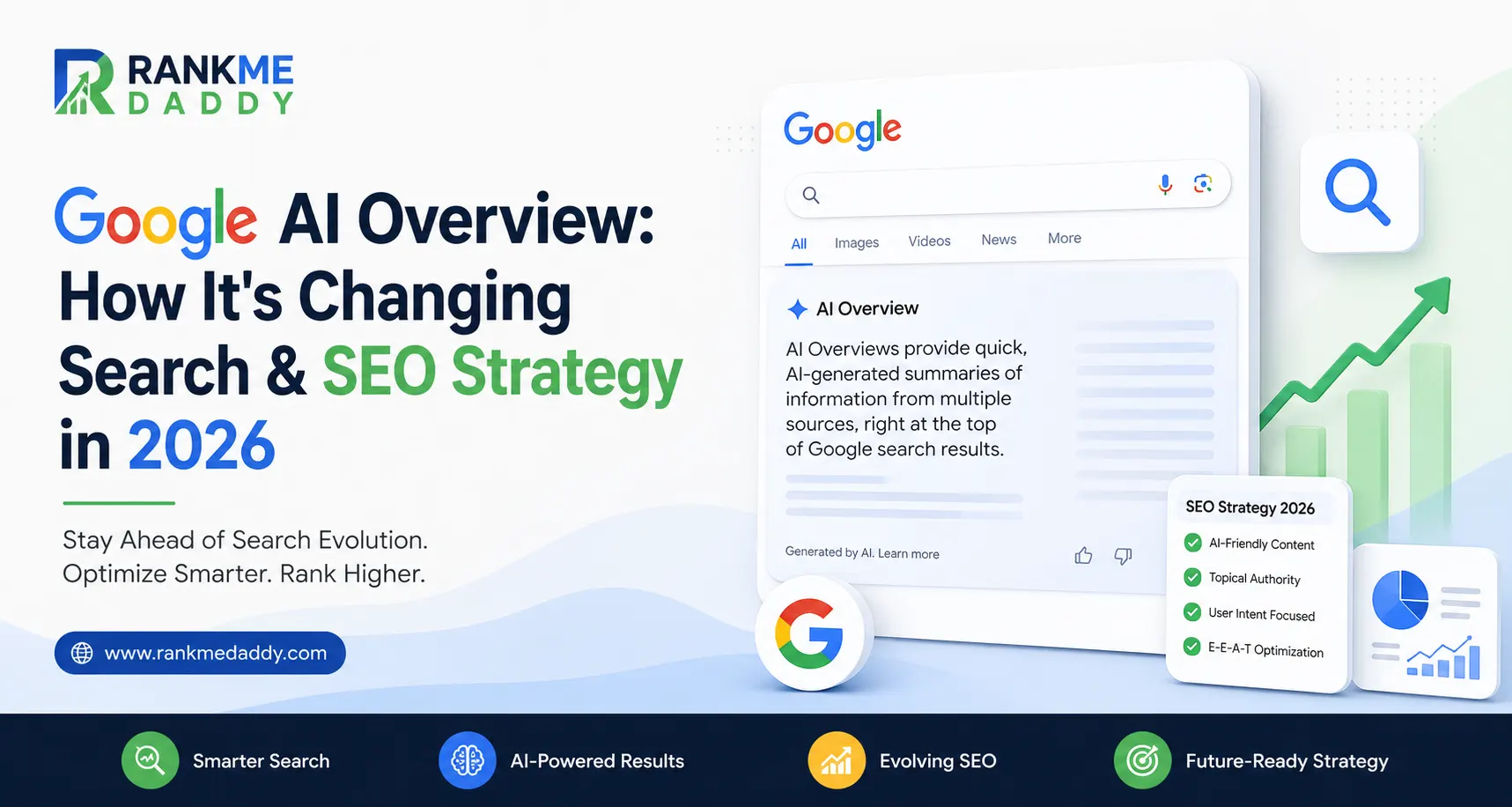
Introduction: The Search Engine You Knew Is Gone
You type a question into Google. Before you even see a single blue link, a wall of AI-generated text answers your query sourced from dozens of websites, synthesized into a tidy paragraph or two, and delivered with the confidence of an encyclopedia.
That’s Google AI Overview and if you’re running a business, managing a website, or working in digital marketing in the United States, this is the single biggest shift in search behavior since Google launched over 25 years ago.
According to data from BrightEdge, Google AI Overviews now appear in over 15% of all U.S. Google searches, with that number climbing steadily into 2026. For certain query categories health, finance, how-to, and product comparisons AI Overviews appear in nearly 50% of searches. If you’re an SEO professional or a business owner and you haven’t updated your strategy to account for this, you’re already losing ground to competitors who have.
This isn’t a doomsday article. AI Overviews are not the end of SEO but they are the end of old SEO. The rules have changed. The metrics have changed. The entire framework for how you earn visibility on Google has changed.
In this guide, we’re going to break down everything you need to know:
- What Google AI Overviews actually are and how they work
- How they’re impacting organic traffic, click-through rates, and rankings across U.S. industries
- Which types of content are most at risk and which are primed for opportunity
- A complete, updated SEO strategy framework designed for the AI Overview era
Let’s get into it.
What Is Google AI Overview? A Clear Breakdown?
The Evolution from SGE to AI Overview
Google first tested AI-powered search results under the name Search Generative Experience (SGE) in May 2023. It was available only through Google Search Labs an opt-in beta. By May 2024, during Google I/O, the company officially launched AI Overviews as a default feature for all U.S. users, making it one of the most significant changes to Google’s core product in its history.
Unlike SGE, AI Overviews are not optional. They appear automatically at the top of search results for qualifying queries, sitting above traditional organic rankings, featured snippets, and paid ads.
How AI Overviews Work Technically
Google’s AI Overview is powered by Gemini, Google’s proprietary large language model. When a user submits a search query, Gemini processes the intent of the question and generates a synthesized response by pulling information from multiple web sources. The AI model doesn’t just copy and paste it reads, interprets, and rewrites the content in its own words before presenting a summary.
Key technical characteristics:
- Source citations appear as small cards within or below the AI summary, linking to the original websites
- The AI Overview box occupies prime real estate at the very top of the SERP, pushing everything else down the page
- Google’s algorithm prioritizes sources that are authoritative, up-to-date, and structured clearly
- The system uses multimodal AI, meaning it can process and reference images, videos, and text simultaneously
What Query Types Trigger AI Overviews?
Not every search triggers an AI Overview. Google has been selective for now. Based on research by Semrush and Search Engine Land, here are the query categories most likely to trigger an AI Overview in the U.S.:
- Informational queries “How does compound interest work?” / “What causes migraines?”
- Comparison queries “iPhone 16 vs Samsung Galaxy S25”
- Health and medical questions “symptoms of high blood pressure”
- Financial and legal questions “how to file taxes as a freelancer”
- How-to and tutorial queries “how to fix a leaky faucet”
- Local service questions “how much does HVAC repair cost in Texas”
Transactional queries (like “buy running shoes”) and navigational queries (like “Facebook login”) are far less likely to trigger an AI Overview. This matters enormously for your SEO strategy, which we’ll cover in detail.
The Real Impact on Organic Search Traffic in the U.S.
Traffic Decline: What the Data Says
Let’s not sugarcoat it. For many websites especially those that built their traffic on informational content Google AI Overviews have caused measurable traffic drops.
Here’s what U.S. publishers are seeing:
- Authoritas tracked over 700,000 keywords and found that pages appearing in AI Overviews received up to 34.5% fewer clicks than the same pages received before AI Overviews were introduced
- Search Engine Roundtable reported that Google’s own internal data briefly leaked in a Wall Street Journal report acknowledged that AI Overviews reduce clicks on top search results by approximately 25–30% for informational queries
- Semrush’s 2024 State of Search Report found that click-through rates (CTRs) for position #1 results dropped from an average of 28.5% to 19.1% in categories where AI Overviews frequently appear
- HouseFresh, a U.S.-based home appliance review site, publicly reported a 91% drop in organic traffic after AI Overviews began dominating their search categories
not every site has suffered equally. Brands with strong domain authority, multimedia content, and E-E-A-T signals have held their ground and some have even gained visibility by appearing inside AI Overviews as cited sources.
The Zero-Click Search Explosion
Zero-click searches queries where users get their answer directly from Google without visiting any website were already a concern before AI Overviews. SparkToro’s research found that nearly 65% of Google searches in the U.S. ended without a click even in 2020. AI Overviews have accelerated this trend dramatically.
For SEO professionals, this reframes the entire purpose of ranking. If a user can read the answer directly in the AI Overview box, they may have no reason to visit your website. This creates a fundamental shift in how we measure the value of search visibility.
Which U.S. Industries Are Hardest Hit?
Based on data tracked across multiple industry verticals in the United States, these sectors are experiencing the greatest disruption from AI Overviews:
High Impact (Major Traffic Risk):
- Health and wellness blogs
- Financial planning and personal finance sites
- Legal information websites
- DIY and home improvement content
- Recipe and food blogs
- General news and media
Moderate Impact:
- Technology review sites
- Travel information and guides
- Education and eLearning platforms
- B2B SaaS knowledge bases
Lower Impact (Relative Opportunity):
- Local service businesses
- eCommerce product pages
- Event-based and time-sensitive content
- Personal brand and thought leadership content
- Niche community sites with unique data or research
Understanding the Opportunity Hidden Inside AI Overviews
Getting Cited in AI Overviews = Massive Brand Exposure
Here’s the flip side that many SEO pessimists are missing: being cited in an AI Overview is arguably more valuable than ranking #1 organically at least for brand awareness.
When Google’s AI Overview references your website, your brand name appears directly inside the most prominent content block on the entire SERP. Even if the user doesn’t click through, millions of users see your brand name associated with the answer to their question. This is an entirely new kind of search visibility one that traditional ranking metrics like position and CTR don’t fully capture.
BrightEdge’s research found that websites cited in AI Overviews saw a measurable lift in branded search volume meaning more users Googled the website name directly after seeing it in an AI Overview. This suggests that AI Overview citations are driving brand recall, even without a direct click.
The “Trusted Source” Halo Effect
When Google’s AI cites your content, it sends a powerful trust signal to users. You’re essentially being endorsed by the most trusted information source in America. For businesses in competitive markets attorneys, accountants, healthcare providers, contractors being a trusted AI citation source can directly drive leads.
New Opportunities for Visual and Video Content
Google’s AI Overviews are increasingly pulling in images, videos, and rich media to accompany text responses. YouTube videos which Google owns are frequently surfaced inside AI Overviews, creating a significant traffic opportunity for brands that invest in video content.
How Google Selects Sources for AI Overviews?
Understanding why Google chooses certain websites to cite in AI Overviews is the foundation of your new SEO strategy. It’s not random. It’s not just about links. It comes down to several interconnected quality signals.
1. E-E-A-T: Now More Critical Than Ever
E-E-A-T stands for Experience, Expertise, Authoritativeness, and Trustworthiness Google’s quality framework for evaluating content. In the AI Overview era, E-E-A-T isn’t just a ranking factor; it’s the primary filter Google uses to decide which sources are safe to quote in its AI-generated responses.
Experience:
Does the author have firsthand, real-world experience with the topic? Google now explicitly looks for content that reflects lived experience product reviews written by actual users, medical content written by practicing physicians, financial advice from licensed professionals.
Expertise:
Is the content created by someone with formal knowledge or skills in the subject area? Author credentials, professional bios, and citations to peer-reviewed research all reinforce expertise signals.
Authoritativeness:
Is your website recognized as a go-to source in your niche? This includes inbound links from other authoritative sites, media mentions, and consistent coverage of a specific topic area.
Trustworthiness:
Does your site have clear policies, transparent ownership, accurate contact information, and positive user signals? HTTPS, privacy policies, author pages, and low bounce rates all contribute to trust.
2. Content Clarity and Structure
AI models are trained to find clear, well-organized answers. Websites that use:
- Descriptive H2 and H3 headings that mirror natural question phrasing
- Short, declarative paragraphs that directly answer a single point
- Numbered lists and bullet points that break complex information into digestible parts
- Summary sections or TL;DR boxes that condense key points are significantly more likely to be pulled into AI Overviews.
3. Page Freshness and Update Frequency
AI Overviews prioritize recent, updated content. If you have a high-authority article from 2021 that hasn’t been touched since, it’s far less likely to be cited than a competitor’s recently updated version of the same topic. Content freshness signals including the date a page was last modified and how frequently it’s updated have become critical factors.
4. Schema Markup and Structured Data
Google’s AI systems love structured data. Websites using schema markup (particularly FAQ schema, HowTo schema, Article schema, and MedicalEntity schema for health content) give the AI clear, machine-readable signals about the nature of their content. This makes it much easier for Gemini to extract relevant information and cite the source accurately.
5. Topical Authority
Google increasingly rewards websites that demonstrate comprehensive, in-depth coverage of a specific topic clusterrather than broad, shallow content across many unrelated subjects. Building topical authority covering a subject area exhaustively through interconnected content is one of the strongest signals for AI Overview citation eligibility.
The New SEO Strategy Framework for 2026: Winning in the AI Overview Era
Alright now we get to the heart of it. Here is a comprehensive, actionable SEO strategy built specifically to help U.S. businesses and digital marketers thrive in a Google AI Overview-dominated search landscape.
Strategy #1: Audit Your Content for AI Overview Vulnerability
Before you build anything new, understand what you’re working with. Conduct an AI Overview vulnerability audit on your existing content:
Step 1:
Use tools like Semrush, Ahrefs, or BrightEdge to identify which of your top-performing pages rank for queries that frequently trigger AI Overviews.
Step 2:
Check Google Search Console to identify pages with declining impressions or CTR over the past 6–12 months. Cross-reference these with keywords known to trigger AI Overviews.
Step 3:
For each vulnerable page, assess: Is this purely informational content? If so, it’s at high risk of being cannibalized by AI Overviews. Plan to either upgrade the content to earn AI citations, or pivot the strategy toward transactional or community-driven formats.
Step 4:
Identify pages that are already appearing in AI Overview citations using Google Search Console’s new AI Overview filter (available in the Performance report). These pages are performing well double down on them.
Strategy #2: Create “Citation-Worthy” Content
The goal has shifted. You’re no longer just trying to rank in position #1. You’re trying to be cited by an AI. These are different goals with different content requirements.
Citation-worthy content characteristics:
Be the original source of data.
Conduct your own surveys, research studies, or data analysis. When you publish original statistics, other sites link to you and AI systems are trained to prefer primary sources over secondary aggregators. For U.S. audiences, original research about American consumer behavior, market trends, or regional data is especially valuable.
Write with absolute clarity.
Avoid jargon, filler sentences, and meandering introductions. Get to the point immediately. AI systems are extracting the clearest, most direct answer to a specific question write as if every paragraph needs to stand alone as an answer.
Use FAQ sections strategically.
Including a well-structured FAQ section at the end of your content with questions phrased exactly the way users search gives Google’s AI a structured, ready-made set of answers to pull. Combine this with FAQ schema markup for maximum effect.
Cover all angles of a topic.
AI Overviews synthesize from multiple sources. If your single piece of content covers a topic comprehensively enough that the AI can answer multiple related questions from just your article, it becomes a highly efficient source to cite.
Include expert quotes and attribution.
Content that features quotes from named experts with their credentials clearly stated signals both E-E-A-T and citability. For health or legal queries especially, Google’s AI heavily favors content sourced from credentialed professionals.
Strategy #3: Double Down on BOFU (Bottom-of-Funnel) Content
Bottom-of-funnel content content that targets users who are close to making a decision is significantly less likely to be overtaken by AI Overviews. This includes:
- Product comparison pages with in-depth, hands-on analysis
- Pricing pages with clear, current pricing information
- Case studies and real client results
- “Best [Product] for [Specific Use Case]” pages with genuine recommendations
- Local service pages with location-specific information
- Free tools, calculators, and templates that provide immediate utility
These content types serve user intent that AI Overviews can’t fully satisfy because they require specific, current, commercial, or interactive information that the AI either won’t generate or users need to verify directly.
A user Googling “best CRM software for small businesses in Texas” doesn’t just want a paragraph they want to compare options, see pricing, read reviews, and potentially contact a vendor. That full journey still goes through your website.
Strategy #4: Build Topical Authority Clusters
Random blog posts about disconnected topics are a dead strategy in 2026. Google’s AI systems reward topical depth and interconnection.
How to build topical authority?:
- Choose 3–5 core topic pillars that are directly relevant to your business and audience. For example, if you run a digital marketing agency in the U.S., your pillars might be: SEO, Content Marketing, Paid Advertising, Social Media, and Analytics.
- Create a comprehensive “pillar page” for each topic a long-form, definitive guide that covers the subject at a high level (think 3,000–5,000 words) with internal links to more specific subtopics.
- Build “cluster content” around each pillar individual articles that go deep on specific subtopics. For the SEO pillar, cluster content might include: “How to Do a Technical SEO Audit,” “Local SEO for U.S. Service Businesses,” “Google Core Update Recovery Guide,” etc.
- Interlink everything. Pillar pages link to cluster content; cluster content links back to the pillar page and cross-references related clusters. This signals to Google that your site is a comprehensive, expert resource on these topics.
- Update consistently. Add new cluster articles regularly and refresh existing content to maintain freshness signals.
Strategy #5: Optimize for “People Also Ask” and Related Questions
The People Also Ask (PAA) box remains one of the most powerful real estate opportunities in Google SERPs and there’s strong evidence that PAA questions heavily influence what AI Overviews cover.
PAA optimization tactics:
- Use tools like AlsoAsked, AnswerThePublic, or Semrush’s Topic Research to identify the full cluster of questions users ask around your target keywords.
- Create dedicated sections within your content or even standalone pages that directly answer PAA questions with concise, 50–100 word responses.
- Use question-phrased H2 and H3 headings (e.g., “What is Google AI Overview?” instead of “Google AI Overview Explanation”) to help Google’s AI identify your content as question-answering.
- Implement FAQ schema markup to formally signal to Google that your content is structured as a Q&A resource.
Strategy #6: Master Technical SEO for AI Readability
AI systems can only cite content they can efficiently read and process. Technical SEO often overlooked in favor of content strategy is more important than ever.
Technical priorities:
Core Web Vitals:
Google’s AI systems are trained on high-quality web pages. Pages with poor loading speed, layout instability, or poor interactivity are less likely to be crawled deeply and therefore less likely to be cited. Aim for a LCP under 2.5 seconds, CLS under 0.1, and INP under 200ms across all devices.
Mobile-First Indexing:
Over 63% of U.S. Google searches now happen on mobile devices. Your content must be fully readable, properly formatted, and lightning-fast on mobile. Google indexes the mobile version of your site first if it’s broken or slow on phones, your AI Overview eligibility suffers.
Schema Markup Implementation:
Beyond FAQ and HowTo, consider implementing:
- Article schema for blog posts and news content
- Product schema for eCommerce
- LocalBusiness schema for local SEO
- MedicalWebPage or Drug schema for health content
- Review and AggregateRating schema for review content
Proper Crawlability:
Make sure your key content pages are crawlable not blocked by robots.txt, not behind paywalls that prevent Google from indexing, and not trapped in JavaScript rendering issues that delay crawling.
Internal Linking Architecture:
A clean, logical internal link structure helps Google’s AI understand which pages on your site are most important and authoritative. Every important page should be reachable within 3 clicks from your homepage.
Strategy #7: Build and Leverage Brand Authority
In the AI Overview era, branded search volume and brand authority are emerging as key signals. Google’s AI is more likely to cite brands that users actively search for because high branded search volume signals real-world trust and recognition.
Brand-building tactics that support AI Overview performance:
PR and media outreach:
Getting mentioned in major U.S. publications (Forbes, TechCrunch, HuffPost, industry trade journals) creates powerful authority signals. These links and brand mentions tell Google’s AI that your brand is a recognized name in your space.
Podcast and interview appearances:
Being featured on popular U.S. podcasts as a subject matter expert builds E-E-A-T signals across media types.
Google Business Profile optimization:
For local businesses, a fully optimized Google Business Profile with regular posts, Q&A responses, and positive reviews directly impacts AI Overview eligibility for local queries.
Wikipedia mentions and citations:
Wikipedia is one of the most-cited sources in Google’s training data. Being referenced on Wikipedia either in your own entry or in relevant topic articles significantly boosts your perceived authority.
Community engagement:
Active participation in industry forums, Reddit communities (especially popular U.S. subreddits in your niche), and Quora builds brand visibility in platforms that Google’s AI actively indexes.
Strategy #8: Invest in Video and Multimedia Content
Google’s AI Overviews are increasingly incorporating video content, and YouTube owned by Google is a primary source. If your competitors are ranking with text-based answers and you can deliver the same information in a well-produced video, you have a genuine competitive advantage.
Video SEO for AI Overviews:
- Create videos that directly answer high-frequency questions in your niche. Title them with the exact question as the video title.
- Include a full transcript in the video description this gives Google text-based content to index.
- Add chapter markers (timestamps) to your videos, which Google uses to surface specific moments within AI Overviews.
- Embed videos within relevant blog posts to create multimedia content that satisfies both AI crawlers and human readers.
Strategy #9: Protect Traffic Through Diversification
One of the most dangerous mistakes U.S. businesses are making right now is remaining 100% dependent on Google organic traffic. AI Overviews have made it crystal clear that Google is building a product that keeps users on Google not on your website.
Traffic diversification strategy:
Email marketing:
Build and protect your email list aggressively. Email traffic is immune to Google algorithm changes. Offer high-value lead magnets (guides, tools, templates) to grow your list.
Social media presence:
LinkedIn for B2B, Instagram and Pinterest for lifestyle and eCommerce, TikTok and YouTube for video-driven audiences build owned audiences that don’t depend on Google.
Direct partnerships and referral traffic:
Strategic partnerships with complementary U.S. businesses, guest posting on authoritative sites, and affiliate relationships create traffic streams independent of Google.
Community building:
Forums, Slack groups, Discord servers, and membership communities create loyal, direct-access audiences that Google can’t disintermediate.
Paid advertising as a supplement:
Google Ads and Meta Ads can supplement organic loss in the short term while your AI-optimized content strategy builds long-term visibility.
Strategy #10: Track the Right Metrics Post-AI Overview
Your old KPIs may no longer tell the full story. Here’s how to update your measurement framework:
Old Metrics → New Context:
| Old Metric | New Reality | What to Track Instead |
| Organic Clicks | May decline even with good rankings | Branded search volume lift |
| CTR by Position | Position #1 CTR has dropped significantly | AI Overview citation appearances |
| Impressions | May increase while clicks fall | Impression-to-click ratio by query type |
| Bounce Rate | Users are more informed pre-click | Engagement Rate, Time on Page |
| Keyword Rankings | Position in SERP matters less if AI Overview dominates | Topical visibility score |
New Metrics to Add:
- AI Overview citation tracking (Google Search Console’s AI Overviews filter)
- Branded search volume trend (Google Search Console, Google Trends)
- Share of Voice across topics (Semrush, Ahrefs)
- Email list growth rate
- Direct traffic percentage
Local SEO and Google AI Overviews: A Special Focus for U.S. Businesses
Local businesses in the United States have a unique and relatively protected position when it comes to AI Overviews but they’re not immune.
How AI Overviews Affect Local Search?
For queries like “best plumber near me” or “emergency dentist in Chicago,” Google typically doesn’t generate an AI Overview instead, it surfaces the Local Pack (the map listing with three businesses). This is good news for small businesses.
AI Overviews do appear for local informational queries like “how much does a roof replacement cost in Florida” or “what questions should I ask when hiring a personal injury attorney.” If your service area business creates educational content around these questions, you can appear in AI Overviews that directly influence a user’s purchase decision before they even see the local pack.
Local SEO Optimization for AI Overview Era
Google Business Profile (GBP) is more important than ever. Make sure your GBP listing includes:
- Complete business information (hours, services, service areas)
- Updated photos (both interior, exterior, and work examples)
- Responses to every review especially negative ones
- Weekly Google Posts with useful content
- Q&A section populated with relevant questions and answers
Local schema markup on your website:
Implement LocalBusiness, Service, and GeoCoordinates schema to give Google precise, machine-readable information about your business and service area.
Location-specific content pages:
Create dedicated pages for each major city or region you serve. These should include locally relevant information neighborhood names, local statistics, regional pricing benchmarks not just generic content with a city name swapped in.
Review generation strategy:
Positive reviews especially those that mention specific services, locations, and outcomes are increasingly cited by Google’s AI when generating responses to local service queries. A consistent review generation strategy should be a core part of every U.S. local business’s SEO plan.
The Future of AI Overviews: What’s Coming Next
Google has made it clear that AI Overviews are not a feature they’re the future of search. Here’s what U.S. SEO professionals and business owners should expect:
Expansion to More Query Types
Currently, AI Overviews are most common for informational queries. Google is actively testing AI Overviews for commercial investigation queries the “best” and “top” searches that currently send enormous traffic to review sites, comparison platforms, and affiliate bloggers. If this expands fully, it will represent the largest single disruption to U.S. affiliate marketing and review content since Google’s Panda update.
AI Overview Ads Integration
In mid-2024, Google began testing ads within AI Overviews sponsored product listings that appear inside the AI-generated response. This is significant for two reasons: it confirms that Google is monetizing AI Overviews (meaning they’re here to stay), and it creates a new paid visibility opportunity that U.S. advertisers should begin testing now through Google Shopping and Performance Max campaigns.
Personalized AI Overviews
Google is actively developing personalized AI Overviews that adjust the generated content based on the user’s search history, location, device, and preferences. This means two users searching the same query may see different AI Overview responses which has profound implications for SEO, as “ranking” in an AI Overview may eventually depend on how well your content aligns with specific user personas.
Multimodal Search Integration
Google Lens, voice search, and multimodal search capabilities are being integrated with AI Overviews. As users increasingly search with images and voice rather than text, AI Overviews will become the primary interface for delivering answers making image SEO, alt text optimization, and voice search optimization critical components of a complete SEO strategy.
Common AI Overview SEO Mistakes U.S. Marketers Are Making Right Now
Before we wrap up, let’s call out the mistakes we’re seeing most frequently across U.S. digital marketing teams in response to AI Overviews:
Mistake #1: Panicking and abandoning SEO entirely.
SEO is not dead. Organic search still drives billions of visits and billions of dollars in commerce every day in the U.S. The strategy needs to evolve not be abandoned.
Mistake #2: Focusing only on avoiding AI Overviews instead of earning citations.
Some SEOs are trying to optimize their content to not trigger AI Overviews a fundamentally reactive strategy. The better play is to make your content so strong and authoritative that Google’s AI cites you as the source.
Mistake #3: Neglecting technical SEO in favor of content alone.
Content strategy alone won’t earn you AI Overview citations if Google can’t efficiently crawl, understand, and index your pages. Technical foundations matter more than ever.
Mistake #4: Chasing AI Overview citations for irrelevant queries.
Not every AI Overview citation opportunity is worth pursuing. Focus on queries where the users who see your brand are likely to be interested in your products or services. Citations for unrelated topics may boost impressions but will do nothing for business outcomes.
Mistake #5: Ignoring the shift to multi-touch attribution.
With more zero-click searches and AI Overview brand exposures happening before a user ever visits your site, traditional last-click attribution models are failing to capture the full value of SEO. Invest in better attribution modeling to understand the true impact of your organic search presence.
Quick-Reference Action Plan: 90-Day AI Overview SEO Sprint
Here’s a prioritized action plan for U.S. businesses to implement over the next 90 days:
Days 1–30: Audit and Foundation
- Conduct an AI Overview vulnerability audit of your top 50 pages
- Set up AI Overview tracking in Google Search Console
- Audit and update author bio pages with credentials and photos
- Implement missing schema markup (FAQ, Article, LocalBusiness)
- Review and improve Core Web Vitals scores
Days 31–60: Content Optimization
- Update your top 10 high-traffic pages with fresh data, expert quotes, and FAQ sections
- Identify 3 content gaps where you can create definitive, citation-worthy resources
- Build or rebuild your topical authority cluster structure
- Launch a systematic content refresh calendar for older posts
Days 61–90: Authority and Diversification
- Launch a PR outreach campaign targeting 5 U.S. media publications in your niche
- Set up an email list growth campaign with a high-value lead magnet
- Optimize your Google Business Profile (if local business)
- Begin producing 2 YouTube videos per month targeting high-frequency questions
- Establish a review generation process for your business
Final Thoughts: Adapt, Don’t Panic
Google AI Overviews represent the biggest change to search in a generation. The websites that will win in this new environment are not those that try to game the system with tricks or shortcuts they never were. The winners are the businesses and content creators who commit to being genuinely helpful, deeply authoritative, and technically excellent.
The search engine has gotten smarter. That’s actually good news if you’re doing SEO the right way because it means low-quality, thin content will be pushed further and further aside, and high-quality, trustworthy content will be rewarded more than ever.
At RankMeDaddy, we work with U.S. businesses every day to build SEO strategies that don’t just survive algorithm changes they thrive because of them. If you want a custom AI Overview optimization audit, a content strategy built for 2026, or hands-on support navigating the new search landscape, we’re here to help.
The rules changed. Your strategy should too.
Frequently Asked Questions About Google AI Overview and SEO
Q1: Will Google AI Overviews completely replace traditional search results?
A1: No. Traditional organic listings, local packs, news carousels, and image results still appear alongside AI Overviews. AI Overviews have taken the most prominent position at the top of the SERP, which reduces visibility for content below them.
Q2: How can I check if my website is being cited in Google AI Overviews?
A2: Google Search Console now includes an AI Overview filter in the Performance report. You can use this to see which queries are triggering AI Overviews and whether your pages are being cited. Additionally, manually searching for your target keywords and observing the SERP can give you real-time visibility.
Q3: Does appearing in an AI Overview mean I’m losing traffic?
A3: Not necessarily. If your content is cited in the AI Overview (your brand card appears as a source), you’re gaining brand visibility. If your content is being summarized without citation or your ranking is simply being pushed below the AI Overview, you may experience click loss.
Q4: Are Google Ads affected by AI Overviews?
A4: Currently, Google Ads and AI Overviews coexist on the SERP. In some cases, ads appear above the AI Overview; in other cases, they appear below it. Google has also begun testing sponsored product results inside AI Overviews, which represents a new paid opportunity.
Q5: How long does it take to start appearing in AI Overview citations?
A5: There’s no guaranteed timeline. Based on what we’ve observed for U.S. clients, websites that implement E-E-A-T improvements, structured content, and schema markup typically begin seeing AI Overview citation appearances within 60–120 days, though highly competitive topics can take longer.
Q6: Should small U.S. businesses be worried about AI Overviews?
A6: Small local businesses are somewhat more protected because most local intent queries don’t trigger AI Overviews they trigger the local map pack. However, small businesses with informational blogs or national-scope content should absolutely be updating their content strategy to account for AI Overview impacts.

Leave a Reply