 +91 73584 98220
 info@rankmedaddy.com
 Rajasthan, India

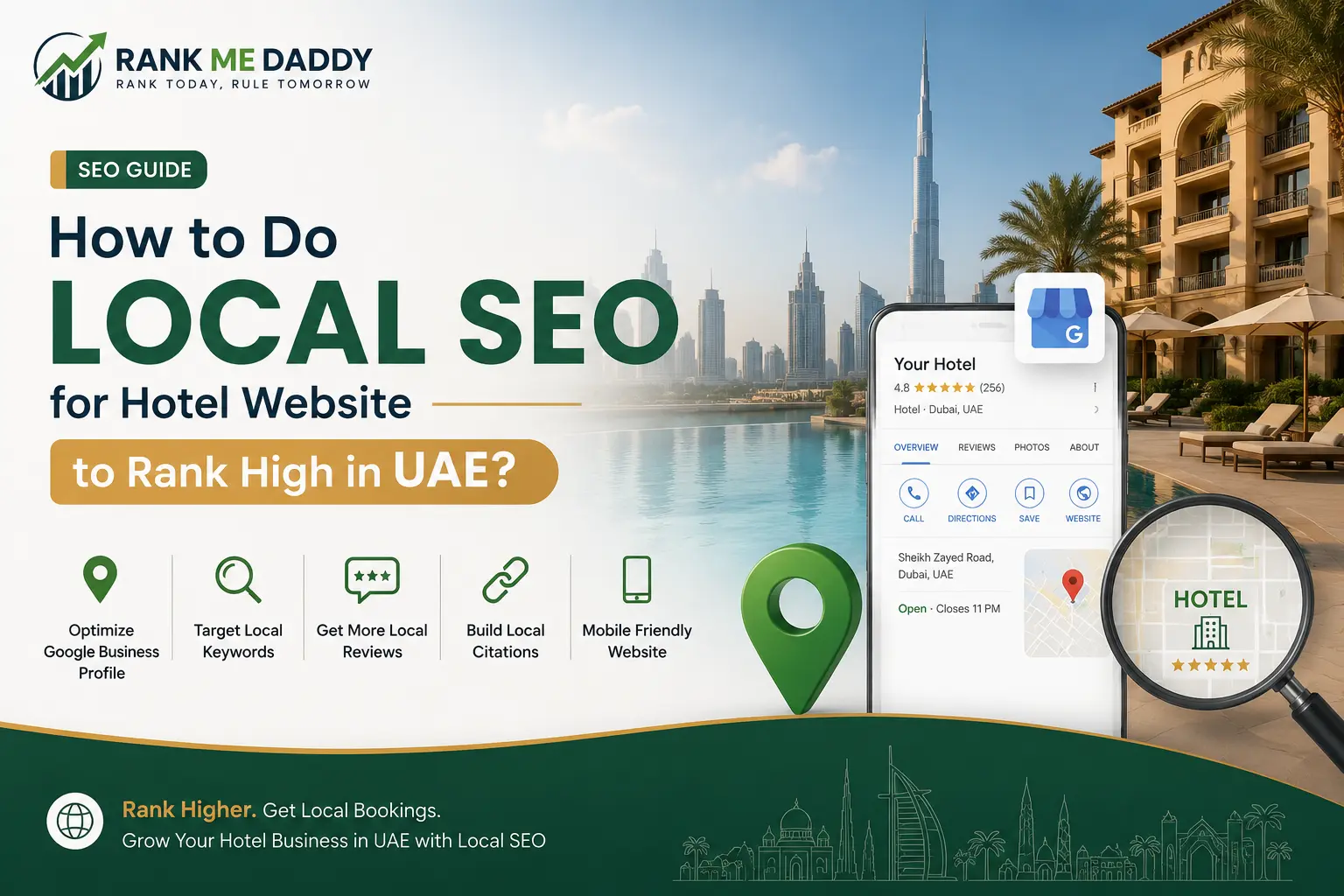
Introduction: Why Local SEO Is the Biggest Growth Lever for UAE Hotels Right Now
Dubai welcomed 19.59 million international overnight visitors in 2025 a 5% year-on-year increase, making it one of the world’s most visited cities for the third consecutive year. Average hotel occupancy reached 80.7%, and occupied room nights hit 44.85 million across 827 establishments. Abu Dhabi, Sharjah, Ras Al Khaimah, and Fujairah are all posting comparable growth numbers. The UAE hospitality market has never been more competitive or more lucrative.
Yet here is the paradox: most hotel websites in the UAE are practically invisible on Google. They pay enormous commissions to Booking.com, Expedia, and Agoda, losing 15–25% of revenue per booking, when with the right local SEO strategy, they could be generating direct bookings at zero commission cost.
This is not a theoretical guide. It is a practical, step-by-step roadmap built specifically for the UAE market covering everything from Google Business Profile optimisation for Dubai’s bilingual audience to Arabic schema markup, emirate-specific landing pages, and reputation management strategies that work in the Gulf. you run a boutique hotel in JBR, a business hotel in DIFC, a resort in Abu Dhabi, or a family property in Sharjah, this guide gives you a competitive edge backed by current data and real UAE search dynamics.
What you will learn:
- How Google’s local ranking algorithm works and what UAE hotels get wrong
- A complete Google Business Profile setup for the UAE market
- UAE-specific keyword research strategies (English + Arabic)
- On-page optimisation for hotel landing pages
- Technical SEO essentials for hotel websites
- Review management strategies tailored to UAE travellers
- Bilingual and multilingual content strategies
- Citation building and NAP consistency in UAE directories
- Local link-building tactics that work in the GCC
- Schema markup for hotel websites
- How to measure and track local SEO performance
Chapter 1: Understanding Local SEO for Hotels in the UAE Context
What Is Local SEO for Hotels?
Local SEO is the process of optimising a hotel’s online presence to appear prominently in location-based search results primarily Google Maps, Google’s local pack (the three-business box), and organic results for geo-targeted searches. When a traveller searches “hotel near Dubai Mall,” “best hotel in Abu Dhabi Corniche,” or “luxury resort Ras Al Khaimah,” local SEO determines whose property shows up first.
For hotels, local SEO directly impacts three key metrics: website traffic, direct booking conversions, and revenue per available room (RevPAR). The top organic result in Google captures an average click-through rate of 27.6%, while the local pack often takes 30–40% of all clicks for accommodation-related queries. This is prime digital real estate and it is free to earn through effective optimisation.
Why UAE Hotels Face Unique Local SEO Challenges?
The UAE is not a typical local SEO market. Several factors make it distinctly complex:
1. Bilingual Search Behaviour
UAE residents and visitors search in both English and Arabic. A guest from Saudi Arabia might search “فندق دبي مارينا” while a British expat searches “hotel Dubai Marina with pool.” Hotels that optimise for only one language immediately halve their potential visibility.
2. Hyper-competitive OTA Dominance
Booking.com, Expedia, Hotels.com, and TripAdvisor dominate the first page for almost every hotel keyword in the UAE. Competing against these platforms requires a smarter approach: targeting long-tail local keywords, building authoritative local backlinks, and earning a disproportionate volume of high-quality reviews.
3. Multi-Emirate Complexity
The UAE is seven emirates, each with distinct neighbourhoods, districts, and travel personas. A Dubai hotel that only optimises for “Dubai hotel” misses the granular, high-converting queries like “hotel near Dubai Frame,” “hotel Bur Dubai for families,” or “boutique hotel in Al Fahidi Historical District.”
4. High Mobile Search Penetration
The UAE has one of the world’s highest smartphone penetration rates. The majority of hotel searches happen on mobile, often with location services enabled. Google uses proximity as a key ranking signal, making mobile optimisation and local signal accuracy non-negotiable.
5. Rapid Tourism Growth
With nearly 71% of the UAE’s upcoming hotel projects through 2030 in the luxury or upscale category, competition for digital visibility will intensify significantly over the next three years. Hotels that invest in local SEO now build compounding advantages that are difficult to replicate quickly.
Chapter 2: How Google Ranks Hotels in Local Search — The UAE Edition
Google’s local ranking algorithm is built on three foundational pillars: Relevance, Distance, and Prominence. Understanding how these apply specifically to UAE hotel searches is critical.
Relevance
Relevance measures how well your Google Business Profile and website match what the searcher is looking for. A hotel that clearly communicates “luxury beachfront resort in Palm Jumeirah with private pool villas” is more relevant to a guest searching those terms than a profile that vaguely says “hotel in Dubai.”
To improve relevance:
- Your Google Business Profile primary category should be “Hotel” with appropriate subcategories such as “Resort Hotel,” “Boutique Hotel,” or “Business Hotel”
- Your profile description, posts, and Q&A sections should naturally include the specific experiences your hotel offers
- Your website content must align with and reinforce the terms used in your GBP
Distance
Distance is the physical proximity of your hotel to the searcher’s location at the time of the query, or to the location mentioned in the search query. You cannot change where your hotel is located. However, you can influence distance signals by:
- Ensuring your address is 100% accurate and consistent across all platforms
- Using geo-coordinates in your schema markup
- Building local citations that confirm your exact location
- Creating content that references nearby landmarks, metro stations, malls, and attractions the way guests actually describe location to each other
Prominence
Prominence is where most hotels have the greatest opportunity to improve their ranking. It reflects how well-known and authoritative your hotel is online. Google measures prominence through:
- The quantity and quality of Google reviews (and your response rate)
- Backlinks from other reputable websites
- Citation consistency across local directories
- Social media signals and content engagement
- Overall domain authority of your website
The key insight: a lesser-known boutique hotel with 400 positive reviews, consistent citations, and strong local backlinks will outrank a larger hotel with poor review management and inconsistent NAP data in many local search scenarios.
Chapter 3: Google Business Profile — Your Most Powerful Free Tool
Your Google Business Profile (GBP) is the single most impactful element of your local SEO strategy. It is your hotel’s digital storefront on Google Search and Google Maps, and it directly controls whether you appear in the coveted local pack.
Step 1: Claim and Verify Your Profile
Visit business.google.com and search for your hotel. If it already exists (Google often auto-creates listings), claim it and request verification. For hotels in the UAE, Google typically offers postcard verification by mail to your registered address, or phone/video verification in some cases.
If your hotel has multiple properties across different emirates, create a separate GBP for each physical location.
Step 2: Complete Every Section — No Exceptions
Incomplete profiles are one of the most common mistakes UAE hotels make. Google rewards completeness with higher visibility. Here is what must be filled in:
Business Name:
Use your official hotel name exactly as it appears on your signage and legal registration. Do not stuff keywords into the name (e.g., “Al Fajer Hotel — Best Dubai Marina Hotel Deal”) as this violates Google’s guidelines and can lead to suspension.
Category:
Select “Hotel” as your primary category. Add relevant secondary categories such as “Resort Hotel,” “Extended Stay Hotel,” “Boutique Hotel,” “Spa,” or “Restaurant” based on your facilities. Secondary categories expand the range of searches your profile can appear for.
Address:
Enter your full UAE address in the standard format. Include building name, street name, district, and emirate. Ensure this matches exactly what appears on your website’s contact page, your UAE trade licence, and every directory listing.
Phone Number:
Use your UAE local number (e.g., +971 4 XXX XXXX for Dubai) as the primary number. Do not use international tracking numbers as your primary contact.
Website:
Link to your official hotel website, not an OTA listing. If you have a direct booking page, link to it.
Business Hours:
Set accurate check-in and check-out information. Use the “special hours” feature for UAE public holidays including UAE National Day (December 2-3), Eid Al Fitr, Eid Al Adha, and Ramadan periods when some services may be adjusted.
Amenities and Attributes:
This is critically important. Tick every relevant attribute: Free Wi-Fi, Pool, Spa, Restaurant, Bar, Parking, Pet-friendly, Family Rooms, Airport Shuttle, Wheelchair Accessible, Air Conditioning, and so forth. These attributes appear in search results and filter options that travellers use on Google Hotel Search.
Description:
Write a compelling 750-character description. Open with your most important local keyword, describe your unique value proposition, mention key landmarks near your hotel, and include a clear call to action. Example:
“A luxury boutique hotel in Dubai Marina offering panoramic sea views, an infinity pool, and world-class dining. Steps from the Marina Walk and JBR Beach, [Hotel Name] combines contemporary design with authentic Arabian hospitality. Book direct for best rate guarantee and exclusive amenity upgrades.”
Step 3: Upload High-Quality Photos — Consistently
Photos are one of the highest-engagement features of any GBP. Hotels with more photos receive significantly more direction requests and website clicks. For UAE hotels specifically:
- Upload at least 50 high-resolution photos at the start
- Add new photos weekly to signal an active, relevant profile
- Include: exterior, lobby, rooms (each category), pool, restaurants, spa, rooftop views, nearby landmarks, and lifestyle shots
- Use photos that showcase experiences UAE and international guests value: Ramadan iftar settings, New Year’s fireworks views from your property, beach access shots during winter months (November–March peak season)
- Add a virtual tour if your hotel has it Google supports 360° imagery
Step 4: Leverage Google Posts
Google Posts allow you to publish updates, offers, and events directly on your profile. They appear prominently in your GBP card and can drive direct clicks to your booking engine. UAE hotels should post:
- Seasonal offers: Dubai Shopping Festival packages, Eid staycation deals, National Day promotions
- Events: Live entertainment nights, Ramadan iftar buffets, weekend brunch specials
- New amenities: Pool renovations, new restaurant menus, spa treatment launches
- Travel tips: “Best time to visit Dubai in 2026,” “What to do near our hotel during UAE Golden Week”
Post at least once a week. Use bilingual content where possible Arabic and English captions perform strongly for UAE-resident audiences.
Step 5: Google Q&A — Own the Conversation
The Q&A section of your GBP is publicly visible and often neglected. Pre-populate it with 10–15 frequently asked questions that your front desk team actually receives:
- “Do you offer airport transfers from DXB/DWC?”
- “Is the hotel Halal-certified?”
- “Do you have parking facilities?”
- “Is there a rooftop pool?”
- “What is the best metro station to reach the hotel?”
Answer these questions yourself, using natural language that includes relevant local keywords. This content appears in searches and can directly answer voice search queries.
Chapter 4: UAE-Specific Keyword Research for Hotel Websites
Keyword research for UAE hotel SEO must account for the bilingual nature of the market, the district/neighbourhood specificity that travellers use, and the intent behind different search queries.
Keyword Intent Categories
Informational intent (early research phase):
- “What is the best area to stay in Dubai for families”
- “Dubai Marina vs Downtown Dubai for hotels”
- “When is the best time to visit Abu Dhabi”
Navigational intent (looking for a specific hotel):
- “[Your Hotel Name] Dubai”
- “[Your Hotel Name] contact number”
- “[Your Hotel Name] reviews”
Transactional intent (ready to book):
- “hotel Dubai Marina book direct”
- “luxury hotel Abu Dhabi best rate”
- “hotel near Burj Khalifa with pool”
Your local SEO keyword strategy should prioritise transactional and navigational intent, while informational content builds topical authority and captures early-stage travellers.
High-Value Local Keyword Patterns for UAE Hotels
Use these templates to generate your target keyword list:
-
[Hotel type] in [District/Neighbourhood], [Emirate]
- “boutique hotel in Al Fahidi Dubai”
- “business hotel in DIFC”
- “family resort in Yas Island Abu Dhabi”
-
Hotel near [Landmark]
- “hotel near Dubai Mall”
- “hotel near Burj Al Arab”
- “hotel near Dubai International Airport”
- “hotel near Abu Dhabi Grand Mosque”
-
[Amenity] hotel [Location]
- “hotel with private beach Dubai”
- “hotel with rooftop pool Dubai Marina”
- “halal hotel Abu Dhabi”
- “pet-friendly hotel Dubai”
-
[Nationality/Market]-targeted searches:
- “Indian wedding venue hotel Dubai”
- “hotel packages Dubai National Day”
- “Ramadan staycation deals Dubai 2026”
Arabic Keyword Research — Non-Negotiable for UAE Rankings
Arabic is the UAE’s official language, and a significant portion of hotel searches particularly from UAE nationals, GCC visitors (Saudis, Kuwaitis, Bahrainis), and Arabic-speaking expats are conducted in Arabic. Key Arabic hotel search patterns include:
- فنادق دبي (Dubai hotels)
- فندق في دبي مارينا (hotel in Dubai Marina)
- أفضل فنادق أبوظبي (best Abu Dhabi hotels)
- فندق عائلي في دبي (family hotel in Dubai)
- فنادق بجانب برج خليفة (hotels near Burj Khalifa)
Arabic keywords are not direct translations of English keywords they represent distinct search intent patterns shaped by cultural context. Partner with a native Arabic SEO specialist to build a proper Arabic keyword map for your hotel.
Tools for UAE Hotel Keyword Research
- Google Keyword Planner with geo-targeting set to UAE (adjust to individual emirates for granular data)
- Google Search Console — look for what queries already bring impressions to your site
- Ahrefs or SEMrush — competitor keyword gap analysis against top-ranking hotels
- Google Autocomplete — type “hotel in [neighbourhood]” and capture autocomplete suggestions, which reflect real search volume
- Google’s “People Also Ask” boxes — these reveal the specific questions UAE travellers ask, which are ideal for FAQ content
Chapter 5: On-Page SEO for Hotel Website Pages
Ranking locally requires both strong off-page signals (GBP, reviews, citations) and well-optimised on-page content. Here is how to optimise the most critical pages of your hotel website.
Homepage Optimisation
Your homepage title tag should follow this structure: [Hotel Name] | [Hotel Type] in [District], [Emirate] | Official Website
Example: Al Bahar Boutique Hotel | Luxury Hotel in Dubai Marina | Official Website
Meta description (155 characters): Lead with a compelling benefit, include your primary local keyword, and include a call to action such as “Book direct for best rates and exclusive perks.”
H1 heading: Make it clear and keyword-rich. “Luxury Boutique Hotel in Dubai Marina Official Site” outperforms a purely brand-focused H1 like “Welcome to Al Bahar Hotel.”
Above the fold content: Include your hotel name, location (with a neighbourhood and emirate reference), a high-quality hero image, and a direct booking button or rate comparison widget.
Body content: The homepage should include at least 300–500 words of meaningful content covering: your hotel’s unique positioning, key amenities, location advantages (proximity to landmarks), types of guests you serve, and trust signals (awards, accreditations, review scores).
Location Landing Pages — Critical for UAE Multi-Neighbourhood Hotels
For hotels in districts with multiple distinct draws like a Dubai property that could serve both business guests visiting DIFC and leisure guests going to Jumeirah Beach create separate service area or neighbourhood pages:
- yourhotel.com/hotels-near-dubai-mall
- yourhotel.com/business-hotel-difc
- yourhotel.com/family-hotel-dubai
Each page should:
- Have a unique title tag with the specific neighbourhood/purpose keyword
- Include 600–1,000 words of genuinely useful content specific to that audience segment
- Embed a Google Map showing your hotel’s proximity to the relevant landmark
- Include local transport instructions (Metro line, RTA bus routes, taxi/Uber access)
- Feature testimonials or reviews from guests who fit that audience persona
- Have a clear direct booking CTA with the specific offer relevant to that audience
Rooms and Suites Pages
Each room category (Deluxe Room, Executive Suite, Family Room, Presidential Suite) should have its own dedicated page not just a tab on a single rooms page. This gives Google more indexable content and allows you to rank for room-specific searches like “family room hotel Dubai with 2 bedrooms” or “executive suite DIFC hotel with office space.”
Room page on-page checklist:
- Unique title tag including room type and location
- 300+ words of descriptive content
- High-quality images with descriptive alt text (e.g., “Deluxe Sea View Room at [Hotel Name] Dubai Marina”)
- Amenities list with schema markup
- Price range or “from AED XXXX/night” to capture intent-rich queries
- Direct booking button
Facilities and Dining Pages
If your hotel has a spa, restaurant, rooftop bar, or event venue, treat each as a standalone page with its own local SEO value. A hotel restaurant that ranks for “best brunch Dubai Marina” or “Ramadan iftar buffet Dubai” can drive significant foot traffic and restaurant bookings that improve overall brand awareness and review volume.
Chapter 6: Technical SEO for Hotel Websites in the UAE
Technical SEO refers to the backend factors that affect how Google crawls, indexes, and ranks your website. UAE hotel websites frequently suffer from technical issues that silently suppress rankings.
Mobile-First Optimisation
The UAE has exceptionally high mobile internet usage. Google uses mobile-first indexing, meaning it primarily evaluates your mobile site to determine rankings. Your hotel website must:
- Load in under 3 seconds on a 4G connection (use Google PageSpeed Insights to test)
- Use responsive design that adapts seamlessly to all screen sizes
- Have tap-friendly buttons (minimum 44x44px) for booking and contact
- Feature a Click-to-Call button for your phone number
- Include a WhatsApp chat button, WhatsApp is the dominant messaging platform in the UAE and a significant driver of direct bookings from Gulf-region guests
Core Web Vitals
Google’s Core Web Vitals (Largest Contentful Paint, First Input Delay, and Cumulative Layout Shift) are confirmed ranking factors. Hotel websites with large image-heavy galleries frequently fail these metrics. Optimise images using WebP format, implement lazy loading, and use a Content Delivery Network (CDN) with UAE-region servers.
HTTPS Security
Your hotel website must use HTTPS. This is a baseline Google requirement and a trust signal for guests who will enter payment information on your site. If your site still runs on HTTP, fix this immediately.
Structured Data (Schema Markup) for Hotel Websites
Schema markup is code added to your website that tells Google exactly what type of business you are, what you offer, and key details about your property. For hotel websites in the UAE, implement the following schema types:
Hotel Schema:
The primary Hotel schema type from schema.org includes:
- name — official hotel name
- address — full UAE address in PostalAddress format
- geo — latitude and longitude coordinates
- telephone — UAE local number
- priceRange — e.g., “AED 500 – AED 5,000”
- starRating — official star classification
- amenityFeature — pool, spa, restaurant, free Wi-Fi, parking, etc.
- checkinTime and checkoutTime
- url — official website
- image — hotel photo URLs
Review Schema:
Aggregate review ratings from your own review collection system can be displayed as rich snippets in Google search results, showing your star rating directly in the SERP. This significantly increases click-through rates.
FAQ Schema:
Add FAQ schema to your pages where you answer common questions. These can appear as expanded dropdown answers in Google search results, effectively doubling your SERP real estate.
BreadcrumbList Schema:
Helps Google understand your site’s structure and can display breadcrumb paths in search results.
For bilingual UAE hotel websites, implement schema in both languages or use inLanguage properties to ensure both Arabic and English versions are correctly interpreted.
XML Sitemap and Robots.txt
Submit a clean XML sitemap through Google Search Console that includes all your hotel’s core pages. Ensure your robots.txt file does not accidentally block important pages from being crawled this is a surprisingly common issue on hotel websites built with booking engine integrations.
Hreflang Tags for Bilingual Websites
If your hotel website has separate Arabic and English versions (which is highly recommended for UAE rankings), implement hreflang tags to tell Google which language version to serve to which searcher. Incorrect or missing hreflang tags cause Google to treat your Arabic and English pages as duplicate content which actively harms rankings.
Chapter 7: Review Management — The UAE Hospitality Game-Changer
Reviews are the single most influential local SEO signal for hotels. In the UAE market specifically, reviews carry outsized weight because:
- UAE residents and Gulf visitors rely heavily on peer reviews before making accommodation decisions
- Google Maps reviews directly impact map pack ranking and visibility
- A high volume of recent, detailed, positive reviews signals to Google that your hotel is active, popular, and trustworthy
Building a Review Generation System
During the stay:
Train your front desk and guest relations team to mention Google reviews naturally. Place tent cards in rooms with a QR code linking directly to your Google review page.
At checkout:
Include a review request in checkout communications. A simple “We hope your stay was wonderful. Your review on Google helps other travellers discover us and means the world to our team” is effective.
Post-stay email:
Send an automated email 24-48 hours after checkout with a personal thank-you message and a direct link to your Google review profile.
WhatsApp follow-up:
For Gulf region guests (Saudis, Emiratis, Kuwaitis) who prefer WhatsApp, a brief WhatsApp message from the guest relations team requesting a review often generates a significantly higher response rate than email.
Responding to Reviews — The SEO Multiplier
Responding to reviews is not just good hospitality it is an active SEO signal. Hotels that consistently respond to reviews rank higher in local pack results. Follow these principles:
- Respond to every review positive and negative within 24-48 hours
- In positive responses, naturally incorporate your hotel name, location, and a relevant keyword (e.g., “Thank you for choosing [Hotel Name] for your stay in Dubai Marina”)
- In negative responses, acknowledge the concern, apologise without admitting fault where appropriate, and offer a resolution path. Never argue publicly.
- Respond in the same language the reviewer used Arabic reviews should receive Arabic responses
Diversifying Your Review Portfolio
Beyond Google, UAE hotel reviews on these platforms directly influence search visibility and traveller trust:
- TripAdvisor — still the dominant travel review platform globally
- Booking.com — high review scores improve your placement within the OTA itself
- Google Maps — primary for local SEO impact
- Facebook — important for Arab-speaking audiences and UAE residents
- Zomato — if your hotel restaurant attracts external diners
- Holidayme and Rehlat — Gulf-region specific booking platforms with growing review influence
Chapter 8: Citation Building for UAE Hotels — NAP Consistency Is Law
A citation is any online mention of your hotel’s Name, Address, and Phone number (NAP). Consistent citations across the web tell Google that your business is legitimate, accurately located, and trustworthy. Inconsistent NAP data even minor discrepancies like “Dubai Marina” vs. “Marina, Dubai” confuse search engines and suppress local rankings.
UAE-Specific Directories to List Your Hotel
Beyond the global standards (Google, Bing Places, Facebook, TripAdvisor), UAE hotels should build citations on:
- Dubai Department of Economy and Tourism (DET) listings
- Abu Dhabi Department of Culture and Tourism directory
- Yas Island / Visit Abu Dhabi tourism portals
- Dubai Tourism (visitdubai.com)
- Dubizzle Business Directory
- Yellowpages UAE (yellowpages.ae)
- UAE Business Directory (uaebizdir.com)
- Zomato UAE (for restaurant listings)
- HolidayMe
- Rehlat
- Wego
- Gulf News and Khaleej Times Business Listings
- Time Out Dubai and Time Out Abu Dhabi
NAP Consistency Audit Process
Before building new citations, audit your existing ones. Search Google for “[Your Hotel Name]” “Dubai” and review every result. Check for:
- Name variations (abbreviations, missing “Hotel” suffix)
- Old phone numbers
- Previous addresses (especially if you renovated or changed offices)
- Incorrect website URLs
Use tools like Moz Local, BrightLocal, or Whitespark to automate the audit and monitor ongoing consistency.
Chapter 9: Local Link Building for UAE Hotel Websites
Backlinks from authoritative websites remain one of Google’s strongest ranking signals. For local SEO, links from locally relevant websites carry extra weight. Here is how UAE hotels can earn high-quality local backlinks:
Tourism Board Partnerships
Register your hotel with the official tourism boards of the emirate you operate in:
- Dubai Department of Economy and Tourism
- Abu Dhabi Department of Culture and Tourism
- Sharjah Commerce and Tourism Development Authority (SCTDA)
- Ras Al Khaimah Tourism Development Authority
These registrations typically result in a backlink from a government tourism website one of the highest-authority local links you can earn.
Travel Blog and Influencer Outreach
The UAE has a thriving travel blogging and influencer ecosystem. Identify bloggers and content creators who regularly publish about UAE travel, Dubai tourism, or GCC hospitality. Offer complimentary stays in exchange for honest reviews with backlinks to your website. Target:
- UAE-based travel blogs with genuine readership and domain authority
- GCC travel influencers (particularly Saudi, Kuwaiti, and Emirati creators who drive significant Gulf booking traffic)
- Indian travel bloggers (India is consistently one of Dubai’s top visitor source markets)
- UK and European travel bloggers (Western Europe is the UAE’s largest international visitor segment)
Local Business Partnerships
Partner with complementary local businesses desert safari operators, dhow cruise companies, private yacht charters, luxury car rental agencies, spa brands, and restaurant groups and agree to mutually reference each other on your respective websites. These local relevance links are valuable and natural.
Event Sponsorship Coverage
Sponsor local UAE events charity galas, business summits, cultural festivals and earn backlinks from the event website, press coverage, and corporate partner pages. GITEX, Abu Dhabi Art, and UAE National Day events frequently generate significant media coverage.
PR and Media Outreach
Pitch story angles to UAE-based online media Gulf News, Khaleej Times, The National, Arabian Business, and Time Out UAE. Story angles that work well:
- “New suite category launch at [Hotel Name]”
- “[Hotel Name] wins [Award] for UAE hospitality excellence”
- “How [Hotel Name] is adapting for the sustainability-conscious traveller”
- “Ramadan iftar experience guide: [Hotel Name]’s exclusive menu”
Each media pickup is a high-authority backlink from a UAE news domain.
Chapter 10: Bilingual and Multilingual Content Strategy for UAE Hotel SEO
The UAE’s tourism market is one of the world’s most diverse. Creating content in multiple languages is not optional for hotels that want maximum local search visibility.
English + Arabic — The Foundation
Every core page of your hotel website should exist in both English and Arabic. This includes:
- Homepage
- Rooms and suites pages
- Facilities pages (pool, spa, dining)
- Location and contact page
- Booking terms and policies
Arabic content must be professionally translated and culturally adapted not machine-translated. Google detects low-quality machine translation and it can hurt rather than help rankings. Work with native Arabic copywriters who understand both SEO and hospitality vocabulary.
Implement the hreflang=”ar” and hreflang=”en” tags across both versions to tell Google which version to serve to which searcher.
Additional High-Value Languages for UAE Hotels
Based on UAE’s visitor source markets, consider:
- Russian — Russia is consistently in the top five source markets for Dubai hotel bookings. A Russian-language landing page targeting search queries from Russian travellers can capture significant, low-competition booking traffic.
- Hindi/Urdu — India is Dubai’s top source market by volume. Indian travellers increasingly research and book in their native language.
- Chinese (Simplified) — Chinese visitor numbers to the UAE grew significantly post-pandemic and continue to expand.
- German and French — Western European audiences from Germany, France, and the UK form a major leisure travel segment.
Creating Content for Cultural Occasions
UAE hotel SEO is strongly influenced by the Islamic calendar and UAE national occasions. Build a content calendar around:
- Ramadan: Iftar packages, suhoor experiences, family-friendly Ramadan programmes. Searches for “Ramadan iftar Dubai hotel 2026” spike enormously in the weeks before the holy month.
- Eid Al Fitr and Eid Al Adha: Staycation packages, family celebration offers, Eid travel deals from GCC.
- UAE National Day (December 2-3): Patriotic content, fireworks viewing experiences from hotel rooftops, special packages.
- Dubai Shopping Festival (January-February): Shopping-focused hotel packages, proximity to key retail districts.
- Abu Dhabi Grand Prix (November): F1 weekend packages, proximity to Yas Marina Circuit.
Chapter 11: Content Marketing for Hotel Local SEO
Beyond your core hotel pages, a strategic blog and content programme builds topical authority, attracts early-stage travellers, and generates natural backlinks. Here are the highest-impact content types for UAE hotel websites:
Destination and Neighbourhood Guides
Create comprehensive guides to your hotel’s surrounding area:
- “Complete Guide to Dubai Marina: What to Do, Where to Eat, How to Get Around”
- “24 Hours in Bur Dubai: A Local’s Guide for Hotel Guests”
- “Top 10 Things to Do Near [Hotel Name] in Abu Dhabi Corniche”
These guides attract informational searches from travellers in the planning phase, introduce them to your hotel, and accumulate backlinks from travel resource aggregators.
Seasonal Travel Content
- “Dubai in December: Weather, Events, and the Best Hotel Deals”
- “Is Ramadan a Good Time to Visit Dubai? What Every Guest Should Know”
- “UAE National Day 2026: Celebrations, Fireworks, and Where to Watch”
“Best Hotels” List Content
Create roundup content that includes your hotel in curated lists:
- “Best Family Hotels in Dubai with Kids’ Clubs in 2026”
- “Top 5 Boutique Hotels in Old Dubai You Need to Know”
These pages can rank for high-volume comparative queries and drive direct discovery.
FAQ Content
Answer the questions UAE hotel guests actually ask. Pull these from your front desk records, Google’s “People Also Ask” results, and TripAdvisor Q&A sections:
- “Is it safe to walk around Dubai at night?”
- “Do Dubai hotels serve alcohol? What are the rules?”
- “What is the tipping etiquette for hotel staff in the UAE?”
- “Can I book a hotel room in Dubai without a marriage certificate?”
FAQ content earns featured snippet positions and FAQ rich results in Google significant visibility real estate that competitors frequently overlook.
Chapter 12: Measuring Local SEO Performance for UAE Hotels
You cannot improve what you do not measure. Track these metrics monthly to evaluate the ROI of your local SEO investment:
Google Business Profile Insights
- Views: How many times your profile appeared in search and maps
- Actions: Calls, website clicks, direction requests, booking button clicks
- Photo views vs. competitor average
- Search queries that triggered your GBP (reveals new keyword opportunities)
Google Search Console
- Clicks and impressions by keyword track progress for your target UAE hotel keywords
- Average position for key pages (homepage, room pages, location pages)
- Click-through rate (CTR) a low CTR despite good rankings signals that title tags and meta descriptions need optimisation
Google Analytics 4
- Organic traffic by channel specifically local/organic vs. OTA referral vs. direct
- Conversions track booking engine starts, booking completions, phone call clicks, and contact form submissions as goals
- Top landing pages which pages bring in the most organic traffic?
Review Metrics
- Total review count (Google, TripAdvisor, Booking.com)
- Average rating across platforms
- Review velocity (how many new reviews per month)
- Response rate and response time
Booking Attribution
The ultimate metric: what percentage of bookings are coming through direct booking (your website) vs. OTA channels? A successful local SEO programme should show a steady upward trend in the direct booking share over a 6–12 month period, reducing your commission costs and improving profitability.
Chapter 13: UAE Hotel Local SEO Checklist — Your Action Plan
Use this checklist to audit and prioritise your local SEO work:
Google Business Profile
- [ ] Profile claimed and verified with accurate UAE address
- [ ] All categories correctly selected (primary + secondary)
- [ ] Full description written with primary keywords (English and Arabic)
- [ ] 50+ high-quality photos uploaded
- [ ] Special hours set for UAE public holidays and Ramadan
- [ ] All amenity attributes selected
- [ ] Direct booking link added
- [ ] Q&A section pre-populated with 10+ relevant answers
- [ ] Google Posts published weekly
- [ ] WhatsApp messaging enabled (where available)
On-Page SEO
- [ ] Homepage title tag with hotel type, district, and emirate
- [ ] Unique meta descriptions for all core pages (150-155 characters)
- [ ] H1 headings with local keywords on all key pages
- [ ] Location pages created for key neighbourhood/audience segments
- [ ] Individual room category pages with unique content
- [ ] Restaurant and facilities pages with local SEO optimisation
- [ ] Arabic language versions of all core pages
Technical SEO
- [ ] Mobile-friendly and passes Google Core Web Vitals
- [ ] HTTPS enabled
- [ ] Hotel schema markup implemented with geo-coordinates
- [ ] FAQ schema on relevant pages
- [ ] Hreflang tags correctly implemented for Arabic/English versions
- [ ] XML sitemap submitted to Google Search Console
- [ ] Robots.txt reviewed and cleaned
- [ ] Page speed optimised (target under 3 seconds on mobile)
- [ ] Click-to-call and WhatsApp button on all mobile pages
Reviews
- [ ] Review generation system in place (email, WhatsApp, in-person)
- [ ] Response protocol for positive and negative reviews established
- [ ] Listed on TripAdvisor, Booking.com, Google, and Facebook
- [ ] 100+ Google reviews accumulated
Citations
- [ ] NAP audit completed and inconsistencies fixed
- [ ] Listed on all major UAE tourism and business directories
- [ ] Bing Places listing created and verified
Links and Content
- [ ] Tourism board registration completed
- [ ] Blog content calendar planned around UAE calendar
- [ ] Destination and neighbourhood guides published
- [ ] Local business partnership links pursued
- [ ] Media outreach strategy for UAE publications in place
Conclusion: Local SEO Is the aDirect Booking Engine UAE Hotels Need
The UAE hospitality market is growing at a record pace, but digital visibility does not come automatically with a great property. The hotels that dominate local search results in Dubai, Abu Dhabi, Sharjah, and beyond are not necessarily the largest or most famous they are the ones that have invested systematically in local SEO.
The opportunity cost of inaction is enormous. Every booking that goes through an OTA instead of your direct website costs you 15–25% in commission. A hotel generating 100 direct bookings per month at an average AED 1,500 per booking that converts 20% of OTA bookings to direct saves AED 45,000–75,000 per month in commission fees alone. Local SEO pays for itself many times over.
At RankMeDaddy, we specialise in results-driven local SEO for the UAE hospitality market. Our strategies are built around the unique bilingual, multi-emirate, high-competition dynamics of UAE hotel search and we measure success in direct bookings and revenue, not just rankings.
x you are a boutique property in Bur Dubai, a luxury resort in Abu Dhabi, or a mid-scale business hotel in Sharjah, the strategies in this guide give you a clear and actionable roadmap. Start with your Google Business Profile, build your review engine, fix your technical foundation, and create genuinely useful bilingual content. Local SEO compounds over time the hotels that start now will enjoy durable advantages that competitors cannot close overnight.
