 +91 73584 98220
 info@rankmedaddy.com
 Rajasthan, India

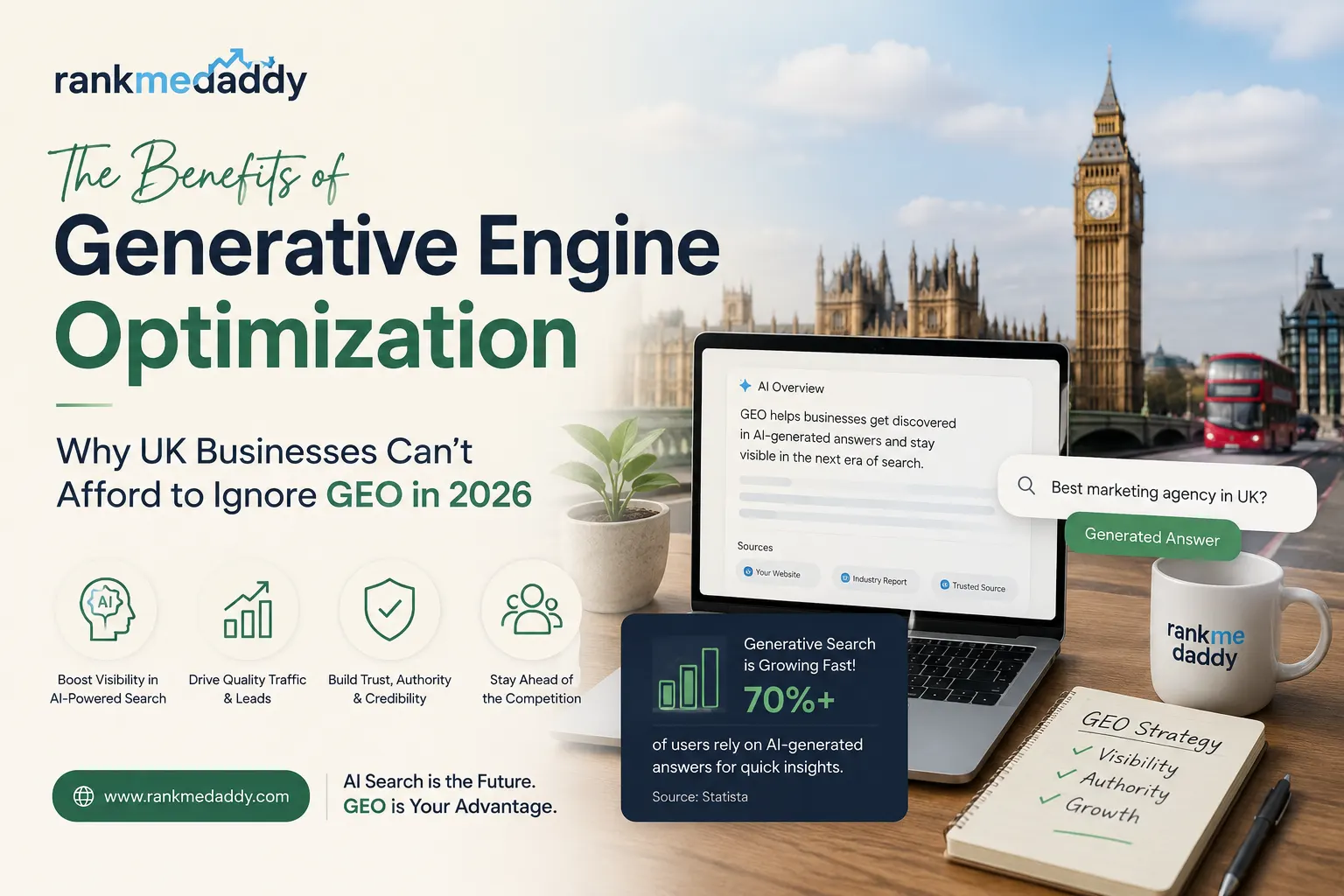
The Benefits of Generative Engine Optimization: Why UK Businesses Can’t Afford to Ignore GEO in 2026
Something fundamental has shifted in the way people in the UK find businesses, compare products and make buying decisions. Where a customer in Manchester might once have typed “best accounting software for small business” into Google and clicked through three or four blue links, they’re now just as likely to ask ChatGPT, Google’s AI Overviews, Perplexity or Gemini and accept the single, synthesised answer they get back.
If your brand isn’t part of that answer, you’ve effectively vanished from a growing share of the buying journey. That’s the problem generative engine optimization (GEO) exists to solve, and it’s why the benefits of generative engine optimization have become one of the most searched-for topics among UK marketers, founders and agency owners heading into the second half of 2026.
In this guide, we’ll break down exactly what those benefits are not in vague, hand-wavy terms, but with the data, mechanisms and practical context you need to make a business case for GEO. Whether you run an e-commerce store in London, a B2B SaaS company in Leeds or a professional services firm in Edinburgh, by the end of this article you’ll understand why GEO is rapidly moving from “interesting experiment” to “non-negotiable channel” and how to start capturing its advantages before your competitors do.
Quick Answer: What Are the Main Benefits of Generative Engine Optimization?
For readers who want the headline version before the deep dive, here are the core benefits of generative engine optimization:
- Visibility inside AI-generated answers your brand gets cited in ChatGPT, Google AI Overviews, Perplexity, Gemini and Copilot responses, where a growing share of UK search activity now happens.
- Dramatically higher-converting traffic visitors referred by AI platforms consistently convert at far higher rates than traditional organic visitors, because they arrive pre-qualified by the AI’s recommendation.
- Brand authority and trust by association being the source an AI cites positions your business as the credible authority in your category.
- Future-proofed search presence as zero-click searches rise and traditional organic click-through rates fall, GEO protects your discoverability.
- First-mover competitive advantage most UK businesses haven’t yet invested seriously in GEO, so early adopters can lock in citation share while the field is still open.
- Compounding returns alongside SEO GEO builds on strong SEO foundations, so the work strengthens both channels at once rather than splitting your budget.
- Presence in zero-click moments even when users never click anything, a brand mention inside an AI answer keeps you in the consideration set.
- Better content and customer experience GEO forces clarity, structure and genuine usefulness, which improves how every visitor experiences your content.
Now let’s unpack each of these properly and look at the evidence behind them.
What Is Generative Engine Optimization? (A 60-Second Refresher)
Generative engine optimization is the practice of structuring your content, technical setup and wider online presence so that AI-driven systems large language models and the search products built on them can find, understand, trust and cite your brand when generating answers for users.
The term traces back to a 2023 academic paper from researchers at Princeton and the Indian Institute of Technology, which framed GEO as a way for content creators to improve their visibility within generative engine responses. Since then, it has evolved from research concept to mainstream marketing discipline, sitting alongside related terms like answer engine optimisation (AEO) and AI optimisation (AIO).
Where traditional SEO is about earning a position on a results page, GEO is about earning a place inside the answer itself. The generative engines that matter most for UK businesses in 2026 include:
- Google AI Overviews the AI-generated summaries that now sit above organic results for a substantial share of UK searches
- Google AI Mode Google’s fully conversational search experience, which behaves differently from AI Overviews and cites different sources
- ChatGPT (including ChatGPT Search) the dominant standalone AI assistant by usage, increasingly used for product research and recommendations
- Perplexity smaller in volume but heavily used by researchers, analysts, journalists and developers, with prominent citations that drive real referral clicks
- Microsoft Copilot embedded across Bing and the Microsoft 365 suite, with a strong skew towards workplace and B2B queries
- Gemini and Claude growing fast as everyday assistants, each with their own retrieval and citation behaviours
Each of these platforms synthesises answers from multiple sources rather than simply listing links. GEO is the discipline of making sure your business is one of the sources they draw on and ideally the one they name.
Why GEO Matters Right Now: The Numbers Behind the Shift
Before we get into the benefits themselves, it’s worth grounding the conversation in data, because the scale of the change is easy to underestimate.
AI answers are now mainstream, not niche.
Google’s AI Overviews reach an estimated two billion-plus users globally each month, and depending on which tracker you follow, AI Overviews now appear on anywhere from a quarter to well over half of searches with informational and how-to queries the most likely to trigger one. Google’s conversational AI Mode has passed a billion monthly active users in its own right.
Traditional clicks are eroding.
Research from Pew found that click-through rates roughly halve when an AI Overview is present, and only around 1% of users click a source link inside the Overview itself. Ahrefs data suggests the top-ranked organic result can lose more than half its clicks when an AI answer appears above it. Industry analyses put the zero-click rate searches that end without any click at all at well over 60% and climbing when AI summaries are shown.
AI-referred traffic is smaller but far more valuable.
This is the statistic that should reframe how you think about GEO. Multiple independent datasets including Ahrefs’ internal data have found that visitors referred by AI platforms convert at dramatically higher rates than traditional organic visitors, with some B2B SaaS companies reporting conversion uplifts of 6x to 27x from AI-referred traffic. AI-referred visitors also tend to bounce less and spend significantly more time on site.
The market is responding.
The GEO software and services market was valued at under $1 billion in 2024 and is projected to grow at roughly 34% annually towards a multi-billion-pound industry by the early 2030s. Surveys suggest a majority of marketers plan to implement GEO within the next two quarters yet only around a quarter currently invest in measuring it properly. That gap between intention and execution is precisely where the opportunity lies for UK businesses willing to move now.
In short: the audience has already moved. The question is whether your visibility strategy has moved with it.
GEO vs Traditional SEO: What’s Actually Different?
A common misconception and one that several top-ranking articles on this topic perpetuate is that GEO replaces SEO. It doesn’t. The two disciplines overlap heavily, and strong organic rankings remain a powerful upstream filter for AI citations: pages that rank well in Google are far more likely to be cited by AI Overviews and AI Mode than pages that don’t. But the overlap is incomplete, and the differences matter.
| Dimension | Traditional SEO | Generative Engine Optimization |
| Primary goal | Rank highly on a results page | Be cited, named or recommended within an AI-generated answer |
| Success metric | Rankings, organic clicks, CTR | Citation frequency, brand mentions, share of voice in AI answers, AI-referred conversions |
| Query style | Short keywords (UK average: 3–4 words) | Long, conversational, natural-language questions (often 20+ words) |
| Key signals | Backlinks, on-page keywords, technical health | Entity clarity, structured data, answer-ready formatting, third-party brand mentions, source credibility |
| Where you appear | A list of links the user chooses from | The single synthesised answer the user actually reads |
| Click behaviour | The user clicks through to compare | Often zero-click; influence happens within the answer itself |
Notably, research correlating different signals with AI Overview appearances found that branded web mentions across the open web correlate far more strongly with AI visibility (correlation of roughly 0.66) than backlinks do (roughly 0.22). That single finding explains a lot about why GEO strategy looks different from classic link building: AI engines weigh who is talked about and trusted across the web, not just who has the most links.
It’s also worth knowing that Google’s own AI surfaces don’t behave identically. Ahrefs analysed over half a million query pairs and found AI Overviews and AI Mode cite the same URLs only about 14% of the time, even though they reach similar conclusions in the vast majority of cases. For UK brands, that means visibility needs to be earned and tracked across multiple AI surfaces separately which is exactly what a structured GEO programme does.
With that foundation in place, let’s get to the heart of this guide.
The 12 Biggest Benefits of Generative Engine Optimization
1. Visibility Where Your Customers Are Actually Looking
The most direct benefit of generative engine optimization is the simplest: it puts your brand inside the answers your customers are reading.
UK search behaviour has fragmented. A prospective customer researching, say, project management software might start in Google, get an AI Overview, follow up in ChatGPT with “which of these is best for a 10-person UK agency?”, then cross-check the recommendation in Perplexity before ever visiting a website. Cross-referencing between AI engines is becoming the new “open three tabs” behaviour which means optimising for a single engine under-serves how people actually research.
GEO ensures that at each of those touchpoints, your brand is present, accurately described and favourably positioned. Without it, the AI simply builds its answer from your competitors’ content and to that user, you may as well not exist.
This matters even more for younger demographics. AI-first search behaviour is most entrenched among users under 35 a cohort that includes a large share of the UK’s next decade of senior buyers, household decision-makers and high-value consumers. The visibility you build in AI answers today is visibility with the buyers of tomorrow.
2. Traffic That Converts at a Different Order of Magnitude
If you only remember one statistic from this article, make it this one: AI-referred visitors convert at rates that traditional organic traffic rarely touches. Ahrefs’ internal data found AI-referred visitors converting at around 23 times the rate of organic search visitors, and B2B SaaS companies have reported conversion multiples ranging from 6x to 27x. AI-referred sessions also show meaningfully lower bounce rates and substantially longer time on site.
Why such a gap? Because of when and how these visitors arrive. A user who clicks through from an AI answer has typically:
- Already had their basic questions answered by the AI
- Already seen your brand recommended or cited as a credible source
- Already narrowed their shortlist often to just one or two options
In effect, the AI has done your top-of-funnel qualification for you. The visitor lands on your site warmed up, pre-sold and ready to act. For a UK e-commerce brand or SaaS business, that changes the economics of acquisition: even modest AI referral volumes can outproduce much larger volumes of cold organic traffic.
So while it’s true that AI platforms send fewer total clicks than traditional search Similarweb data shows AI platform visits growing strongly while outbound referrals stay relatively flat the clicks they do send are disproportionately valuable. GEO is how you compete for them.
3. Borrowed Trust: The Authority Effect of Being Cited
When ChatGPT or Google’s AI Overview names your business as a source or better still, recommends you directly something psychologically powerful happens. The recommendation doesn’t read like an advert. It reads like advice from a knowledgeable, neutral assistant.
That’s borrowed trust at scale. Users increasingly treat AI answers as a form of editorial endorsement, and brands that appear consistently in those answers accumulate authority by association. For UK professional services firms solicitors, accountants, consultants, financial advisers where trust is the entire purchase decision, this benefit is arguably worth more than the traffic itself.
There’s a compounding effect, too. AI engines favour sources that the wider web already treats as authoritative: brands mentioned in industry publications, comparison sites, forums and news coverage. As your GEO programme earns more citations and mentions, those mentions themselves become signals that earn further citations. Authority in AI search is a flywheel, and the businesses that start spinning it earliest benefit most.
4. Future-Proofing Against the Decline of the Blue Link
Every dataset points the same direction: the classic ten-blue-links results page is shrinking in importance. AI Overview coverage grew by more than half in a single year, B2B technology queries triggering AI results jumped from roughly a third to over four-fifths, and zero-click search keeps rising.
For businesses whose growth has been built on organic traffic which describes a huge proportion of UK SMEs, publishers and e-commerce stores this is an existential trend, not a tactical one. Traffic that took years to build can erode quickly when AI answers intercept your most valuable informational queries.
GEO is the hedge. By optimising for citation and inclusion rather than relying solely on clicks, you keep your brand present in the journey even as the journey changes shape. Think of it as diversifying your visibility portfolio: SEO remains a core holding, but GEO is the growth allocation that protects you against where the market is heading.
5. First-Mover Advantage in a Wide-Open Field
Here’s the strategic reality in mid-2026: most UK businesses talk about GEO, and very few actually do it well. Surveys show a majority of marketers intend to implement GEO in the coming months, yet only around 23% currently invest in measuring AI visibility at all. The gap between awareness and execution is enormous.
That gap is your opportunity. AI engines are still forming their “mental map” of which brands are authoritative in each category, and citation patterns, once established, show real stickiness engines repeatedly draw on sources they’ve learned to trust. The brands earning citations now are training the engines to keep citing them.
Compare this to the early days of SEO in the 2000s: the businesses that invested before their competitors built moats that lasted a decade. GEO in 2026 presents the same window, and like all such windows, it will close. Every quarter of delay means competitors accumulating the mentions, structured content and entity authority that you’ll later have to displace rather than simply claim.
6. Staying Visible in Zero-Click Moments
A subtle but crucial benefit: GEO delivers value even when nobody clicks anything.
With most AI-assisted searches ending without a click, the battle has shifted from winning the click to winning the mention. When a user in Birmingham asks an AI “what’s the best local marketing agency for e-commerce brands?” and your company is named in the answer, you’ve entered their consideration set regardless of whether they click. They may search your brand name directly later, visit your site days afterwards, or mention you to a colleague.
Traditional analytics struggles to capture this, which is why brands that only measure last-click traffic systematically undervalue GEO. The measurable proxies rising branded search volume, direct traffic growth, “how did you hear about us?” responses mentioning ChatGPT consistently show that AI mentions drive demand that arrives through other doors. GEO ensures you’re winning those invisible moments rather than ceding them to competitors.
7. Compounding Returns: GEO Strengthens Your SEO (and Vice Versa)
One of the most underrated benefits of generative engine optimization is that the work isn’t separate from SEO it compounds with it.
Strong organic rankings act as an upstream filter for AI citations: studies consistently show top-ranked pages are far more likely to be cited in AI Overviews than lower-ranked ones. At the same time, the things GEO demands clear answer-first structure, comprehensive topical coverage, robust schema markup, demonstrable expertise, fast and crawlable pages are exactly what modern Google rewards in traditional rankings too.
This means a well-run GEO programme is rarely a budget split; it’s a budget multiplier. The same content restructure that earns you an AI Overview citation typically improves your featured snippet eligibility, your organic CTR and your topical authority. UK businesses with limited marketing budgets should find this reassuring: investing in GEO doesn’t mean abandoning the SEO equity you’ve already built. It means upgrading that equity so it pays out across two channels instead of one.
The reverse warning applies as well: GEO built on weak SEO foundations underperforms. AI engines can’t cite content they can’t crawl, and they won’t trust a site that broader web signals say is marginal. The best results come from treating GEO and SEO as one integrated visibility strategy which is exactly how the leading UK agencies now structure their services.
8. Better Content and a Better Experience for Every Visitor
GEO imposes a useful discipline on your content. To be citable by an AI engine, a page generally needs to:
- Answer the core question directly within the opening section (research from SparkToro found that over 44% of all LLM citations come from the first 30% of a piece of content)
- Use clear headings that map to the actual questions people ask
- Include specific facts, statistics, named sources and expert quotations rather than vague generalities the original Princeton GEO research found that adding citations, quotations and statistics measurably increased content visibility in generative engines, in some cases by 30–40%
- Maintain consistent, unambiguous descriptions of what your business is and does
Notice what this list really is: a description of genuinely good content. Pages optimised for generative engines are clearer, more scannable, more evidence-based and more directly useful to the humans who read them too. Many businesses that undertake a GEO content programme report improvements in engagement metrics across all traffic sources, simply because their content stopped burying the answer.
There’s an internal benefit as well. The process of making your expertise machine-readable defining your entities, standardising your terminology, documenting your proof points forces a clarity about positioning that improves sales decks, proposals and onboarding materials far beyond the website.
9. Cost-Efficient Visibility Compared with Paid Channels
UK customer acquisition costs through paid channels have climbed steadily for years, and AI surfaces currently offer very limited paid placement. You largely cannot buy your way into a ChatGPT recommendation or a Perplexity citation you have to earn it.
That’s a feature, not a bug, for businesses willing to invest in earning it. GEO operates like organic search did in its golden era: an upfront and ongoing investment in content, structure and authority that then delivers visibility without a per-click toll. Once your content becomes a trusted source for a topic cluster, it can be drawn into thousands of AI answers month after month at zero marginal cost.
For comparison: a competitive UK Google Ads click in legal, finance or insurance can cost £20–£50+. A citation in an AI answer for the equivalent query costs nothing per impression and carries the credibility of an editorial recommendation rather than a labelled advert. As AI surfaces capture more of the journey, the share of high-intent moments you can influence without paying per click grows accordingly.
10. Readiness for Voice and Conversational Search
The same optimisation that wins AI citations prepares you for voice and conversational interfaces, which draw on the same underlying systems. Voice queries through assistants increasingly powered by the same LLMs behind AI search return one answer, not ten. GEO is, in practical terms, the discipline of becoming that one answer.
UK smart speaker and in-car assistant usage continues to grow, and AI assistants are being embedded into phones, browsers and operating systems by default Apple’s integration of AI search into Safari being a notable accelerant. Each of these surfaces narrows the funnel from “a page of options” to “the answer”. Businesses with strong GEO foundations are positioned for every one of them at once; businesses without are betting everything on interfaces that are losing share.
11. Measurable Share of Voice in a Channel Your Competitors Can’t See
Mature GEO programmes now track metrics that simply didn’t exist three years ago: citation frequency across engines, brand mention sentiment in AI answers, share of voice for priority prompts versus named competitors, and AI-referred conversion rates. Tooling for this has matured quickly, and the leading UK agencies have built frameworks for tracking AI visibility and share of voice in generative results.
This creates an intelligence advantage. If you’re measuring how often ChatGPT recommends you versus your three closest UK competitors and they’re not measuring anything you can see gaps, correct misrepresentations and target specific prompts while they remain blind to the entire battlefield. You’ll also catch problems early: AI engines sometimes describe brands inaccurately or rely on outdated information, and only the businesses monitoring their AI presence can detect and fix that before it costs them customers.
12. Resilience of Brand Narrative: You Shape How AI Describes You
Left alone, AI engines will describe your business based on whatever they find: old press coverage, a competitor’s comparison page, a years-old forum thread. GEO gives you a hand on the wheel.
By publishing clear, structured, consistent information about who you are, what you do, who you serve and what differentiates you and by ensuring third-party sources echo that story you materially influence the narrative AI engines reproduce. For UK brands, this extends to the details that matter locally: your accreditations, your regulatory status (FCA authorisation, SRA regulation, and so on), your service areas, your pricing in pounds rather than dollars.
This is brand management for the AI era, and it’s a benefit that compounds defensively: a brand with a strong, consistent entity footprint is far harder for misinformation, outdated data or competitor framing to dislodge.
Why GEO Benefits Hit Differently for UK Businesses?
Most of the content ranking for this topic is written for a US audience, with US statistics, US platforms and US spelling. But the UK context has its own dynamics worth understanding.
UK search behaviour is heavily Google-centric which makes AI Overviews unavoidable.
Google’s share of UK search remains above 90%, higher than in the US. That means the rollout of AI Overviews and AI Mode across UK results pages affects British businesses proportionally more: there’s no large alternative-engine audience to fall back on. If Google’s AI layer is rewriting how your category’s queries are answered, UK visibility is AI visibility.
AI engines are trained on regional data and British phrasing matters.
UK consumers phrase questions differently (“best ISA for first-time savers”, “do I need an MOT for a new car”, “VAT registration threshold for sole traders”), use different terminology, and operate within UK-specific regulatory and cultural contexts. Content optimised for American query patterns frequently fails to surface for British ones. GEO done properly for a UK audience means optimising for the questions Britons actually ask, in the language they ask them including, yes, spelling it “optimisation” in your customer-facing content even when the search keyword data skews to the American spelling.
UK trust signals carry specific weight.
AI engines lean on credibility markers, and in the UK those include Companies House records, FCA/SRA/GMC and other regulatory registrations, Trustpilot and Google review profiles, trade body memberships, and coverage in recognised British publications. A GEO programme that strengthens these UK-specific signals builds citation authority that generic, geography-blind optimisation misses entirely.
The UK competitive window is wider.
GEO adoption among US enterprises is further along; the UK market, particularly outside London, remains early. For regional UK businesses a Bristol law firm, a Glasgow manufacturer, a Cardiff e-commerce brand the realistic chance of becoming the cited authority for your category and region is higher right now than it will ever be again.
How to Actually Capture These Benefits: A Practical GEO Framework
Understanding the benefits is one thing; realising them is another. Here is the framework we use at RankMeDaddy, distilled into seven pillars. Each one maps directly to the benefits above.
Pillar 1: Build on Solid SEO Foundations
AI engines retrieve before they generate, and retrieval favours pages that are crawlable, fast, well-linked and already ranking. Before anything else: ensure your site is technically healthy, your key pages are indexed, your robots.txt doesn’t block AI crawlers you want (GPTBot, PerplexityBot, Google-Extended make deliberate choices here), and your core commercial pages rank respectably for their target terms. GEO without SEO is a roof without walls.
Pillar 2: Restructure Content to Be Answer-First
Lead every important page with a direct, self-contained answer to its core question ideally within the first 100 words. Use question-based H2s and H3s that mirror real queries. Keep paragraphs extractable: one idea, clearly stated, that makes sense even when lifted out of context. Remember that the opening third of your content earns the overwhelming majority of LLM citations; stop burying your best material beneath warm-up prose.
Pillar 3: Load Your Content with Citable Evidence
The original GEO research is unambiguous: content containing statistics, named expert quotations and cited sources is significantly more likely to be included in generative answers. Audit your key pages and ask where are the numbers? Where are the named experts? Where is the original data? Publishing your own research, surveys or benchmark data is the single most powerful move here, because it makes you the primary source that both AI engines and other websites must cite.
Pillar 4: Implement Structured Data Properly
Schema markup is how you speak to machines in their native format. Prioritise Organization, LocalBusiness, Product, FAQPage, HowTo, Article and Person schema as relevant. Ensure your Organization schema nails down your entity: legal name, founding date, location, sameAs links to your social and directory profiles. Clean structured data is repeatedly identified by leading practitioners as a cornerstone of AI retrievability.
Pillar 5: Build Your Entity and Earn Third-Party Mentions
Remember the correlation data: branded mentions across the web predict AI visibility roughly three times more strongly than backlinks. That means digital PR, expert commentary in industry publications, inclusion in credible “best of” lists, podcast appearances, and active presence on the platforms AI engines cite heavily Reddit and YouTube together account for the large majority of AI social citations, with Reddit alone the single most-cited social source. For UK brands, target British trade press, regional business media and UK-centric communities where your buyers actually discuss your category.
Pillar 6: Demonstrate E-E-A-T Relentlessly
Experience, Expertise, Authoritativeness and Trust aren’t just Google quality-rater concepts; they’re the heuristics AI engines approximate when deciding whom to trust. Use named authors with real credentials and detailed bios. Show first-hand experience: original photography, real case studies with real numbers, documented processes. Keep content current visibly date and update it, because AI engines preferentially cite fresh sources for time-sensitive topics.
Pillar 7: Measure, Monitor and Iterate
Set up tracking for: citation frequency across ChatGPT, AI Overviews, AI Mode, Perplexity and Copilot for your priority prompt set; share of voice versus named competitors; AI referral traffic (filter for chatgpt.com, perplexity.ai, gemini.google.com and copilot referrers in your analytics); and conversion rates by referral source. Re-run your prompt audits monthly AI answers are volatile, and what you measure, you can improve.
Common Mistakes That Forfeit GEO’s Benefits
Even businesses that invest in GEO can squander the upside. The most frequent failure modes we see in UK audits:
Treating GEO as keyword stuffing 2.0.
Cramming “best [service] UK” into headers doesn’t influence an LLM the way it once influenced a crawler. Generative engines reward substance, structure and corroborated authority not repetition.
Optimising one engine and declaring victory.
AI Overviews and AI Mode cite the same URLs barely one time in seven. ChatGPT, Perplexity and Copilot each have distinct retrieval behaviours. A single-engine strategy leaves most of the battlefield uncontested.
Inconsistent brand information across the web.
If your website, LinkedIn, Companies House listing, directories and press coverage describe your business in conflicting ways, AI engines receive mixed signals and either describe you wrongly or skip you for a clearer competitor. Entity consistency is unglamorous and essential.
Ignoring measurement.
With only around a quarter of marketers measuring AI visibility, most GEO spend is flying blind. You cannot manage citation share you do not track.
Set-and-forget thinking.
Generative engines update constantly; answers that cite you today may not next month. GEO is a programme, not a project.
Abandoning SEO.
The brands winning AI citations are overwhelmingly the brands with strong organic foundations. Cannibalising your SEO budget to fund GEO usually weakens both.
What GEO’s Benefits Look Like by Industry
E-commerce and retail.
Product recommendation queries (“best waterproof walking boots under £150”) are increasingly answered by AI with specific product and brand picks. GEO benefits here centre on product schema, comparison-ready content, strong review profiles and presence in the buying guides AI engines draw from. With around 60% of searches ending without a click, being the named recommendation matters more than ranking #3.
B2B and SaaS.
This is where GEO’s conversion benefit is most dramatic the 6x–27x conversion multiples come disproportionately from B2B SaaS and where AI adoption in the buying process is highest, since technical, research-led buyers lean hardest on AI tools. Benefits centre on category definition content, original data, and presence in the comparison and review ecosystems LLMs trust.
Professional services.
For solicitors, accountants, consultants and financial advisers, the authority-by-citation benefit dominates. UK regulatory trust signals (SRA, FCA, ICAEW) woven into your entity footprint give AI engines exactly the credibility markers they seek for “your money or your life” topics.
Local and regional businesses.
AI assistants increasingly handle “near me” and regional queries conversationally. Consistent NAP data, LocalBusiness schema, strong Google review profiles and locally-relevant content let regional UK businesses become the default AI answer for their patch often against minimal competition.
Publishers and content businesses.
The threat is sharpest here (AI answers consume informational clicks), which makes the defensive benefit existential: original reporting, proprietary data and distinctive expertise are what keep publishers cited and therefore relevant in a zero-click landscape.
Frequently Asked Questions
Is GEO worth it for small UK businesses, or only for big brands?
Arguably more worth it for small businesses. Large brands carry existing entity authority into AI answers by default; smaller businesses must earn theirs but the competitive field in most UK niches and regions is still nearly empty. A focused small business can become the consistently cited authority for a tight topic-and-region combination far faster than it could ever outrank national players in classic SEO.
How long does it take to see the benefits of generative engine optimization?
Faster than traditional SEO in many cases. Content and structural changes can surface in AI answers within weeks, because several engines retrieve live or recently-crawled content rather than relying solely on training data. Entity authority and citation share build over months. A realistic UK programme shows early citation wins inside 4–8 weeks and compounding share-of-voice gains over two to four quarters.
Will GEO replace SEO?
No they’re converging into a single visibility discipline. Strong rankings feed AI citations; GEO-quality content improves rankings. Businesses should think in terms of total search visibility across both traditional and generative surfaces, which is how forward-thinking UK agencies (ours included) now scope the work.
How do I measure GEO if AI answers don’t always send clicks?
Track four layers: (1) citation and mention frequency for a fixed prompt set across engines; (2) share of voice versus competitors on those prompts; (3) AI referral traffic and its conversion rate in analytics; (4) demand proxies branded search volume, direct traffic, and “how did you hear about us?” data. Together these capture both the clicked and the zero-click value.
Does GEO work for content in British English?
Yes and you should write in British English for a UK audience. AI engines handle both spellings of “optimization/optimisation” as the same concept, and they’re trained on regional data, so authentically British phrasing, terminology and context help rather than hinder your visibility for UK-originated queries.
What’s the difference between GEO, AEO and AIO?
They’re overlapping labels for the same broad practice. GEO (generative engine optimization) emphasises visibility in generated answers; AEO (answer engine optimisation) emphasises being the direct answer to questions; AIO (AI optimisation) is the broadest umbrella. Whichever label you prefer, the underlying work structured, evidence-rich, entity-clear, authoritative content is essentially the same.
The Bottom Line: The Benefits Go to the Brands That Move First
The benefits of generative engine optimization aren’t speculative anymore. The data is in: AI answers now mediate a substantial and fast-growing share of UK search activity; traditional clicks are eroding wherever AI summaries appear; and the traffic AI platforms do send converts at multiples that make it some of the most valuable acquisition available to a UK business in 2026.
GEO delivers visibility inside the answers your customers actually read, traffic that arrives pre-qualified, authority borrowed from the most trusted interfaces in modern computing, and a defensive moat against the structural decline of the blue link. It strengthens rather than competes with your SEO, improves your content for every visitor, and for now operates in a field most of your UK competitors haven’t seriously entered.
That last point is the one with an expiry date. Citation patterns are forming now. Entity authority is being allocated now. The brands that AI engines learn to trust in 2026 will be disproportionately hard to displace in 2028.
Ready to claim your share of AI search?
At RankMeDaddy, we build integrated SEO + GEO programmes for UK businesses from AI visibility audits and prompt-level competitor tracking to the content, schema and digital PR that earn citations across ChatGPT, Google AI Overviews, Perplexity, Gemini and Copilot. Get in touch for a free AI visibility audit and see exactly where you stand in the answers your customers are already reading.
