 +91 73584 98220
 info@rankmedaddy.com
 Rajasthan, India

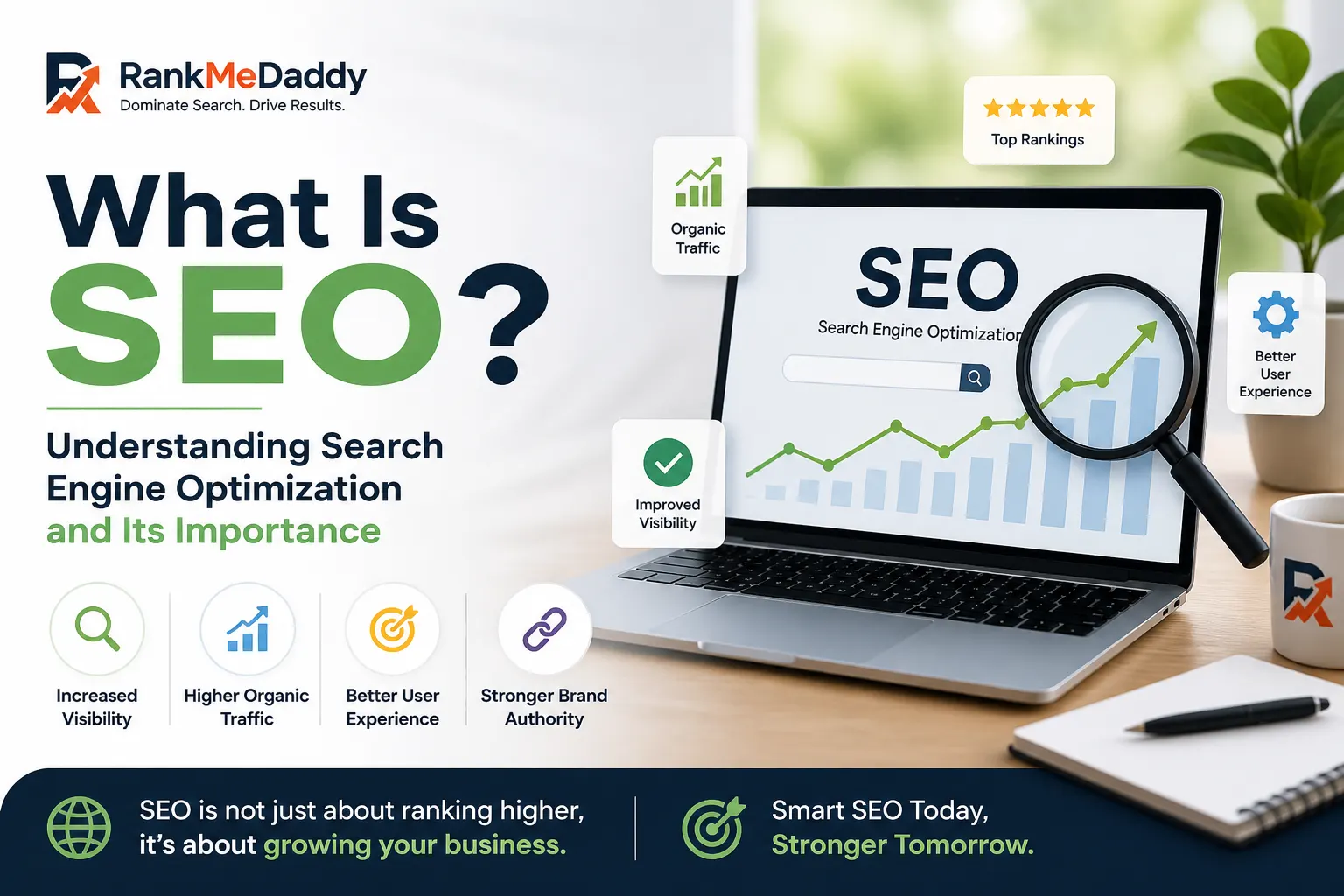
What Is SEO? Understanding Search Engine Optimization and Its Importance
Every day, Americans perform over 8.5 billion searches on Google. They’re looking for restaurants, lawyers, plumbers, products, medical advice, how-to guides you name it. And in those fractions of a second, Google decides whose website gets seen and whose gets buried on page 10.
If you’ve ever asked, “What is SEO?” you’re already thinking about one of the most powerful forces in modern business. Search Engine Optimization isn’t just a technical buzzword. It’s the difference between a thriving online presence and digital invisibility. Whether you’re a startup founder in Austin, a local dentist in Chicago, or an e-commerce brand in New York, SEO determines whether your ideal customers find you or your competitor.
In this comprehensive guide from RankMeDaddy, we’re going to break down everything you need to know about SEO in plain English: what it is, how it works, why it matters more than ever in 2025, and how you can start using it to grow your business in the United States.
QUICK DEFINITION
SEO (Search Engine Optimization) is the practice of optimizing your website and online content so that search engines like Google rank it higher in organic (non-paid) search results bringing you more traffic, leads, and revenue without paying per click.
- 68% of online experiences begin with a search engine
- 27.6% Average click-through rate for the #1 Google result
- 0.63% of searchers click results on page 2 of Google
- $79B US SEO industry value by 2025
What Is SEO? A Clear, Simple Definition
SEO stands for Search Engine Optimization. At its core, SEO is the process of making your website more attractive and understandable to search engines so they rank it higher when someone types in a relevant query.
Think of Google as the world’s most powerful librarian. When you search for “best pizza near me” or “how to file taxes in Texas,” Google instantly sorts through billions of web pages and delivers what it believes are the most relevant, trustworthy, and useful results. SEO is how you convince that librarian that your page belongs at the top of the stack.
Unlike paid advertising (where you pay for each click), SEO generates organic traffic visitors who find your site naturally through search. This traffic is free, sustainable, and often converts better because users actively searching for what you offer have high buying intent.
SEO vs. SEM vs. PPC: What’s the Difference?
These terms often cause confusion, especially for business owners just getting started. Here’s a quick breakdown:
| Term | Full Form | What It Means | Cost Model |
| SEO | Search Engine Optimization | Ranking organically in search results through optimization | No cost per click (investment in time/tools/services) |
| SEM | Search Engine Marketing | Umbrella term covering both SEO and paid search | Varies |
| PPC | Pay Per Click | Paid ads on Google/Bing that appear above organic results | You pay each time someone clicks your ad |
While PPC delivers faster results, SEO compounds over time. A well-optimized page can generate traffic for years without additional spending. For US businesses focused on long-term growth, SEO is almost always the superior investment.
How Do Search Engines Actually Work?
To understand SEO, you first need to understand what search engines do. It happens in three stages:
1. Crawling
Search engines use automated bots (called “crawlers” or “spiders”) to browse the internet and discover web pages. Google’s bot, Googlebot, constantly follows links from page to page, indexing new content and checking for updates. If your site isn’t accessible to crawlers due to technical errors, blocked pages, or poor link structure Google can’t find your content, no matter how good it is.
2. Indexing
After crawling, Google analyzes each page and stores it in its index a massive database of all the web content it has discovered. When you search for something, Google searches its index, not the live web. Pages with confusing structure, duplicate content, or thin information may be indexed poorly or not at all.
3. Ranking
When someone performs a search, Google’s algorithm evaluates hundreds of ranking factors to decide which pages to show and in what order. These factors include relevance to the search query, page authority, content quality, user experience signals, and many more. SEO is the practice of optimizing for these ranking factors.
KEY INSIGHT
Google updates its algorithm thousands of times per year. Most are minor, but major updates (like Core Updates, Helpful Content Updates, and Link Spam Updates) can significantly shift rankings. Staying current with Google’s guidelines is an essential part of sustainable SEO.
The 4 Core Types of SEO (And Why You Need All of Them)
SEO isn’t a single tactic it’s a multi-pillar discipline. To rank well on Google in 2025, you need to address all four core types:
On-Page SEO: Optimizing What’s On Your Website
Optimizing the content and HTML of individual pages keywords, titles, meta descriptions, headings, images, internal links. On-page SEO refers to all the optimizations you make directly on your web pages. It’s the most hands-on type of SEO and the one you have the most direct control over. Here’s what it covers:
KEYWORD RESEARCH & TARGETING
At the heart of on-page SEO is targeting the right keywords the phrases your potential customers actually type into Google. Effective keyword research involves identifying terms with strong search volume, manageable competition, and clear commercial or informational intent. Tools like Google Keyword Planner, Ahrefs, and SEMrush help US businesses uncover the exact language their audience uses.
TITLE TAGS & META DESCRIPTIONS
Your title tag is the blue clickable text in search results the single most important on-page SEO element. It should include your primary keyword, be under 60 characters, and be compelling enough to earn the click. Your meta description (under 160 characters) is the snippet below it doesn’t directly affect rankings but dramatically impacts click-through rates.
HEADING STRUCTURE (H1, H2, H3…)
Headings give your content structure and signal hierarchy to search engines. Every page should have a single H1 (your main topic), followed by H2s for major sections and H3s for sub-points. Including keywords naturally in headings helps Google understand your page’s topical focus.
CONTENT QUALITY & LENGTH
Google’s Helpful Content System rewards content that is written for people first, not just for search engines. In competitive US markets, top-ranking pages are typically comprehensive, well-researched, and genuinely useful. Thin content pages with little value to the reader is increasingly penalized.
IMAGE OPTIMIZATION
Images should have descriptive file names and alt text that include relevant keywords. Compress images to improve page speed (a direct ranking factor), and use modern formats like WebP where possible.
INTERNAL LINKING
Linking to other relevant pages on your own website helps Google crawl your site more effectively, distributes “link equity” (authority) across your pages, and keeps users engaged longer all positive ranking signals.
Off-Page SEO: Building Authority Beyond Your Website
Building your site’s authority through backlinks, brand mentions, social signals, and digital PR from external websites.
Off-page SEO is about building your website’s authority, trustworthiness, and reputation through external signals. Google treats backlinks (links from other websites to yours) like votes of confidence the more high-quality sites that link to you, the more authoritative your site appears.
BACKLINK BUILDING
A backlink from the New York Times, an industry trade publication, or a .edu/.gov domain carries far more weight than a link from a random blog. Quality always trumps quantity. Common backlink acquisition strategies include:
- Digital PR Getting your business featured in news articles, industry roundups, and resource pages
- Guest Posting Writing valuable content for reputable websites in your niche in exchange for an author link
- Broken Link Building Finding dead links on authoritative sites and offering your content as a replacement
- HARO (Help a Reporter Out) Responding to journalist queries to earn citations and backlinks from major publications
- Skyscraper Technique Creating content that’s measurably better than top-ranking competitors’ and outreaching to sites that link to them
BRAND MENTIONS & UNLINKED CITATIONS
Even mentions of your brand name without a hyperlink (called “unlinked citations”) contribute to Google’s understanding of your authority. Building brand awareness through PR, social media, and community engagement indirectly supports your SEO.
Technical SEO: The Foundation Your Rankings Are Built On
Ensuring your website is fast, secure, mobile-friendly, and crawlable the technical foundation everything else depends on. Technical SEO ensures that search engines can efficiently crawl, index, and understand your website. Without a solid technical foundation, even great content and strong backlinks won’t get you to page one. Key technical SEO elements include:
WEBSITE SPEED & CORE WEB VITALS
Google officially uses Core Web Vitals a set of real-world performance metrics as ranking signals. These include:
- LCP (Largest Contentful Paint): How fast the main content loads (target: under 2.5 seconds)
- INP (Interaction to Next Paint): How quickly the page responds to user interactions
- CLS (Cumulative Layout Shift): Visual stability does the page jump around as it loads?
A slow website doesn’t just hurt rankings it loses customers. Studies show that 53% of mobile users abandon a site that takes longer than 3 seconds to load.
MOBILE-FIRST OPTIMIZATION
Google uses mobile-first indexing, meaning it primarily uses the mobile version of your site for ranking. Over 60% of US searches now happen on smartphones. Your website must be responsive, readable, and easy to navigate on small screens or you’ll pay the price in rankings.
HTTPS SECURITY
Google confirmed HTTPS as a ranking signal back in 2014, and it remains essential today. An SSL certificate not only helps SEO but also builds trust with visitors. In 2025, any site without HTTPS will be flagged as “Not Secure” in Chrome an immediate trust killer.
XML SITEMAP & ROBOTS.TXT
An XML sitemap tells Google exactly which pages to crawl and index. Your robots.txt file tells it which pages not to crawl. Both are critical for ensuring the right pages get indexed and the right pages stay private.
STRUCTURED DATA (SCHEMA MARKUP)
Schema markup is a vocabulary of code you add to your website to help Google understand your content more precisely. It can trigger rich results in SERPs like star ratings, FAQ dropdowns, recipe cards, and event listings which significantly increase click-through rates.
Local SEO: Dominating Search in Your City or Region
Optimizing for location-based searches so nearby customers can find your business on Google Maps and local SERPs. For businesses that serve specific geographic areas restaurants, dental offices, law firms, contractors, real estate agents local SEO is arguably the highest-ROI marketing investment you can make.
When someone in Dallas searches “emergency plumber near me,” Google serves a Local Pack the map with three business listings at the top of results. Appearing in this pack can transform a local business. Here’s how local SEO works:
GOOGLE BUSINESS PROFILE (GBP) OPTIMIZATION
Your Google Business Profile (formerly Google My Business) is the backbone of local SEO. A fully optimized GBP listing with accurate NAP (Name, Address, Phone), categories, services, photos, and regular posts dramatically improves your chances of appearing in the local pack.
LOCAL CITATIONS & NAP CONSISTENCY
Citations are mentions of your business on directories like Yelp, Yellow Pages, and industry-specific sites. Consistent NAP information across all directories signals reliability to Google. Inconsistencies (like different phone numbers or address formats) can hurt your local rankings.
REVIEWS & REPUTATION MANAGEMENT
Google Reviews are a major local ranking factor. Businesses with more positive reviews rank higher in local results and they convert better. Proactively asking satisfied customers for reviews and responding professionally to all feedback is non-negotiable for local SEO success.
LOCALIZED CONTENT
Creating content that speaks directly to local audiences blog posts about city-specific topics, landing pages for service areas, local event coverage helps Google connect your business with local search intent.
The Most Important Google Ranking Factors in 2025
Google’s algorithm uses over 200 ranking factors. While the company keeps the exact weights secret, years of research and industry testing have surfaced the ones that matter most:
| Ranking Factor | Category | Importance Level |
| Content Quality & Relevance | On-Page | 🔴 Critical |
| Backlink Profile (Quality & Quantity) | Off-Page | 🔴 Critical |
| Core Web Vitals (Speed, Stability) | Technical | 🔴 Critical |
| Mobile-Friendliness | Technical | 🟠 High |
| HTTPS / Site Security | Technical | 🟠 High |
| Keyword Optimization | On-Page | 🟠 High |
| User Engagement (CTR, Time on Site) | UX / Behavioral | 🟠 High |
| E-E-A-T Signals | Content / Trust | 🟠 High |
| Schema Markup / Structured Data | Technical | 🟡 Medium |
| Social Signals | Off-Page | 🟡 Low–Medium |
Understanding E-E-A-T: Google’s Content Quality Framework
Since 2022, Google has placed increasing emphasis on E-E-A-T which stands for Experience, Expertise, Authoritativeness, and Trustworthiness. This framework comes from Google’s Search Quality Rater Guidelines and is especially critical for websites in YMYL (Your Money or Your Life) niches like health, finance, law, and news.
Experience
Does the content creator have first-hand experience with the topic? (A dentist writing about dental care, not a generalist)
Expertise
Is the author a credible expert in the field, with credentials or demonstrable knowledge?
Authoritativeness
Is the website recognized as an authority by other reputable sources (backlinks, citations)?
Trustworthiness
Is the site honest, transparent, and secure? Does it have clear contact info, privacy policies, and author bios?
For US businesses, building E-E-A-T should be a cornerstone of your content strategy especially as AI-generated content floods the internet and Google works harder to surface genuinely credible sources.
Why SEO Is Critically Important for US Businesses in 2025?
You might be wondering: with social media, YouTube, podcasts, and paid ads available, why should SEO be a priority? The answer is simple no other digital channel delivers the same combination of volume, intent, and long-term ROI.
1. Organic Search Is the #1 Driver of Website Traffic
Study after study confirms that organic search drives more traffic than any other channel more than social media, email, and paid ads combined for most industries. In the US, where Google holds over 88% of the search market, ranking well on Google is synonymous with being found online.
2. SEO Delivers Compounding Returns
Unlike paid advertising that stops the moment you stop paying, SEO compounds over time. A well-optimized blog post or landing page can rank for years, continuously driving traffic without additional spend. Businesses that invest in SEO today are building an asset not just buying attention.
3. High-Intent Traffic = Higher Conversion Rates
People who find your business through search are already looking for what you offer. They have active search intent they’ve typed a specific query into Google because they have a need. This makes organic traffic convert significantly better than cold audience advertising on social platforms.
4. It Builds Credibility and Trust
Ranking on the first page of Google especially in positions 1-3 signals authority and credibility to potential customers. Americans have learned to trust Google’s top results. Being there is a form of implicit endorsement that money can’t directly buy.
5. It’s Cost-Effective Compared to Paid Ads
In competitive US markets like legal, real estate, or insurance, a single Google Ads click can cost $50–$100+. SEO requires an upfront investment but delivers clicks for free at scale. The long-term cost per acquisition for organic traffic is typically dramatically lower than paid search.
6. Local SEO Drives Real-World Revenue
For brick-and-mortar businesses, local SEO is transformative. According to Google, 76% of people who search for something nearby visit a related business within a day. And 28% of those searches result in a purchase. If you’re a local business not investing in SEO, you’re leaving significant revenue on the table.
7. Your Competitors Are Already Doing It
Every competitive industry in America has businesses investing heavily in SEO. If you’re not optimizing, you’re ceding ground to competitors who are. The longer you wait, the harder it becomes to catch up because authority and backlinks accumulate over time.
Building an SEO Strategy That Works in 2025
Knowing what SEO is and why it matters is one thing actually executing a winning strategy is another. Here’s a framework that top US SEO agencies (including RankMeDaddy) use to build first-page rankings:
Step 1: Conduct a Comprehensive SEO Audit
Before you can improve, you need to know where you stand. A technical SEO audit identifies crawl errors, indexing issues, broken links, slow pages, and other problems that are holding your site back. Tools like Google Search Console, Screaming Frog, and Ahrefs Site Audit are industry standards.
Step 2: Research Your Target Keywords
Identify the keywords your ideal US customers use when searching for your products or services. Focus on a mix of:
- Head terms high-volume, competitive (e.g., “personal injury lawyer”)
- Long-tail keywords lower volume but highly specific and often higher-converting (e.g., “personal injury lawyer for car accidents in Phoenix AZ”)
- Local keywords geographic modifiers (e.g., “best HVAC company in Denver”)
- Question-based keywords great for featured snippets and voice search (e.g., “how much does SEO cost for a small business”)
Step 3: Create and Optimize High-Quality Content
Content is still king in 2025 but the bar has risen dramatically. Google’s Helpful Content Update has made it clearer than ever: superficial, keyword-stuffed content doesn’t cut it anymore. Your content must:
- Comprehensively cover the topic from the reader’s perspective
- Be written by people with genuine knowledge and experience
- Answer the specific search intent behind the keyword
- Include original insights, data, examples, or expertise
- Be regularly updated to remain accurate and relevant
Step 4: Build a Strong Backlink Profile
Develop a systematic outreach strategy to earn high-quality backlinks from authoritative US websites. Focus on industry publications, local news outlets, business directories, and partner websites. Avoid black-hat tactics like buying links Google’s spam filters are sophisticated enough to detect and penalize these practices.
Step 5: Fix Technical Issues
Address all technical SEO issues identified in your audit. Prioritize: page speed optimization, mobile responsiveness, fixing crawl errors, implementing structured data, and ensuring proper canonicalization to avoid duplicate content issues.
Step 6: Optimize for Local Search (If Applicable)
Claim and fully optimize your Google Business Profile. Build consistent citations across major directories. Develop a review generation strategy. Create location-specific content and landing pages.
Step 7: Track, Measure, and Iterate
SEO isn’t set-and-forget. Monitor your performance through Google Analytics 4 and Google Search Console. Track keyword rankings, organic traffic, click-through rates, and conversion rates. Use this data to continuously refine your strategy.
Essential SEO Tools Every US Business Should Know
The right tools make SEO measurable, efficient, and strategic. Here are the most widely used in the industry:
| Tool | Primary Use | Best For | Price |
| Google Search Console | Monitor search performance & indexing | All businesses | Free |
| Google Analytics 4 | Website traffic & conversion tracking | All businesses | Free |
| Ahrefs | Backlink analysis, keyword research, site audit | Agencies, serious SEOs | From $99/mo |
| SEMrush | All-in-one SEO, competitive analysis | Mid to large businesses | From $119/mo |
| Moz Pro | Keyword tracking, site audits, local SEO | SMBs, beginners | From $99/mo |
| Screaming Frog | Technical SEO crawling | Technical SEOs, agencies | Free (500 pages) / £259/yr |
| Google Keyword Planner | Keyword research & search volume | Beginners, local businesses | Free |
10 Common SEO Mistakes That Kill Your Rankings
Even well-intentioned SEO efforts can backfire if you’re making these common mistakes:
Keyword stuffing
Overusing keywords unnaturally in an attempt to manipulate rankings. Google’s algorithms are sophisticated enough to detect and penalize this.
Ignoring mobile optimization
With Google’s mobile-first indexing, a poor mobile experience can devastate your rankings.
Neglecting technical SEO
Great content on a broken, slow website simply won’t rank.
Buying cheap backlinks
Low-quality or spammy links can trigger Google penalties that take months to recover from.
Publishing thin content
Short, shallow pages that don’t genuinely help users are increasingly penalized by Google’s Helpful Content System.
Ignoring search intent
Writing a blog post when the searcher wants a product page (or vice versa) will result in poor engagement and low rankings.
Not optimizing title tags and meta descriptions
These are your first impression in search results. Generic titles are click killers.
Neglecting local SEO basics
An unclaimed or incomplete Google Business Profile is a missed opportunity every single day.
Failing to update old content
Outdated information signals to Google (and users) that your site isn’t actively maintained.
Measuring the wrong KPIs
Ranking for keywords that don’t convert is a vanity exercise. Always connect SEO metrics to business outcomes.
SEO vs. Paid Ads: Which Should You Invest In?
This is one of the most common questions US business owners ask. The honest answer is: ideally, both. But if you’re working with limited resources, here’s how to think about it:
Choose SEO When:
- You’re building for long-term, sustainable growth
- Your business has been established for 6+ months
- You operate in a niche where content and information add value
- Your cost per click in Google Ads is prohibitively high
- You want to build brand authority and trust
Choose Paid Ads When:
- You need results immediately (new product launch, seasonal promotion)
- You’re testing which keywords convert before investing in SEO
- You’re targeting very specific audiences beyond keyword intent
- You have the budget and the math works out profitably
PRO STRATEGY
The most successful US brands use paid ads to generate immediate revenue while building SEO for the long term. As organic traffic grows and cost per acquisition drops, they gradually shift more budget to SEO. This “hybrid flywheel” approach maximizes ROI across both channels.
The Future of SEO: What’s Changing in 2025 and Beyond
SEO is not static. The landscape is constantly evolving and the businesses that adapt quickest win. Here are the major trends shaping SEO in 2025:
AI-Generated Content and Google’s Response
The explosion of AI writing tools has flooded the internet with generic, low-value content. Google has responded aggressively its Helpful Content System specifically targets content written primarily for search engines rather than humans. In 2025, human expertise and original perspective are more valuable than ever. AI can assist with content creation, but it needs to be enhanced with genuine human insight and first-hand experience.
Generative AI in Search (AI Overviews)
Google’s AI Overviews feature which generates AI-written summaries at the top of search results is reshaping how clicks are distributed. While this does reduce some organic clicks for informational queries, it also creates new opportunities: being cited within AI Overviews requires exactly the kind of authoritative, well-structured content that good SEO produces anyway.
Voice Search Optimization
With the continued growth of voice assistants (Alexa, Siri, Google Assistant), optimizing for conversational, question-based queries is increasingly important. This means creating FAQ-style content, optimizing for featured snippets, and targeting natural language phrases.
Search Experience Optimization
Google increasingly uses engagement signals how long users spend on your page, whether they return to the search results (pogo-sticking), and whether they interact with your content as proxy signals for quality. Optimizing the on-page experience, readability, and UX is now as important as keyword optimization.
Video SEO
YouTube is the world’s second-largest search engine, and Google increasingly surfaces video results in standard SERPs. Brands that create high-quality video content and optimize it properly gain a significant organic visibility advantage.
How Much Does SEO Cost in the USA?
SEO investment varies widely depending on your goals, competition, and the scope of work involved. Here’s a realistic breakdown for the US market in 2025:
| SEO Service Model | Monthly Investment Range | Best For |
| DIY SEO (your time + tools) | $100–$500/mo (tools only) | Bootstrapped startups with time to learn |
| Freelance SEO Consultant | $500–$3,000/mo | Small businesses with specific needs |
| Entry-Level SEO Agency | $1,500–$4,000/mo | SMBs in low-medium competition markets |
| Mid-Tier SEO Agency | $4,000–$10,000/mo | Growing businesses in competitive niches |
| Full-Service SEO Agency | $10,000–$50,000+/mo | Enterprise brands, national campaigns |
Remember:
the question isn’t just “how much does SEO cost?” it’s “what’s the ROI?” A $3,000/month SEO campaign that generates $30,000 in new revenue every month is a bargain. Always evaluate SEO as an investment, not an expense.
Do You Need an SEO Agency?
Whether to hire an SEO agency depends on several factors: your available time, your budget, the competitiveness of your market, and how quickly you need results. Here’s a simple framework:
You should consider an SEO agency if:
- You’re in a competitive market (legal, real estate, healthcare, e-commerce)
- You don’t have the time or expertise to implement SEO yourself
- You’ve tried DIY SEO and aren’t seeing results
- You want to scale faster than organic learning allows
- SEO is a critical business growth channel, not an experiment
When evaluating an SEO agency, look for proven case studies, transparent reporting, clear communication, and a methodology aligned with Google’s guidelines. Be wary of anyone promising “guaranteed first-page rankings” overnight real SEO takes time and expertise, not magic.
WHY RANKMEDADDY?
RankMeDaddy is a results-focused SEO agency built specifically for US businesses. Our team combines deep technical expertise with a proven content and link-building methodology delivering first-page rankings across competitive markets. Get your free SEO audit today and see exactly where your biggest opportunities lie.
Frequently Asked Questions About SEO
Q1. What is SEO in simple terms?
SEO (Search Engine Optimization) is the practice of improving your website so it appears higher in search engine results pages (SERPs) like Google without paying for ads. The higher your site ranks, the more organic (free) traffic you receive from people actively searching for what you offer.
Q2. How long does SEO take to work?
SEO typically takes 3–6 months to show significant results for new websites. Established websites with existing authority can see improvements in 4–8 weeks. Major results often come at the 6–12 month mark. SEO is a long-term investment the rewards grow substantially over time as your authority compounds.
Q3. Is SEO worth it for small businesses in the USA?
Absolutely. SEO delivers one of the highest ROIs in digital marketing. For US small businesses, especially those serving local communities, local SEO in particular can drive foot traffic, phone calls, and conversions at a fraction of the cost of paid ads. Even a few first-page rankings can generate significant new business.
Q4. What are the three types of SEO?
The three core types of SEO are: On-Page SEO (optimizing content and HTML elements on your individual pages), Off-Page SEO (building your site’s authority through backlinks and external signals), and Technical SEO (ensuring your site is fast, secure, crawlable, and mobile-friendly). Local SEO is often added as a fourth type for geographically-focused businesses.
Q5. Can I do SEO myself?
Yes many foundational SEO tasks (setting up Google Search Console, optimizing title tags, creating quality content, building local citations) can be done without hiring an agency. However, for competitive markets or to accelerate results, working with experienced SEO professionals significantly increases your chances of first-page rankings.
Q6. Does social media affect SEO?
Social media is not a direct Google ranking factor. However, active social media presence can indirectly boost SEO by increasing brand awareness, driving traffic to your content, and earning backlinks from people who discover your work through social channels. Think of social media as an amplifier for your content, not a replacement for SEO.
Q7. How does Google decide which website ranks first?
Google uses over 200 ranking factors evaluated by its algorithm. The most important include: the relevance and quality of your content to the searcher’s query, the authority and trustworthiness of your website (measured largely through backlinks), Core Web Vitals (site speed and user experience), and mobile-friendliness. Google’s goal is always to return the most helpful, authoritative result for any given search.
Conclusion: SEO Is Not Optional It’s Essential
If you’ve made it this far, you now have a comprehensive understanding of what SEO is, how it works, and why it’s one of the most powerful growth tools available to US businesses today.
Let’s recap the key takeaways:
- SEO is the practice of optimizing your website to rank higher in organic search results and attract more of the right visitors.
- It works through three interconnected pillars: on-page, off-page, and technical optimization.
- Local SEO is particularly powerful for US businesses serving geographic communities.
- SEO takes time but delivers compounding, long-term returns that paid advertising cannot match.
- Google’s algorithm favors content that demonstrates Experience, Expertise, Authoritativeness, and Trustworthiness (E-E-A-T).
- The future of SEO is being shaped by AI, voice search, and rising user experience standards.
The businesses that will dominate their industries in the next 5 years are investing in SEO today. Whether you decide to tackle it yourself or partner with a specialist, the worst thing you can do is ignore it entirely.
At RankMeDaddy, we help US businesses of all sizes build first-page rankings through proven, ethical, results-driven SEO strategies. If you’re ready to stop guessing and start ranking, we’d love to talk.
RANKMEDADDY TEAM
The RankMeDaddy team consists of experienced SEO strategists, content specialists, and digital marketers with over a decade of experience helping US businesses achieve first-page Google rankings. Our data-driven approach has generated millions in organic revenue for clients across industries including legal, healthcare, e-commerce, real estate, and professional services.
Ready to Rank #1?
Get a free, no-obligation SEO audit from our team of US-based experts.
Get Free Audit →
Quick Stats
Why SEO matters for your business:
- 68% of online experiences start with search
- 27.6% click the #1 result
- SEO ROI: $2.75 for every $1 spent
- 76% of local searches lead to a same-day visit
