 +91 73584 98220
 info@rankmedaddy.com
 Rajasthan, India

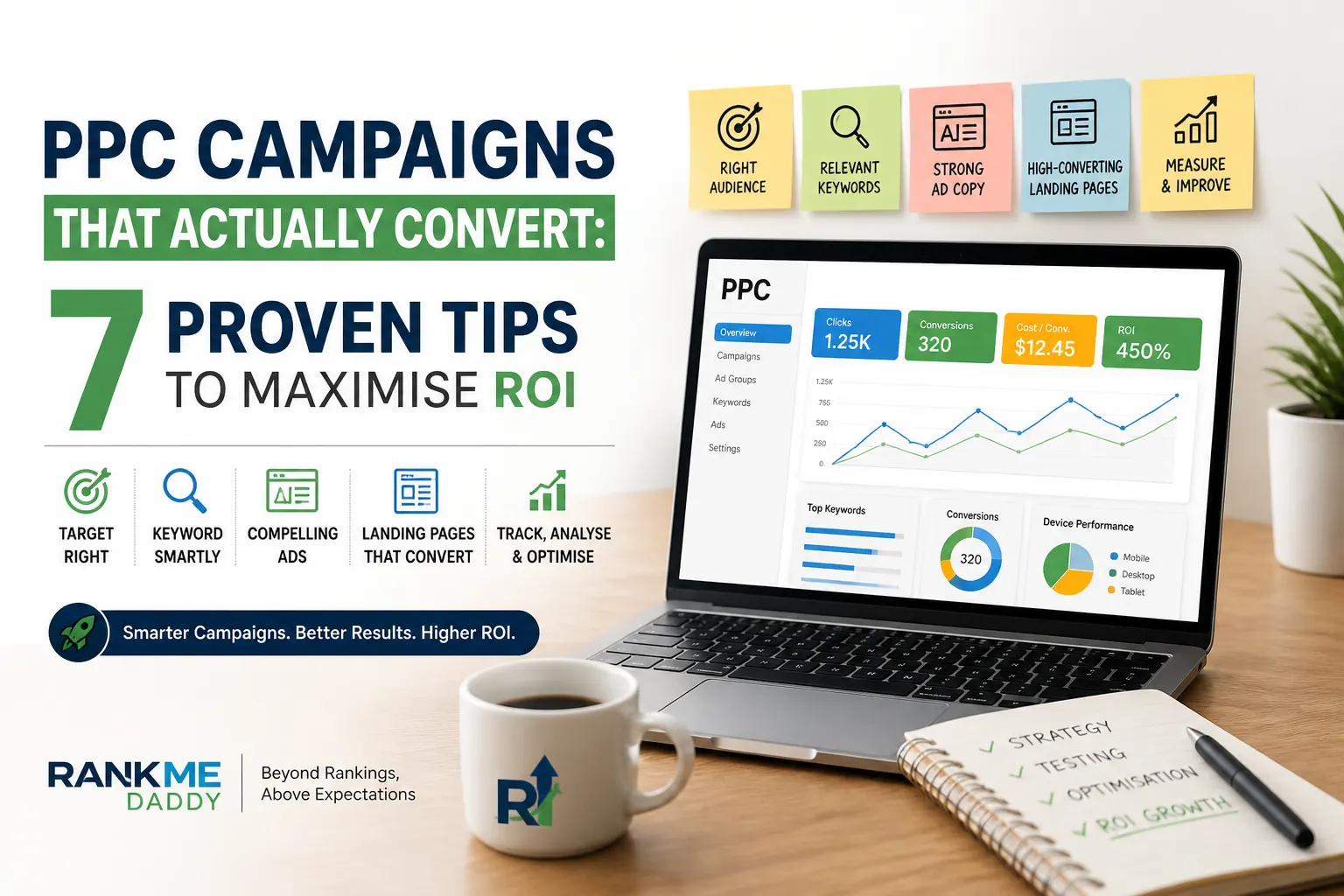
Table of Contents
- Why Most PPC Campaigns Fail (And What to Do Differently)
- Tip 1 – Master Intent-Based Keyword Targeting
- Tip 2 – Write Ad Copy That Actually Stops the Scroll
- Tip 3 – Build Landing Pages Engineered for Conversion
- Tip 4 – Use Smart Bidding Strategies the Right Way
- Tip 5 – Leverage Audience Targeting & Remarketing
- Tip 6 – Obsess Over Quality Score & Ad Relevance
- Tip 7 – Track, Test, and Iterate Relentlessly
- UK-Specific PPC Considerations for 2025
- Frequently Asked Questions
- Final Thoughts
PPC Campaigns That Actually Convert: 7 Proven Tips to Maximise ROI
If you’ve ever poured a significant portion of your marketing budget into a Google Ads or Microsoft Ads campaign and watched it haemorrhage money without a single meaningful conversion, you’re not alone. Across the UK, thousands of businesses from ambitious start-ups in Manchester to established e-commerce brands in London are running PPC campaigns that simply don’t convert. They get clicks. They burn cash. They get very little in return.
The uncomfortable truth? The problem is rarely the platform. Google Ads and Microsoft Ads are extraordinarily powerful tools when used correctly. The problem is almost always strategy, structure, and execution. A poorly configured PPC campaign is like a leaky bucket you can keep pouring water in, but you’ll never fill it up.
This guide is for UK business owners, marketing managers, and digital marketing professionals who want to stop wasting budget and start building PPC campaigns that actually convert. We’ll cover seven proven, data-backed strategies that are working right now in the UK market from intent-based keyword targeting and high-converting ad copy to smart bidding and conversion rate optimisation (CRO).
UK Market Stat Businesses make an average of £2 for every £1 they spend on Google Ads but only when campaigns are properly optimised. Poorly run campaigns can see cost-per-acquisition (CPA) figures 3–5× higher than necessary. The gap between a good and bad PPC campaign is enormous.
Let’s close that gap step by step.
Why Most PPC Campaigns Fail in the UK?
Before diving into the seven tips, it’s worth understanding the root causes of PPC underperformance because without this context, even the best tactics won’t stick. In our experience working with UK businesses across retail, SaaS, legal, finance, and hospitality sectors, failed PPC campaigns almost always share a handful of common problems.
The Most Common UK PPC Mistakes
- 76% of UK businesses don’t use negative keywords properly
- 63% send PPC traffic to generic homepages instead of dedicated landing pages
- 58% never run A/B tests on their ad copy or landing pages
- £1.2B estimated wasted UK PPC ad spend annually on irrelevant clicks
The core issues boil down to: targeting the wrong intent, sending traffic to weak landing pages, writing generic ad copy, misusing bidding strategies, and failing to measure properly. Each of the seven tips below directly addresses one or more of these failure points.
TIP 01 Master Intent-Based Keyword Targeting
The single biggest driver of low conversion rates in PPC campaigns is targeting keywords with the wrong search intent. A click only has value if the person behind it is actually likely to convert. And whether someone converts depends almost entirely on why they searched in the first place.
Understanding the Four Stages of Search Intent
Google categorises search intent broadly into informational, navigational, commercial, and transactional. For PPC campaigns focused on conversions, you should be concentrating your budget overwhelmingly on commercial and transactional intent keywords the ones that signal a user is close to making a purchase decision or taking action.
| INTENT TYPE | EXAMPLE KEYWORDS | PPC VALUE | TYPICAL CPC (UK) |
|---|---|---|---|
| Informational | “what is PPC advertising” | Low – Not ready to buy | £0.30 – £0.80 |
| Navigational | “Google Ads login” | Very Low – Already knows where to go | £0.20 – £0.60 |
| Commercial | “best PPC agency UK” | High – Researching options | £2.50 – £7.00 |
| Transactional | “hire PPC agency London” | Very High – Ready to act | £5.00 – £18.00 |
Build a Tiered Keyword Strategy
Rather than treating all keywords equally, structure your campaigns around keyword tiers. Your highest budget allocation should go to tight, transactional, bottom-of-funnel (BoFu) keywords. A smaller portion can go to mid-funnel commercial keywords. Informational keywords, if used at all in PPC, should be reserved for remarketing campaigns or content promotion with minimal spend.
The Power of Negative Keywords
One of the most overlooked elements of UK PPC campaigns is the negative keyword list. Without a robust negative keyword list, Google will show your ads to people searching for things that are tangentially related but completely irrelevant to your offer. For a commercial solicitor in Bristol, appearing for “free legal advice” or “DIY will template” wastes significant budget.
Negative Keyword Audit Checklist
- Review your Search Terms Report weekly (not monthly weekly)
- Add irrelevant queries to negative keyword lists at campaign or account level
- Block generic job-seeking queries: “jobs”, “careers”, “apprenticeship”, “salary”
- Add “free”, “DIY”, “template” and “course” unless they match your offer
- Exclude competitor brand terms unless you’re running deliberate conquest campaigns
- Use phrase and exact match negatives to prevent over-blocking
UK-specific tip:
Account for British spelling variations. “Optimise” vs “optimize”, “colour” vs “color” while Google often handles these, verify that your keyword match types accommodate both where relevant, especially in broad or phrase match settings.
TIP 02 Write Ad Copy That Actually Stops the Scroll
In the UK’s competitive PPC landscape, your ad copy is doing two jobs simultaneously: it needs to earn the click from a highly sceptical audience, and it needs to pre-qualify the user before they even reach your landing page. Most businesses treat ad copy as an afterthought, churning out generic headlines that look identical to every competitor on the page.
The Anatomy of High-Converting UK Ad Copy
With Responsive Search Ads (RSAs) now the standard format in Google Ads, you have up to 15 headlines and four description lines to work with. Google’s machine learning will test combinations but only if you give it genuinely varied, strategic inputs. Don’t feed it 15 variations of the same idea.
Pro Tip
Pin your primary keyword-rich headline to Position 1, your strongest USP to Position 2, and a clear CTA to Position 3. This ensures your most critical messaging always appears while still giving Google’s algorithm creative latitude with remaining headlines.
Headlines That Convert Framework for UK Audiences
British consumers respond well to specificity, credibility signals, and understated confidence. Hyperbolic American-style copy (“AMAZING DEALS BUY NOW!!!”) tends to underperform in the UK market. Instead, use these proven frameworks:
- Specificity over vagueness: “Rated 4.9 Stars by 1,200+ UK Customers” beats “Highly Rated Service”
- Address the objection: “No Hidden Fees · Fixed-Price Quotes” tackles price anxiety upfront
- Use local signals: “Same-Day Delivery Across Greater London” outperforms “Fast Delivery”
- Time pressure that’s honest: “Free Consultation Limited Slots This Month” rather than fake urgency
- Mirror the search query: Dynamic keyword insertion (DKI) with care ensure it reads naturally
Descriptions: Earn the Trust, Then Drive the Action
Your description lines are where you expand on the headline promise. Use the first description to reinforce your key value proposition and address a likely objection. Use the second to create urgency and include your call to action. In the UK context, mentioning trust signals (accreditations, years in business, money-back guarantees, FCA authorisation for financial services) significantly increases CTR and conversion rates.
Ad Extensions: The Free Conversion Boost
Ad assets (formerly extensions) are arguably the most underutilised free tool in Google Ads. They increase your ad’s visual footprint, improve CTR, and contribute positively to your Quality Score. For UK campaigns, these assets are non-negotiable:
Essential Ad Assets for UK PPC Campaigns
- Sitelink extensions: Link to your most relevant pages (pricing, case studies, contact, specific services)
- Callout extensions: “Free UK Delivery”, “Rated Excellent on Trustpilot”, “No Contract Tie-In”
- Structured snippets: Highlight specific services, products, or locations you cover
- Call extensions: Critical for mobile UK consumers often prefer calling for high-value purchases
- Location extensions: Link your Google Business Profile; essential for local UK businesses
- Price extensions: Show pricing upfront to filter out non-buyers before they click
- Promotion extensions: Highlight seasonal UK promotions (Black Friday, Summer Sales)
TIP 03 Build Landing Pages Engineered for Conversion
This is where most PPC campaigns die a silent death. You’ve done the hard work crafted brilliant ad copy, targeted the right keywords, set a competitive bid. And then you send the traffic to your generic homepage, or worse, a product category page with twelve options and zero clear next step. A click is not a conversion. A landing page is where conversions live or die.
“Your landing page should be the logical, inevitable conclusion of your ad. If there’s any disconnect between what the ad promises and what the page delivers, you’ve lost the conversion.”
The Message Match Principle
The single most impactful improvement you can make to an underperforming PPC campaign is often not the ad itself it’s the landing page. Specifically, the concept of message match: your landing page headline should directly echo the ad headline that drove the click. If someone clicks an ad that says “Bespoke Kitchen Design Free Home Survey in London”, they must land on a page that immediately affirms that exact offer, not a generic “Kitchen Services” page.
Anatomy of a High-Converting PPC Landing Page
The best-performing PPC landing pages for UK audiences share a consistent structure. While design and copy vary by industry, the conversion architecture remains remarkably consistent:
| SECTION | PURPOSE | KEY ELEMENTS |
|---|---|---|
| Hero | Confirm they’re in the right place | Keyword-matched headline, clear subheadline, hero image |
| Value Proposition | Answer “Why you?” | 3–4 core benefits (not features), trust signals |
| Social Proof | Reduce risk & anxiety | Reviews, ratings, logos, case study snippets |
| Offer Clarity | Make the next step obvious | Clear offer, pricing (if appropriate), what happens next |
| CTA | Drive the conversion action | One primary CTA, contrasting button, minimal form fields |
| Objection Handling | Remove the final hesitations | FAQs, guarantees, accreditations, security badges |
UK-Specific Landing Page Trust Signals
British consumers are, as a rule, more sceptical of advertising than their American counterparts. Trust signals are not optional they are conversion-critical. Depending on your industry, these can include: Trustpilot or Google Reviews badges, industry body logos (FCA, ICO, RICS, Law Society, FSB), money-back guarantees clearly stated, GDPR-compliant privacy notice near any form, and UK contact details (a local phone number, not a premium-rate number, is strongly preferred).
⚠️ Common Mistake
Avoid placing your main navigation menu on dedicated PPC landing pages. Navigation gives users exit routes and reduces focus on conversion. Remove it, or use a simplified header with only your logo and contact number.
Page Speed: The UK Mobile Imperative
Over 60% of Google Ads clicks in the UK now come from mobile devices. A landing page that loads in more than 3 seconds on mobile will bleed conversions silently. Google’s own research shows that as page load time increases from 1 to 3 seconds, the probability of bounce increases by 32%. For every additional second, conversion rates fall. Use Google PageSpeed Insights and Core Web Vitals to ensure your landing pages meet the performance bar your UK mobile users expect.
TIP 04 Use Smart Bidding Strategies the Right Way
Google’s automated bidding has matured dramatically over the past three years. When used correctly, Smart Bidding can genuinely outperform manual bidding by analysing hundreds of contextual signals device, time of day, location, browser, audience segment, and more in real time. But many UK advertisers either resist Smart Bidding entirely (and miss out), or adopt it without the prerequisite setup (and waste budget).
The Smart Bidding Hierarchy
Different Smart Bidding strategies serve different campaign objectives. Matching the right strategy to the right campaign stage is critical:
Smart Bidding Strategies When to Use Each
- Maximise Clicks: Use for new campaigns to gather data; not for conversion-focused campaigns long-term
- Target Impression Share: Useful for brand awareness and defence; not conversion-focused
- Maximise Conversions: Ideal when you have a daily budget you want to exhaust on conversions
- Target CPA (Cost Per Acquisition): Best once you have 30+ conversions/month in the campaign; set a realistic CPA target based on historical data
- Target ROAS (Return on Ad Spend): Ideal for e-commerce with sufficient volume; requires 50+ conversions/month for reliable optimisation
- Maximise Conversion Value: Use when you want to prioritise high-value conversions without a fixed ROAS target
The Learning Period Don’t Touch the Dials
One of the most costly mistakes UK advertisers make when switching to Smart Bidding is interfering with the learning period. When you change bids, budgets, or targeting significantly during this 1–2 week window, you reset the learning process. This is especially damaging for campaigns with lower volume. Set a realistic starting target, give it at least two weeks without major changes, and only adjust if performance is dramatically off your baseline.
Data Requirement
For Target CPA bidding to function reliably, Google recommends a minimum of 30 conversions per month within the campaign. Below this threshold, Maximise Conversions without a CPA target is typically more effective for UK campaigns with limited volume.
Portfolio Bid Strategies for Multi-Campaign Advertisers
If you’re running multiple campaigns with similar objectives common for UK agencies managing client accounts across related product lines portfolio bid strategies in Google Ads allow Smart Bidding to optimise across all campaigns simultaneously. This pools conversion data across campaigns, solving the volume problem for smaller individual campaigns while maintaining overall efficiency targets. It’s one of the most powerful features that UK advertisers consistently underutilise.
TIP 05 Leverage Audience Targeting & Remarketing
Modern PPC is not just about keywords it’s about reaching the right person with the right message at the right moment. UK advertisers who treat Google Ads as purely a keyword-buying exercise are leaving enormous conversion potential on the table. Audience targeting and remarketing are where PPC campaigns truly start to compound in performance.
Audience Layering: Adding Intelligence to Keyword Campaigns
Even in keyword-based Search campaigns, you can layer audience signals to bid more aggressively (or more conservatively) for users who match specific profiles. This doesn’t restrict who sees your ads it adjusts your bids based on audience behaviour. Key audiences to layer in UK Search campaigns include:
- Remarketing lists (RLSA): Users who’ve visited your website but haven’t converted bid aggressively for these, they’re warm
- Customer Match: Upload your existing customer or lead email list; suppress them from acquisition campaigns or show them upsell ads
- Similar Audiences: Google creates lookalike audiences based on your existing customers or website visitors
- In-Market Audiences: Google identifies users actively researching products/services in your category
- Life Events: Particularly powerful for financial services, legal, or property sectors (new movers, recently married, etc.)
Remarketing That Converts: Beyond Basic Retargeting
Most UK businesses set up a basic “all website visitors” remarketing audience and serve them generic display ads for 30 days. This is the bare minimum. High-converting remarketing strategies are far more nuanced:
| AUDIENCE SEGMENT | SUGGESTED APPROACH | AD MESSAGE DIRECTION |
|---|---|---|
| Cart/Form abandoners | Aggressive bid increase; 7-day window | Overcome the specific objection; offer help |
| Pricing page visitors | High bid adjustment; 14-day window | Social proof, ROI stats, comparison to alternatives |
| Blog/content readers | Moderate bid; 30-day window | Move them down funnel; webinar, free trial, demo |
| Past customers | Upsell/cross-sell; 180-day window | New products, loyalty offers, referral incentive |
| Converted leads (not customers) | Suppress from lead gen; nurture separately | Sales enablement content, testimonials |
✅ GDPR Note for UK Advertisers
Post-Brexit, the UK follows UK GDPR rather than EU GDPR, but the principles are effectively identical for digital advertising. Ensure your cookie consent mechanism is compliant, your privacy policy explicitly covers remarketing pixels, and you have a legal basis for audience targeting. Non-compliance can result in ICO action and can undermine your Google Ads account’s data quality.
TIP 06 Obsess Over Quality Score & Ad Relevance
Quality Score is one of the most misunderstood metrics in PPC. It’s not just a vanity number it directly determines your ad auction position and your cost per click. A higher Quality Score means you pay less for the same (or better) ad position than a competitor with a lower score. In a competitive UK market, this efficiency advantage compounds over time into significant budget savings.
What Quality Score Actually Measures?
Google’s Quality Score (scored 1–10 at keyword level) is determined by three components:
- ~40% Expected Click-Through Rate How likely users are to click your ad
- ~40% Landing Page Experience Relevance, speed & usability of your page
- ~20% Ad Relevance How closely your ad matches the search intent
Practical Steps to Improve Quality Score
Understanding the components makes the improvement path clear. To lift Expected CTR: write compelling, relevant ad copy and use all available ad assets. To improve Landing Page Experience: ensure your landing page content mirrors your ad keywords, loads quickly, and is mobile-optimised. To boost Ad Relevance: tighten your ad groups so each group contains a small, tightly themed set of keywords ideally 5–15 keywords per ad group with ad copy that directly addresses those specific terms.
Single Keyword Ad Groups (SKAGs) vs Tightly Themed Ad Groups (TTAGs)
The debate between SKAGs and TTAGs has evolved significantly with RSAs and Smart Bidding. Pure SKAGs (one keyword per ad group) made sense in an era of exact match control and manual bidding. With RSAs and broader match types now preferred by Google’s algorithm, tightly themed ad groups (TTAGs) of 5–15 closely related keywords typically perform better in 2025 giving Smart Bidding enough signal volume while maintaining message coherence and relevance.
Quality Score Impact
A keyword with a Quality Score of 7 can cost up to 28% less per click than the same keyword with a Quality Score of 5. Over a £10,000/month PPC budget, that difference equates to £2,800 in additional budget efficiency or roughly 560 extra clicks at an average CPC of £5.
TIP 07 Track, Test, and Iterate Relentlessly
The uncomfortable secret of PPC success is that it’s never “set and forget”. The campaigns generating the best ROI for UK businesses are never static they’re living, breathing systems under constant refinement. The brands dominating their competitive niches on Google are the ones that have built a culture of testing, measuring, and iterating faster than their competitors.
Conversion Tracking: Get This Right First
You cannot optimise what you cannot measure. And you’d be surprised or perhaps you wouldn’t be how many UK businesses are running thousands of pounds of PPC spend against incomplete or incorrect conversion tracking. Before any optimisation work, audit your conversion tracking completely:
Conversion Tracking Audit Checklist
- Confirm Google Ads conversion tags are firing correctly (use Tag Assistant Chrome extension)
- Ensure you’re tracking micro-conversions (form fills, phone clicks, chat initiations) and macro-conversions (purchases, booked appointments)
- Check for duplicate conversion counting a common issue after website redesigns
- Import GA4 conversions into Google Ads for enriched data signals
- Set up offline conversion tracking if your sales cycle includes phone or in-person closes
- Verify Google Ads and GA4 conversion numbers are broadly aligned (some discrepancy is normal, 10%+ warrants investigation)
- Ensure conversion windows match your typical decision timeline (e.g., 90 days for high-consideration B2B purchases)
A/B Testing: The Engine of PPC Improvement
Systematic A/B testing is what separates amateur PPC from professional PPC. Use Google Ads’ built-in Campaign Experiments feature to run controlled tests where traffic is split between your control and test variant. This gives you statistically valid results rather than the false comparisons you get from time-based comparisons.
What to test and in what order of impact:
- Landing page CTA and headline Highest impact; test this first
- Bidding strategy Compare Manual CPC vs Target CPA vs Maximise Conversions
- Audience layering With vs without audience bid adjustments
- Ad copy headlines Test different USP angles, emotional vs rational appeals
- Keyword match types Broad match vs Phrase match performance differences
- Ad scheduling Test dayparting assumptions against actual conversion data
The PPC Reporting Cadence for UK Businesses
The right reporting rhythm depends on budget and campaign complexity. A useful framework for most UK businesses:
| FREQUENCY | WHAT TO REVIEW | ACTION THRESHOLD |
|---|---|---|
| Daily | Budget pacing, major spend anomalies, impression share | Act if budget over/under-delivers by >20% |
| Weekly | Search terms report, CTR, CPA by campaign, Quality Scores | Add negatives; adjust bids; pause underperformers |
| Monthly | Full performance review, audience insights, keyword performance | Strategic adjustments; budget reallocation; new tests |
| Quarterly | Account structure review, competitor landscape, seasonal planning | Structural changes; new campaigns; strategy shifts |
UK-Specific PPC Considerations for 2025
Running PPC campaigns in the UK comes with a distinct set of market dynamics that differ from the US or European markets. Understanding these nuances is essential for building campaigns that resonate specifically with British consumers and businesses.
The UK Competitive Landscape by Sector
PPC costs vary enormously by sector in the UK. Legal services, financial products, and insurance remain among the most expensive verticals, with average CPCs for terms like “personal injury solicitor” or “life insurance quotes” running anywhere from £15 to £80+ per click. E-commerce, local services, and B2B SaaS sit at significantly lower CPCs but face different challenges around conversion path length.
Understanding your sector’s competitive density using tools like SEMrush, SpyFu, or simply Google’s own Keyword Planner is essential for setting realistic budget expectations and CPA targets before launching a campaign.
Seasonality Patterns Unique to the UK Market
UK consumer behaviour follows specific seasonal patterns that should inform your PPC budget allocation and messaging calendar:
UK PPC Seasonality Calendar January: New Year intent surge for health, finance, home improvement. Q2: Garden, home, and travel peak. Back-to-School (August–September): Education, stationery, uniform-adjacent categories. Black Friday/Cyber Monday: UK adoption now rivals US; e-commerce CPCs spike but ROAS can be exceptional with right offers. Christmas: Start gifting campaigns in early October for competitive categories.
Microsoft Ads: The Underrated UK Opportunity
While Google dominates UK search with approximately 93% market share, Microsoft Ads (formerly Bing Ads) deserves attention particularly for B2B and older demographic audiences. Bing’s user base in the UK skews older (35–65), more affluent, and is accessed predominantly via desktop. For sectors like financial services, professional services, and healthcare, Microsoft Ads can deliver CPCs 30–50% lower than Google with comparable conversion rates. It’s not a replacement for Google Ads, but it can be a high-efficiency complement.
Performance Max Campaigns: Handle With Care
Google’s Performance Max (PMax) campaigns have become unavoidable Google actively pushes advertisers towards them. PMax campaigns use AI to place ads across all of Google’s inventory (Search, Shopping, Display, YouTube, Gmail, Maps) simultaneously. For UK e-commerce businesses with a well-populated product feed and established conversion data, PMax can be powerful. However, for service businesses or those with limited conversion volume, PMax can be a budget sinker. Use it alongside not instead of traditional Search campaigns, and monitor asset group performance closely.
First-Party Data in a Post-Cookie World
The phasing out of third-party cookies is reshaping how UK advertisers target audiences. Building first-party data assets email lists, CRM data, website engagement data via GA4 is now a competitive advantage in PPC. Advertisers who invest in building and activating first-party data through Customer Match, Enhanced Conversions, and GA4 audience imports will have a significant structural advantage over those relying entirely on Google’s contextual signals.
Frequently Asked Questions About PPC in the UK
How much should a UK small business spend on PPC per month?
There’s no universal answer, but a useful rule of thumb is: your monthly PPC budget should be at least 20–30× your target cost per acquisition (CPA). So if you want to acquire a customer for £50, you need a minimum budget of £1,000–£1,500/month to generate enough data for meaningful optimisation. Below this threshold, you won’t have enough conversion data for Smart Bidding to function effectively, and your results will be highly variable. Most UK SMEs running effective Google Ads campaigns invest between £1,500 and £5,000/month as a starting point, with management fees additional if working with an agency.
What is a good conversion rate for UK PPC campaigns?
UK average PPC conversion rates vary considerably by industry. Across all verticals, average Google Ads conversion rates in the UK sit around 3–5% for Search campaigns. However, well-optimised campaigns in less competitive niches regularly achieve 8–15%, while highly competitive sectors like legal or financial services may consider 2–3% strong given their higher average order values. Rather than benchmarking against industry averages, focus on improving your own baseline conversion rate month-over-month. A campaign converting at 4% that was converting at 2% three months ago is delivering genuine progress regardless of the industry average.
How long does it take for a PPC campaign to start performing well in the UK?
Expect the first 4–6 weeks of a new PPC campaign to be a data-gathering and refinement phase. During this period, you’re learning which keywords actually drive conversions, which ad copy resonates, and what your actual CPA looks like versus initial estimates. Weeks 6–12 are typically when meaningful optimisation begins yielding consistent improvements. Campaigns using Smart Bidding strategies should be evaluated over a minimum 4-week post-learning-period window. Avoid making major judgements on campaign performance within the first two weeks you simply won’t have enough data.
Should UK businesses use Google Ads or Microsoft Ads (Bing)?
Ideally, both. Google dominates UK search volume and should be your primary platform. Microsoft Ads reaches approximately 7–10% of UK searchers, but this audience typically older, more affluent, and often using desktop devices in professional settings can be extremely valuable for B2B companies, professional services, financial advisers, and premium consumer brands. Because Microsoft Ads typically has lower competition and CPCs in the UK, your existing Google Ads campaigns can often be imported and will achieve a lower CPA on Bing for modest additional management effort. Start with Google, add Microsoft once your Google campaigns are stable.
What’s the difference between PPC management and Google Ads management?
PPC (Pay-Per-Click) management is the broader term covering any paid advertising where you pay per click this includes Google Ads, Microsoft Ads, Meta Ads (Facebook/Instagram), LinkedIn Ads, and others. Google Ads management specifically refers to managing campaigns on Google’s advertising platform. Most UK businesses use these terms interchangeably because Google Ads dominates their paid search activity, but a full-service PPC strategy should consider the multi-channel landscape particularly for businesses targeting different audience segments across different platforms.
How do I know if my PPC agency is doing a good job?
Good PPC agencies should provide transparent, regular reporting on the metrics that matter most to your business: cost per acquisition, conversion rate, return on ad spend (ROAS for e-commerce), click-through rate trends, and Quality Score improvements over time. Red flags include: reporting only on clicks and impressions (vanity metrics), inability to explain their optimisation strategy, no proactive testing or experimentation, and resistance to sharing actual Google Ads account access. You should always have full admin access to your own Google Ads account reputable UK agencies insist on this rather than gatekeeping your data.
Does PPC help with SEO rankings in the UK?
No PPC advertising has no direct impact on organic search rankings. Google is explicit about this: paying for Google Ads does not improve your position in organic search results, and vice versa. However, PPC and SEO complement each other powerfully in practice. PPC data reveals which keywords actually convert (invaluable for SEO content strategy), PPC can provide immediate visibility while SEO builds over months, and together they create a dual presence on high-intent SERPs that significantly increases overall click share and brand authority.
Final Thoughts: Building PPC Campaigns That Compound Over Time
The gap between a PPC campaign that haemorrhages budget and one that delivers consistent, scalable returns almost always comes down to the same core principles: targeting intent rather than just keywords, respecting the message match between ad and landing page, leveraging audience data intelligently, letting Smart Bidding work with sufficient data, and building a genuine culture of measurement and testing.
None of these seven tips require an enormous budget to implement. They require attention, discipline, and a willingness to resist the temptation to make constant reactive changes. The best-performing PPC campaigns in the UK are not necessarily the ones with the biggest budgets they’re the ones that are most systematically managed.
If you’ve been struggling with PPC campaigns that click but don’t convert, start by auditing the basics: Are your keywords aligned to commercial or transactional intent? Does your landing page immediately confirm the ad’s promise? Is your conversion tracking actually accurate? Is your Quality Score holding your costs artificially high? These fundamentals, addressed systematically, will unlock far more performance improvement than any clever tactic or shiny new feature.
“The brands winning at PPC in 2025 aren’t the ones with the highest budgets. They’re the ones obsessing over the details that their competitors are too impatient to fix.”
PPC, done right, is one of the highest-returning marketing channels available to UK businesses. It’s measurable, scalable, and directly tied to commercial intent. The opportunity is enormous but only for those willing to invest in doing it properly.
Ready to Build PPC Campaigns That Actually Convert?
RankMeDaddy’s PPC specialists work with UK businesses across all sectors to build data-driven campaigns that deliver measurable ROI. Get a free account audit and discover exactly what’s holding your campaigns back.
